
Cicindela formosa
Say, 1817
Big Sand Tiger Beetle, Flashy Tiger Beetle
Species Guides
5- Cicindela formosa formosa(big sand tiger beetle)
- Cicindela formosa generosa(Eastern Big Sand Tiger Beetle)
- Cicindela formosa gibsoni(Gibson's Big Sand Tiger Beetle)
- Cicindela formosa pigmentosignata(Reddish-green Sand Tiger Beetle)
- Cicindela formosa rutilovirescens(Mescalero Sand Tiger Beetle)
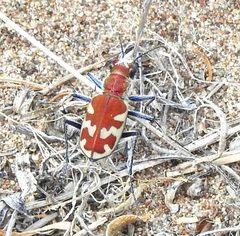
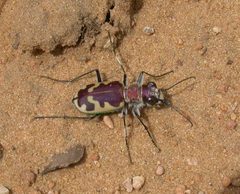
Cicindela formosa is a large, robust tiger found in deep, dry sand across much of North America east of the Rocky Mountains. are powerful fliers known for their distinctive escape —long ending with a characteristic bounce and tumble across the sand. The species exhibits notable geographic variation in coloration, with western typically showing bright coppery-red coloration and eastern populations dark brown. Six are currently recognized, though the validity of some subspecific distinctions remains debated.
Pronunciation
How to pronounce Cicindela formosa: //ˌsɪsɪnˈdɛlə fɔrˈmoʊsə//
These audio files are automatically generated. While they are not always 100% accurate, they are a good starting point.
Identification
Distinguished from co-occurring sand-dwelling tiger beetles by its large size (approximately 25 mm), robust build, and characteristic 'C'-shaped humeral marking on the . Most similar to Cicindela lengi, which differs in having a slightly narrower body, longer and narrower , and an obliquely straight (rather than 'C'-shaped) humeral marking. Behaviorally, C. lengi lands quickly after short , while C. formosa flies further and lands with a characteristic bounce and tumble. Distinguished from C. scutellaris by body shape and maculation pattern.
Images
Habitat
Deep, dry, open sand without standing water. In Missouri and surrounding states, occurs primarily along major river systems (Missouri, Mississippi, and larger tributaries) where alluvial sand deposits persist, as well as in sand prairie remnants in the southeastern lowlands. Fidelity to deep, dry sand makes localized and patchy in distribution. Also found in dune margins, sand flats, and sandy roadsides in the Great Plains.
Distribution
North America east of the Rocky Mountains; absent from Appalachia and much of the Interior Highlands due to lack of suitable sand . Absent across much of the southeastern coastal plain and south/west Texas despite apparently suitable habitat. Western (nominotypical ) in Great Plains; eastern populations (subspecies generosa) in Midwest and Northeast; additional subspecies in Texas/Arkansas/Louisiana (pigmentosignata), New Mexico (rutilovirescens), Colorado (gibsoni), and Saskatchewan (gibsoni).
Seasonality
are active during spring and fall, exhibiting a 'spring/fall' pattern where sexually adults emerge in fall, pass winter in burrows, and re-emerge in spring ready to mate and lay . Activity patterns influenced by temperature; beetles seek shade and exhibit thermoregulatory (stilting, shade-seeking) during hot midday periods.
Life Cycle
Sexually emerge in fall, overwinter in burrows, and become reproductively active in spring. Specific details of -laying, larval development, and not documented in available sources.
Behavior
Highly wary and alert; quick to take when approached. Powerful escape flights cover considerable distance, typically ending with a comical bounce and tumble across the sand before landing on their feet facing the pursuer. Exhibits thermoregulatory including stilting (elevating body on long legs to avoid superheated air layer just above sand surface) and active shade-seeking during hot periods. shuttle between exposed and shaded microhabitats to maintain optimal body temperatures for foraging.
Human Relevance
Subject of interest to entomologists and naturalists due to its striking appearance and charismatic . are vulnerable to loss from river channelization, levee construction, and vegetation in sand habitats. Some populations have declined or disappeared from historically known sites. The C. f. gibsoni is considered threatened in Canada.
Similar Taxa
- Cicindela lengiSimilar size and coloration in sand ; distinguished by narrower body, longer , straight humeral marking, and shorter landing without tumbling
- Cicindela scutellarisCo-occurs in sand ; distinguished by different body proportions and elytral maculation pattern
- Ellipsoptera lepidaShares deep sand but distinguished by much smaller size, pale coloration, and different
More Details
Subspecific variation and debate
Six are currently recognized, but the validity of some distinctions is debated. The eastern subspecies C. f. generosa (dark brown) and western nominotypical C. f. formosa (coppery-red) intergrade broadly along the Missouri River through Nebraska, Iowa, and the Dakotas. Some researchers hypothesize that color differences may reflect environmental factors (such as soil pH) rather than genetic divergence, though this remains unconfirmed. showing intermediate coloration in Missouri and elsewhere complicate subspecific assignment.
Habitat specificity and conservation concern
The ' strict fidelity to deep, dry sand makes naturally patchy and vulnerable. Natural flooding cycles that historically created and maintained sand deposits have been disrupted by river channelization and flood control structures. Habitat patches are subject to revegetation and , leading to population declines or local extirpations. The ephemeral nature of these habitats means populations must maintain strong capabilities to colonize new sites.
Sources and further reading
- BugGuide
- Wikipedia
- GBIF taxonomy match
- iNaturalist taxon
- NCBI Taxonomy
- Catalogue of Life
- Cicindela lengi vs. Cicindela formosa | Beetles In The Bush
- Cicindela formosa pigmentosignata (the “reddish-green sand tiger beetle”) | Beetles In The Bush
- Big, Bold and Beautiful—Redux | Beetles In The Bush
- Big, Bold, and Beautiful | Beetles In The Bush
- August | 2017 | Beetles In The Bush
- “All the better to see you with, my dear!” | Beetles In The Bush
- Distribution, abundance, and ecology of the threatened Gibson’s Big Sand Tiger Beetle (Cicindela formosa gibsoni Brown) in the Elbow Sand Hills of Saskatchewan