
Ellipsoptera lepida
(Dejean, 1831)
Ghost Tiger Beetle, Little White Tiger Beetle
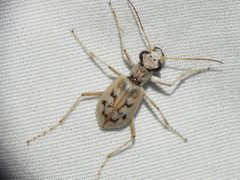
Ellipsoptera lepida, known as the ghost tiger or little white tiger beetle, is a small tiger beetle notable for its almost pure white coloration that provides exceptional camouflage on pale sandy substrates. measure 9–11 mm and are active during summer months. The occupies a specialized in deep, dry sand and has a two-year . are localized and patchy across its range, and it has disappeared from many historical sites due to habitat and revegetation. It is listed as a state threatened species in Minnesota.
Pronunciation
How to pronounce Ellipsoptera lepida: /ɛˌlɪpˈsɒptərə ˈlɛpɪdə/
These audio files are automatically generated. While they are not always 100% accurate, they are a good starting point.
Identification
Distinguished from other tiger beetles by its almost pure white coloration and greatly expanded maculations that leave minimal dark patterning. The combination of small size (9–11 mm), white/cream with reduced brown markings, and dense white setae on the and separates it from sympatric sand-dwelling such as Cicindela formosa (larger, more robust, with bold maculations and brown coloration) and C. scutellaris (metallic green, blue, or coppery coloration). When disturbed, fly short distances and land quickly, blending immediately into the substrate.
Images
Appearance
Small tiger , 9–11 mm in length. surface predominantly white or cream-colored. and green or reddish, covered with dense white setae. Elytral maculations are greatly expanded, leaving only small areas of white-brown coloration. The overall pale coloration provides effective camouflage against white sand substrates.
Habitat
Pure white to pale yellow dry sandy areas with sparse or no vegetation. Commonly found on coastal shorelines and large lake shores. In inland areas, occupies deep sand deposits along major river systems, particularly areas with deposits deep enough to become dry. are characterized by open, barren sand with minimal vegetative cover; successional changes leading to forest establishment eliminate suitable habitat.
Distribution
Central America and North America. Documented from Canada, Mexico, and the United States. In the United States, occurs across central North America from the Great Plains eastward, with records along the Missouri and Mississippi River systems. Distribution is patchy and localized; many historical no longer persist. Listed as state threatened in Minnesota.
Seasonality
Active during summer months. emerge in summer and are sexually mature during this period. Two-year with sexually adults emerging in fall, passing winter in burrows, and emerging again in spring ready to mate and lay .
Life Cycle
Two-year . Sexually emerge in fall, overwinter in burrows, and emerge in spring to mate and oviposit. Larvae develop in burrows in sandy substrate. Adults are present and active during summer months.
Behavior
are extremely wary and difficult to approach. When disturbed, they fly short distances and land quickly, often becoming nearly invisible against the white sand substrate. They exhibit "disappearing" —capable of seeming to vanish even when observers are looking directly at them due to their cryptic coloration. Adults are most active during morning and late afternoon, avoiding midday heat.
Ecological Role
in open sand . As a tiger , likely preys on small arthropods in the sandy microhabitat. presence indicates intact, early-successional sand habitats with minimal vegetation cover.
Human Relevance
Subject of conservation concern due to loss; listed as state threatened in Minnesota. Loss of at historical sites documented, attributed to habitat and revegetation. Serves as an for early-successional sand habitats. Popular among tiger enthusiasts due to its distinctive appearance and challenging observation.
Similar Taxa
- Cicindela formosaLarger (typically 12–17 mm), more robust body, brown to reddish-brown coloration with bold, contrasting maculations rather than near-white appearance. Exhibits longer escape with characteristic bouncing landing, unlike E. lepida's short flights.
- Cicindela scutellarisMetallic green, blue, or coppery coloration with variable maculations; lacks the pure white/cream coloration and dense white setae of E. lepida. Often found in similar sand but readily distinguished by color.
- Ellipsoptera gratiosaSimilar white coloration with expanded maculations, but occurs in coastal pine barrens of the Atlantic coastal plain from Virginia to Florida panhandle; ranges do not overlap with E. lepida, which is primarily inland and central North American.
- Ellipsoptera hirtilabrisSimilar white coloration and expanded maculations, but restricted to peninsular Florida; distinguished by dense prostrate hairs on the (the "moustache"). distribution separates the two .
More Details
Conservation Status
are inherently vulnerable due to dependence on ephemeral, early-successional sand . Historical records from many sites no longer support populations, likely due to natural to forest or plant establishment. River sand deposits—prime habitat—are also subject to human modification and flood control.
Detection Challenges
The is exceptionally difficult to detect due to its cryptic coloration matching white sand substrates. Observers often detect movement rather than the itself. Even experienced collectors report beetles seeming to disappear while being observed.