
Brasiella
Rivalier, 1954
Species Guides
2- Brasiella viridisticta
- Brasiella wickhami(Sonoran Tiger Beetle)
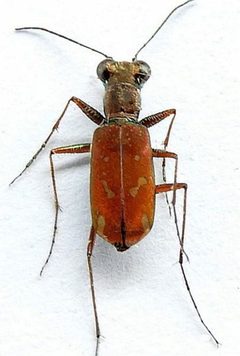
Brasiella is a of small to very small tiger beetles () containing more than 50 described . Formerly treated as a subgenus of Cicindela, it is now recognized as a distinct genus based on morphological and behavioral differences. The genus is predominantly Neotropical in distribution, with species occurring from Panama and the West Indies south to Peru and Argentina. Most species are (running) beetles adapted to open, sandy or muddy . Brasiella argentata is among the most common and widespread species, though it appears to represent a distinguishable primarily by male genitalic characters.
Pronunciation
How to pronounce Brasiella: /braˈsiː.e.la/
These audio files are automatically generated. While they are not always 100% accurate, they are a good starting point.
Identification
Distinguished from related tiger by small body size, habits, and predominantly Neotropical distribution. Within the genus, identification often requires examination of male genitalia; B. cuyabaensis females can be distinguished from B. argentata by their longer, more convex . Superposition versus apposition may differ among species based on preferences—species in shaded forest habitats may exhibit different adaptations than those in open, sunny environments.
Images
Habitat
Primarily sandy or muddy substrates in open, sunny environments including river banks, lake shores, and sandy clearings. Some occur in forest openings with sunnier, sandier patches. Moisture levels vary from wet mud to dry sand.
Distribution
Almost exclusively Neotropical. Occurs from Panama and the West Indies south through South America to Peru and Argentina. Only one , B. wickhami, reaches the United States (southern Arizona).
Behavior
Highly (running) beetles with rapid, darting movements. are wary and quick to take when disturbed. Some have been observed to be extremely difficult to approach for photography due to persistent fleeing . Flight typically results in landing on adjacent bare substrate or low vegetation.
Similar Taxa
- Cicindela (genus)Brasiella was formerly treated as a subgenus of Cicindela but differs in smaller body size, predominantly Neotropical distribution, and ; now recognized as distinct in modern treatments
- OdontocheilaAnother Neotropical tiger , but Odontocheila such as O. chrysis are larger, occur in more shaded forest , and possess superposition —distinct from the smaller, open-habitat Brasiella
More Details
Taxonomic History
Until recently classified as a subgenus of Cicindela, Brasiella has been elevated to status in comprehensive modern treatments including Cassola & Pearson (2001) and Erwin & Pearson (2008). The genus contains a ' swarm' around B. argentata, with numerous described that may represent distinct species distinguishable only by male characters.
Species Complex
B. argentata appears to comprise multiple cryptic . Specimens of B. cuyabaensis were previously misidentified as B. argentata in collections; the two species differ in male genitalia shape (longer and narrower in B. cuyabaensis) and female .