
Cicindelidia
Rivalier, 1954
Prairie Tiger Beetles, Limestone Tiger Beetles, Miami Tiger Beetle (for C. floridana), Highlands Tiger Beetle (for C. highlandensis), Scabrous Tiger Beetle (for C. scabrosa)
Species Guides
19- Cicindelidia abdominalis(Eastern Pine Barrens Tiger Beetle)
- Cazier's Tiger Beetle(Cazier's Tiger Beetle)
- Cicindelidia floridana(Miami Tiger Beetle)
- Cicindelidia haemorrhagica(Wetsalts Tiger Beetle)
- Cicindelidia highlandensis(Highlands Tiger Beetle)
- Cicindelidia hornii(Horn's Tiger Beetle)
- Cicindelidia marginipennis(Cobblestone Tiger Beetle)
- Cicindelidia melissa(Melissa's Tiger Beetle)
- Cicindelidia nigrocoerulea(Black Sky Tiger Beetle)
Cicindelidia is a of small to medium-sized tiger beetles primarily distributed in North America, with greatest diversity in the southern and western United States. The genus includes several notable groups, most prominently the abdominalis species-group containing four sand-dwelling species (C. abdominalis, C. floridana, C. highlandensis, C. scabrosa) with red venters. Many species exhibit specialized associations, including thermal springs (C. haemorrhagica), limestone outcrops (C. politula), pine rocklands (C. floridana), and sand scrub habitats (C. scabrosa, C. highlandensis). Several species are of conservation concern due to restricted ranges and habitat loss.

Pronunciation
How to pronounce Cicindelidia: //sɪˌsɪndɛˈlɪdiə//
These audio files are automatically generated. While they are not always 100% accurate, they are a good starting point.
Identification
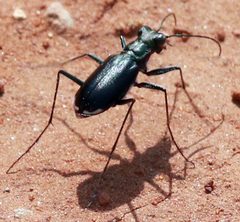
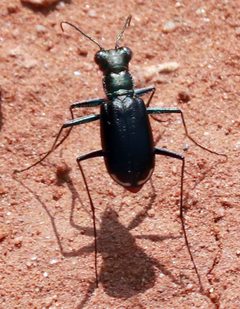
Members of Cicindelidia can be distinguished from related tiger by combinations of morphological characters including elytral sculpturing, pronotal setation patterns, and coloration. The abdominalis -group is characterized by small size, red venters, and smooth or punctured depending on species. C. scabrosa and C. floridana exhibit distinctly punctured elytra and dense lateral pronotal setae, while C. abdominalis and C. highlandensis have smooth elytra and glabrous or finely setose pronota. C. politula is recognized by shiny black to blue-black elytra with white markings absent or limited to apices. C. haemorrhagica shows minimal morphological differentiation but is ecologically distinct in thermal spring .
Images
Habitat
associations are highly variable across and often diagnostic. C. haemorrhagica is exclusively associated with thermal springs in Yellowstone National Park, occupying barren soils with gradual slopes (less than 5°) toward thermal water at pH 2.7–9.0 and temperatures 29.1–75.0°C. C. politula occurs on exposed limestone road banks and outcrops in dry to xeric upland habitats. C. floridana is restricted to pine rockland habitat with open sandy patches in Miami-Dade County. C. scabrosa occupies sand pine scrub on well-drained, infertile sandy soils. C. highlandensis is to remnant sand scrub and pine woodland habitats on the Lake Wales Ridge. C. obsoleta vulturina occurs on lichen-covered sandstone balds and prairie glades.
Distribution
The is primarily North American in distribution. C. haemorrhagica occurs in western thermal spring areas including Yellowstone National Park, California, and New Mexico, with additional records from wet salt lakes, lakes, ponds, rivers, sea beaches, and tidal flats outside YNP. C. politula occurs primarily in Texas with extensions into Oklahoma. C. floridana is to Miami, Florida. C. scabrosa is distributed across peninsular Florida north of Miami-Dade County, extending slightly into southeastern Georgia. C. highlandensis is restricted to Polk and Highlands Counties, Florida. C. abdominalis ranges across the southeastern U.S. Coastal Plain from New Jersey to Louisiana. C. marginipennis occurs from New Brunswick, Canada to Alabama.
Seasonality
Activity periods vary by and climate. C. haemorrhagica shows daytime activity with activity limited to air temperatures above 15.5°C. C. floridana is active during warmer months with peak activity in spring. C. scabrosa and C. highlandensis are summer species with peak activity in July and August. C. obsoleta vulturina shows fall in the White River Hills region. C. politula appears in late September in northern Texas and Oklahoma.
Life Cycle
Larvae of most construct vertical burrows in sandy or appropriate soils; C. haemorrhagica larvae burrow in thermal soils near springs or pools. C. marginipennis larvae produce distinctive 'throw piles' of excavated soil that serve as search images for locating burrows. Larval instars have been described for C. marginipennis, showing characteristic including white-margined pronotum in Tetracha (historically congeneric). The species can be reared in captivity with appropriate soil and temperature conditions.
Behavior
are active that forage visually. C. haemorrhagica exhibits thermoregulatory , spending most time on substrates at 30–40°C and showing resistance to high temperatures; adults have been recorded on surfaces exceeding 50°C and up to 61.5°C at Rabbit Creek. The shows minimal , making light trapping ineffective. C. politula adults are extremely wary and difficult to approach, exhibiting rapid escape and evasive behaviors. C. floridana adults are flighty and difficult to observe, becoming more so as temperatures rise; they exhibit mate-guarding behavior with males riding on females' backs. Many species show 'stilting' behavior—elevating bodies on long legs to minimize thermal exposure in hot environments.
Ecological Role
C. haemorrhagica functions as an apex in Yellowstone thermal spring , bioaccumulating heavy metals and metalloids from prey with bioaccumulation factors of at least 10-fold for most metals and 9.7-fold for arsenic. The facilitates transfer of metals from aquatic invertebrate prey to terrestrial , contributing to through the trophic web.
Human Relevance
Several are of conservation concern. C. floridana is critically endangered and a candidate for federal listing, having been rediscovered in 2011 after being presumed extinct for over 50 years; it survives in tiny urban fragments. C. highlandensis is one of Florida's rarest tiger beetles with extremely restricted range. C. marginipennis is state-listed as threatened or endangered throughout its U.S. range and receives periodic consideration for federal listing due to habitat decline. C. obsoleta vulturina represents a disjunct of conservation interest in the White River Hills. The is popular among tiger collectors and photographers, with some species requiring specialized search techniques including blacklighting for species.
Similar Taxa
- CicindelaHistorically, Cicindelidia was treated as a subgenus of Cicindela; the two share tiger but differ in pronotal structure, elytral sculpturing patterns, and male genitalia characters that justify generic separation
- TetrachaTetracha are and larger-bodied with distinctive larval including white-margined pronotum; historically congeneric with some Cicindelidia species but now recognized as distinct based on and larval characters
- EllipsopteraEllipsoptera often co-occur with Cicindelidia in sandy and share similar size ranges, but differ in elytral maculation patterns and habitat preferences; E. hirtilabris co-occurs with C. scabrosa in Florida sand pine scrub
Sources and further reading
- BugGuide
- GBIF taxonomy match
- iNaturalist taxon
- NCBI Taxonomy
- Catalogue of Life
- Photographing the Newly Rediscovered Cicindelidia floridana | Beetles In The Bush
- The (almost) Florida-endemic Cicindelidia scabrosa | Beetles In The Bush
- Revisiting the Highlands tiger beetle (Cicindelidia highlandensis) | Beetles In The Bush
- Cicindelidae | Beetles In The Bush | Page 10
- Just repanda… er, wait a minute… | Beetles In The Bush
- Photographing the Limestone Tiger Beetle | Beetles In The Bush
- Habitat Characteristics, Distribution, and Abundance of Cicindelidia haemorrhagica (LeConte) (Coleoptera: Cicindelidae) in Yellowstone National Park
- Habitat, Distribution, Biology, and Conservation of the Miami Tiger Beetle, Cicindelidia floridana (Cartwright) (Coleoptera: Carabidae: Cicindelinae)
- Figure 1: Map of Yellowstone National Park indicating Cicindelidia haemorrhagica habitat and research locations including Dragon-Beowulf Hot Springs and Rabbit Creek Hot Spring.
- Determining Type Locality Habitat and Historic Land Use at Current Sites of the Miami Tiger Beetle, Cicindelidia floridana (Cartwright) (Coleoptera: Carabidae: Cicindelinae)
- First Account of Phylogeographic Variation, Larval Characters, and Laboratory Rearing of the Endangered Cobblestone Tiger Beetle Cicindelidia marginipennis, Dejean, 1831 with Observations of Their Natural History
- Thermal profiles of Cicindelidia haemorrhagica (Coleoptera: Cicindelidae) activity in hot springs in Yellowstone National Park