
Cicindelidia floridana
(Cartwright, 1939)
Miami Tiger Beetle
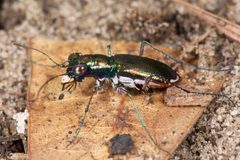
Cicindelidia floridana, the Miami Tiger , is a critically to pine rockland in Miami-Dade County, Florida. Rediscovered in 2007 after being presumed extinct since the 1940s, it is one of the rarest tiger beetles in North America. are with brilliant coppery-green coloration, reduced elytral maculation, and distinctly punctured with dense lateral pronotal setae. The shows extreme habitat specificity to open sandy patches within fire-maintained pine rocklands, making it exceptionally vulnerable to urban development.
Pronunciation
How to pronounce Cicindelidia floridana: /sɪˌsɪndɛˈlɪdiə flɒrɪˈdænə/
These audio files are automatically generated. While they are not always 100% accurate, they are a good starting point.
Identification
Most similar to C. scabrosa, from which it differs by: (1) brilliant coppery-green rather than black coloration (obvious in live specimens); (2) usually lacks post- marginal spot on ; (3) lighter leg coloration; (4) restricted to pine rockland versus sand pine scrub ; and (5) distribution in Miami-Dade County where C. scabrosa does not occur. Distinguished from C. abdominalis and C. highlandensis by distinctly punctured (not smooth) elytra and dense lateral pronotal setae.
Images
Habitat
Pine rockland —fire-adapted savanna-like with open of south Florida slash pine (Pinus elliottii var. densa) and diverse understory including cabbage palm (Sabal palmetto). specifically frequent small, open, sandy exposures with sparse vegetation and high sun exposure within this matrix. Requires well-drained sandy soils for larval burrow construction. Habitat depends on regular fire events for maintenance.
Distribution
to Miami-Dade County, Florida, USA. Historically known from Miami and South Miami; rediscovered in 2007 at two sites: U.S. Coast Guard land and University of Miami campus (Richmond Heights area). Current known distribution extremely limited with extent of suitable among the smallest of all North American tiger beetles.
Seasonality
active during wet season, May through October, with peak activity in June–July. Activity pattern ; beetles become increasingly flighty and seek under debris as temperatures rise during the day.
Diet
Active visual ; hunts small prey. Specific prey items not documented but presumed similar to other Cicindelidia .
Life Cycle
Complete with , larva, pupa, and stages. Larvae construct vertical burrows in sandy soil; third instar larvae have been observed. Oviposition occurs in soil among sparse vegetation, with females excavating holes using eversible ovipositor.
Behavior
activity with visual hunting. Exhibits thermoregulatory stilting —elevating body on long legs to avoid overheating on hot substrates. Extremely flighty and difficult to approach; rapid running and escape responses when disturbed. Males engage in mate-guarding, remaining coupled with females for extended periods post-mating to prevent rival male copulation. During copulation, males alternately hold forelegs tightly against female or extend them widely to sides; function of extended leg posture unknown but possibly tactile warning against intruding males.
Ecological Role
in pine rockland . Potential for quality given extreme habitat specificity. Part of unique pine rockland fauna that includes multiple and .
Human Relevance
Subject of intensive conservation concern due to extreme rarity and loss. Candidate for listing under Act. Rediscovery in 2007 generated significant scientific and public interest. Precise locations of not publicly disclosed to protect against collection pressure. Habitat threatened by urban development, including a 2017 proposal for Walmart and strip mall construction on pine rockland tract (halted by court order).
Similar Taxa
- Cicindelidia scabrosaFormerly considered (as C. scabrosa floridana); shares punctured and dense lateral pronotal setae but differs in black coloration, presence of post- elytral spot, darker legs, sand pine scrub , and distribution north of Miami-Dade County
- Cicindelidia abdominalisSmooth and glabrous or finely setose pronotum lacking dense lateral setae; widespread across southeastern U.S. Coastal Plain
- Cicindelidia highlandensisSmooth and completely glabrous pronotum and episterna; restricted to Lake Wales Ridge in Polk and Highlands Counties, central Florida
Misconceptions
Formerly treated as a of C. scabrosa; elevated to full status by Brzoska et al. (2011) based on morphological, ecological, and distributional differences. Presumed extinct from 1940s until 2007 rediscovery.
More Details
Conservation Status
Critically endangered with one of the smallest extents of suitable of any North American tiger . viability potentially compromised by habitat fragmentation, fire suppression, and sea level rise.
Research History
Original description by Cartwright (1939). Rediscovery in 2007 by Barry Knisley and colleagues during surveys of Miami-Dade County pine rocklands. First photographs of live wild individuals taken by Chris Wirth and Ted MacRae in 2011.
Taxonomic Notes
Member of the Cicindelidia abdominalis group, characterized by small size, red venters, and sand-dwelling habits. The four species in this group (C. abdominalis, C. highlandensis, C. scabrosa, C. floridana) presumably evolved during Pleistocene sea level fluctuations that repeatedly isolated peninsular Florida.
Sources and further reading
- BugGuide
- GBIF taxonomy match
- iNaturalist taxon
- Photographing the Newly Rediscovered Cicindelidia floridana | Beetles In The Bush
- Mini-review of the Cicindelidia abdominalis species-group | Beetles In The Bush
- The (almost) Florida-endemic Cicindelidia scabrosa | Beetles In The Bush
- Why I Roamed the Marsh at Night | Beetles In The Bush
- Cicindelidae | Beetles In The Bush | Page 10
- Bug Eric: Losing the Pine Rocklands
- Habitat, Distribution, Biology, and Conservation of the Miami Tiger Beetle, Cicindelidia floridana (Cartwright) (Coleoptera: Carabidae: Cicindelinae)
- Determining Type Locality Habitat and Historic Land Use at Current Sites of the Miami Tiger Beetle, Cicindelidia floridana (Cartwright) (Coleoptera: Carabidae: Cicindelinae)