
Celaenorrhinus
Hübner, 1819
sprites, flats
Species Guides
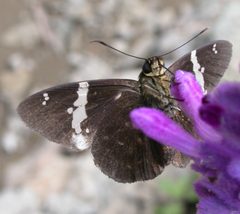
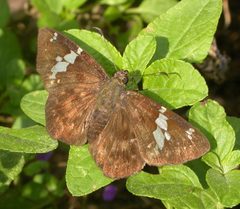
2- Celaenorrhinus fritzgaertneri(Fritzgaertner's Flat)
- Celaenorrhinus stallingsi(Stallings's Flat)
Celaenorrhinus is a of in the Hesperiidae, commonly known as sprites or flats. The genus comprises over 100 distributed across tropical regions of Africa, Asia, and the Americas, divided into three major species groups. Members are characterized by their habit of resting with wings held flat and spread horizontally, distinguishing them from related genera such as Notocrypta. The genus serves as the type genus for tribe Celaenorrhinini within Pyrginae. Phylogenetic evidence indicates Celaenorrhinus is likely and may be subject to future taxonomic revision.
Pronunciation
How to pronounce Celaenorrhinus: //ˌsɛlɨˌnɔːrˈaɪnəs//
These audio files are automatically generated. While they are not always 100% accurate, they are a good starting point.
Identification
Distinguished from related by resting posture with wings spread flat and wide, never folded upright. Separated from Notocrypta by this flat-winged resting . Forewing venation with characteristic subcostal nervule pattern: first, second, and third subcostal nervules with bases almost equidistant, fourth subcostal with base half as near to third as third is to second. Hindwing with more or less spotted pattern in all . Species-level identification requires examination of genitalia and detailed wing pattern analysis.
Images
Appearance
Medium-sized with wings held flat at rest. Forewing with slightly arched , acute apex, convex outer margin, and straight inner margin. Hindwing with strongly arched costa at base, acute apex in males (rounded in females), and rounded outer margin. Wing venation diagnostic: forewing with long, narrow discoidal and characteristic subcostal nervule arrangement; hindwing with fine, straight discoidal nervule arising at junction of disco-cellular nervules. Most exhibit spotted or maculate hindwing patterns. present in wing apex shape.
Habitat
Tropical forest . Specimens collected at elevations ranging from 500–1,200 m in montane and submontane regions. Specific localities include riverbed in Western Himalayas (Simla), forested mountains in southwestern China (Yunnan, Chongqing, Tibet), and similar elevations in Thailand, Vietnam, and South America.
Distribution
Pantropical distribution across three major regions: Africa, Asia (South and Southeast Asia including India, China, Thailand, Vietnam, Indochina), and the Americas (South America including Surinam, Venezuela). C. pyrrha ranges from Sikkim, Bhutan, and Assam through Indochina to southwestern China. C. munda extends from Simla, India eastward to southern Tibet. C. eligius occurs in Surinam and Venezuela.
Behavior
activity observed in some ; C. leucocera in Western Himalayas flies rapidly along riverbeds after sunset, settling briefly on leaves before flying again. Resting distinctive: all species settle with wings wide outspread, never folded upright. rapid and darting, difficult to follow visually.
Ecological Role
Sensitive bioindicators of environmental changes; , distribution patterns, and diversity reflect health status of forest and can track responses to extreme climate events and metal .
Human Relevance
Subject of taxonomic and phylogenetic research; complete mitochondrial sequenced for multiple (C. victor, C. pyrrha) supporting and molecular . Rare species (C. pyrrha, C. munda) of biogeographic interest for documenting range extensions.
Similar Taxa
- NotocryptaRelated skipper distinguished by resting with wings folded upright over the back, versus flat-winged posture in Celaenorrhinus
- AurivittiaFormer Celaenorrhinus (C. aurivittata, C. vietnamicus) transferred to this based on revised
- ApallagaFormer Celaenorrhinus (C. mokeezi, C. pooanus, C. rutilans) transferred to this
Misconceptions
The 'flats' is also applied to related , not exclusive to Celaenorrhinus. The genus name has been historically misspelled in some sources. The genus is not monophyletic as currently circumscribed, despite long-standing usage.
More Details
Taxonomic Status
Currently recognized as likely to be split in future revisions. Formerly contained now assigned to Aurivittia and Apallaga. Phylogenetic analysis of mitochondrial places C. victor as sister to C. consanguineus within monophyletic Celaenorrhinini clade.
Species Groups
organized into three major groups by geography: Africa species group, Asia species group, and America species group. Over 100 species worldwide, with 23 recorded in China.
Molecular Resources
Complete mitochondrial available for C. victor (15,180 , 79.64% A+T content) and COI barcode sequence (658 bp) published for C. pyrrha. Comparative analysis across five Celaenorrhinus shows similar -usage profiles with A/U-ending and predominant purifying selection.
Sources and further reading
- BugGuide
- Wikipedia
- GBIF taxonomy match
- iNaturalist taxon
- NCBI Taxonomy
- Catalogue of Life
- New records of Celaenorrhinus pyrrha de Nicéville, 1889 and C. munda (Moore, 1884) from China (Lepidoptera, Hesperiidae)
- Characterization and Phylogenetic Analysis of the Complete Mitochondrial Genome of Celaenorrhinus victor (Lepidoptera: Hesperiidae).