
Cicindela decemnotata
Say, 1817
Badlands Tiger Beetle
Species Guides
4- Cicindela decemnotata bonnevillensis(Lake Bonneville Tiger Beetle)
- Cicindela decemnotata decemnotata(Badlands Tiger Beetle)
- Cicindela decemnotata meriwetheri(Meriwether's Badlands Tiger Beetle)
- Cicindela decemnotata montevolans
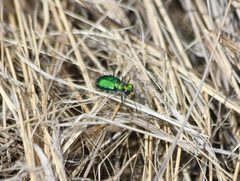
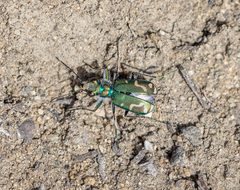
Cicindela decemnotata, commonly known as the badlands tiger , is a flashy tiger beetle in the Carabidae. It is the westernmost representative of a species group characterized by green coloration with variable red markings on the , pronotum, and . The species has undergone recent and rapid phylogenetic radiation following glacial recession, with five recognized based on morphological and molecular evidence. show relatively low genetic divergence despite marked morphological differences, suggesting within the past 10,000 years.
Pronunciation
How to pronounce Cicindela decemnotata: //sɪˈsɪndələ dɛˌsɛmnoʊˈtɑːtə//
These audio files are automatically generated. While they are not always 100% accurate, they are a good starting point.
Identification
Distinguished from related by the sharply angled elytral band that does not reach the elytral edge, combined with green and variable red coloration. Most similar to Cicindela limbalis, C. splendida, and C. denverensis, which occur further east in the Great Plains, and to C. sexguttata, C. patruela, and C. denikei in forested regions to the east. The 'greasy' appearance and specific maculation pattern separate it from these relatives. Five (C. d. albertina, C. d. bonnevillensis, C. d. decemnotata, C. d. meriwetheri, C. d. montevolans) are recognized based on geographic distribution and subtle morphological differences.
Images
Habitat
Inhabits alkaline flats, sandy ridges, and open sagebrush landscapes in arid western regions. Often found on exposed sandy soils rather than the most obvious alkaline flat surfaces. Associated with badlands topography and post-glacial landscapes in the northern Great Plains, northern Great Basin, and Rocky Mountain regions.
Distribution
North America: Rocky Mountains from northwestern Great Plains and northern Great Basin north to Yukon. Easternmost records from northwestern Nebraska; occurs more reliably in Wyoming and westward. Distribution largely confined to areas uncovered by glacial ice within the last 10,000 years.
Seasonality
active in late summer and fall; observations from September and October documented. Activity likely limited by cooler temperatures at northern latitudes and higher elevations.
Life Cycle
Larval stage has been observed in suitable sandy ; details of development and otherwise poorly documented.
Behavior
are fast-running and can be skittish, though some individuals tolerate close approach. Exhibits thermoregulatory including stilting when active in open, sunny . Readily takes when disturbed after initial escape running.
Ecological Role
Predatory occupying open, arid ; likely functions as an in sandy and alkaline flat . Part of a post-glacial colonizing fauna with rapid recent radiation.
Human Relevance
Subject of entomological collecting and photography, particularly sought after by tiger enthusiasts due to its restricted distribution and distinctive appearance. Five described in 2012 based on combined morphological and molecular study, contributing to understanding of rapid post-glacial speciation.
Similar Taxa
- Cicindela limbalisOccurs further east in Great Plains; part of same but with different geographic range and maculation details
- Cicindela splendidaEastern Great Plains relative with similar green-red coloration but distinct distribution and subtle morphological differences
- Cicindela denverensisPartially member occurring further east
- Cicindela sexguttataMore eastern, forested with related but different ecological preferences
- Cicindela patruelaEastern forest-dwelling relative in same group
- Cicindela denikeiEastern forest with related ancestry but distinct and distribution
More Details
Subspecies and Recent Radiation
Molecular and morphological analyses support recognition of five : C. d. decemnotata (nominate), C. d. albertina, C. d. bonnevillensis, C. d. meriwetheri, and C. d. montevolans. Three subspecies were described as new in 2012 by Knisley, Woodcock, and Kippenhan. Low genetic divergence combined with marked morphological differences indicates rapid phylogenetic radiation following glacial recession within the last 10,000 years, paralleling patterns seen in the Cicindela maritima group.