
Cicindela sexguttata
Fabricius, 1775
Six-spotted Tiger Beetle, Six-spotted Green Tiger Beetle
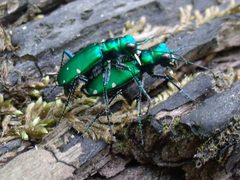
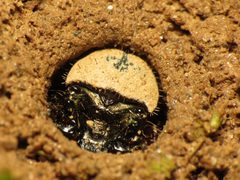
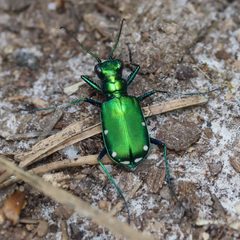
Cicindela sexguttata is a common North American tiger recognized by its bright metallic-green to blue-green , often bearing six small white spots. are active of small arthropods in deciduous forest , where they hunt in sunlit patches on the forest floor. The exhibits specialized thermal , basking to elevate body temperature and foraging optimally at approximately 32.8°C. Larvae are subterranean ambush predators that construct burrows in sandy soils. The species has been reported to live up to five years total, with approximately one year spent in larval development.
Pronunciation
How to pronounce Cicindela sexguttata: //sɪsɪnˈdɛlə sɛksˈɡʊtəˌtɑː//
These audio files are automatically generated. While they are not always 100% accurate, they are a good starting point.
Identification
Distinguished from similar green tiger beetles by the glabrous (smooth, setae-free) front of the ; C. denverensis and other similar have setose (hairy) and legs. C. scutellaris typically shows red or purple elytral coloration and stockier, shorter-legged build. C. decemnotata often exhibits reddish tinting and shinier, almost oily elytral appearance. C. patruela is generally less brightly colored. C. denikei is restricted to clay-sandy and silty till soils with larval burrows uniquely opening beneath stones. Diagnostic characters include elytral maculation pattern, stipal pilosity, antennal scape setae number, and male and female genitalia structure.
Images
Appearance
measure 12–14 mm in length with long, slender legs adapted for rapid running. The body is metallic green to blue-green with a smooth, glabrous front of the ( and lacking setae). typically bear six small white spots, though spot number varies from zero to more than six due to genetic . Large, prominent and oversized white overlapping give a distinctive predatory appearance. The is pale cream-colored. Antennal scape bears a characteristic number of sensory setae useful for identification.
Habitat
Deciduous forests with warm, moist, loamy soils rich in humus. are strongly associated with sunlit patches free of undergrowth, including dirt paths, fallen logs, and light gaps created by openings. Thermal microhabitats are critical: beetles aggregate in illuminated areas for basking and foraging once the canopy closes. Larval burrows are constructed in sandy patches within these wooded environments.
Distribution
Eastern North America, ranging from Minnesota and southeastern Canada south to eastern Texas, excluding the Florida Panhandle. Distribution limited by soil and forest types, with strongest association to eastern deciduous forest biome.
Seasonality
active from spring through summer; activity constrained by thermal microhabitat availability. Foraging ceases or becomes restricted to light gaps once closure reduces ground-level illumination. Adults enter in autumn when thermal resources become insufficient to maintain preferred body temperature. Seasonal varies geographically across the range.
Diet
are of small arthropods including caterpillars, ants, spiders, and other insects. Larvae are subterranean ambush predators that capture small arthropods passing near their burrow entrances.
Life Cycle
Females deposit singly in sandy patches. Larvae hatch and construct underground burrows, where they reside for approximately one year, feeding on passing prey. Larvae possess hook-like abdominal structures that anchor them in burrows. occurs in the burrow. Total lifespan has been reported up to just under five years, though three years has also been cited.
Behavior
are active, visual hunters that pursue and capture prey rather than employing sit-and-wait tactics. They exhibit complex thermoregulatory : basking to elevate body temperature, foraging at preferred body temperature (~32.8°C), and employing stilting, sun-facing, or shade-seeking when body temperature exceeds ~35°C. When approached by humans or , adults characteristically fly short distances, land, and turn to the observer—often repeating this evasive behavior multiple times. Adults are not gregarious but multiple individuals may aggregate in suitable hunting areas.
Ecological Role
providing of small in forest . As ectothermic predators dependent on thermal microhabitats, they serve as model organisms for studies of temperature-dependent activity patterns in patchy environments.
Human Relevance
Generally harmless to humans; does not bite unless handled, though large can deliver a noticeable pinch if the is captured. Frequently encountered by hikers and cyclists on forest trails, where their evasive and bright coloration make them conspicuous. Occasionally trapped in human materials such as plastic sheeting. Popular subject for insect photographers and naturalists due to approachable habit and striking appearance.
Similar Taxa
- Cicindela denverensisSimilar bright green coloration, but distinguished by setose (hairy) front of and legs; C. sexguttata has glabrous
- Cicindela scutellarisOverlapping range but typically shows red or purple ; stockier build with shorter legs
- Cicindela decemnotataSimilar size and but often with reddish tinting and shinier, oily elytral appearance; less bright green
- Cicindela patruelaLess brightly colored, generally duller green; different associations
- Cicindela denikeiSister with similar appearance but restricted to clay-sandy and silty till soils; larval burrows uniquely open beneath stones
Misconceptions
The 'six-spotted' is misleading: spot number varies genetically from zero to more than six, and some individuals lack spots entirely. The is sometimes assumed to be fluorescent due to its bright metallic appearance, but the coloration is iridescent structural coloration, not fluorescence.
More Details
Thermal ecology
Research demonstrates that C. sexguttata has lower thermoregulatory set points than open- tiger beetles, reflecting to forest environments with patchy, ephemeral thermal resources. Foraging rate and searching speed are independent of body temperature, unlike other cicindelids, possibly reflecting adaptation to ambush hunting in light gaps rather than active pursuit.
Phylogenetic position
Member of the C. sexguttata group, which originated in eastern North American forests during the Late Miocene. C. sexguttata and C. denikei are sister species that speciated in the Late Pleistocene, influenced by continental ice mass dynamics.
Sources and further reading
- BugGuide
- Wikipedia
- GBIF taxonomy match
- iNaturalist taxon
- NCBI Taxonomy
- ID Challenge #1 | Beetles In The Bush
- Six-legged tiger king: Six-spotted green tiger beetle, Cicindela sexguttata — Bug of the Week
- The utilization of patchy thermal microhabitats by the ectothermic insect predator, Cicindela sexguttata
- GEOGRAPHICAL VARIATION, CLASSIFICATION, RECONSTRUCTED PHYLOGENY, AND GEOGRAPHICAL HISTORY OF THECICINDELA SEXGUTTATAGROUP (COLEOPTERA: CICINDELIDAE)