
Pieris rapae
(Linnaeus, 1758)
small white, cabbage white, cabbage butterfly, small cabbage white, imported cabbageworm (larval stage), white butterfly (New Zealand)
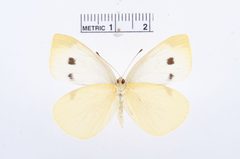
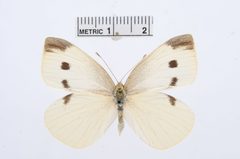
is a small to medium-sized in the Pieridae, native to Europe and Asia and introduced to North America, Australia, New Zealand, and Hawaii. are white with black wing markings; females bear two additional black spots on the forewings. The is a significant agricultural pest in its larval stage, known as the imported cabbageworm, feeding on cruciferous crops. It has been extensively studied for its responses to climate change, with long-term data showing progressively earlier spring in North America.
Pronunciation
How to pronounce Pieris rapae: //ˈpiː.ɛ.rɪs ˈræ.peɪ//
These audio files are automatically generated. While they are not always 100% accurate, they are a good starting point.
Identification
Distinguished from Pieris brassicae (large white) by smaller size and lack of black band at forewing tip. Distinguished from Pieris napi (green-veined white) by wing pattern and pupal extending far beyond antennal sheath. Females distinguished from males by presence of two black forewing spots.
Images
Habitat
Open areas with diverse plant associations including towns, agricultural fields, gardens, and natural valley bottoms. Has been observed entering small forest clearings. Avoids cool, shaded woodlands for oviposition even when plants are present. Absent or scarce in desert and semidesert regions except irrigated areas.
Distribution
Native to Europe, Asia, and North Africa. Introduced to eastern North America (Quebec, ~1860), Hawaii (1897), New Zealand (~1930), and Australia (1937). Present across North American life zones from Lower Austral/Lower Sonoran to Canada. Not found north of Canadian life zone or on Channel Islands off southern California. Absent from South America.
Seasonality
In Britain, two periods: April–May and July–August. In North America, continuously brooded from early spring until hard freeze in fall. First flight in central California has ranged from January 1 to February 22 since 1972, averaging about January 20, with trend toward earlier emergence due to climate warming.
Diet
feed on nectar, preferring purple, blue, and yellow flowers. Larvae feed on plants containing glucosinolates, primarily Brassicaceae including cultivated cabbage, kale, bok choy, broccoli, radish, and wild mustards such as charlock (Sinapis arvensis) and hedge mustard (Sisymbrium officinale).
Host Associations
- Brassica oleracea - larval cultivated cabbage
- Brassica rapa - larval field mustard; has UV
- Brassica juncea - larval
- Brassica napus - larval rapeseed
- Brassica nigra - larval black mustard
- Sinapis arvensis - larval charlock, wild mustard
- Sisymbrium officinale - larval hedge mustard
- Raphanus sativus - larval cultivated radish
- Raphanus raphanistrum - larval wild radish
- Nasturtium officinale - larval watercress
- Capsella bursa-pastoris - oviposition siteshepherd's purse; females oviposit but larvae refuse
- Lunaria annua - larval honesty; retards larval growth
- Thlaspi arvense - larval field pennycress; larvae grow slowly or refuse
- Tropaeolum majus - larval nasturtium
- Hirschfeldia incana - larval shortpod mustard; allowing summer survival
- Lepidium latifolium - larval peppergrass; in western Great Basin
Life Cycle
laid singly on plant leaves. Larva hatches and consumes eggshell before feeding on host foliage, boring into cabbage to feed on new sprouts. Five larval instars; development rate temperature-dependent, optimal near 30–35°C under field conditions. occurs on substrate matching larval background color. Overwinters as pupa. Multiple per year in favorable climates.
Behavior
, flying throughout day except early morning and evening. Males patrol around plants seeking females; upon encountering female, zigzag pattern followed by attempt to mate by grasping forewings with legs. Unreceptive females reject by flying vertically or raising with wings spread. Males engage in mud-puddling for sodium uptake, correlated with increased reproductive success. Adults capable of long-distance flight, observed moving up to 12 km in single flight; average female daily movement ~0.7 km. Females follow linear flight paths when searching for host plants, abandoning linearity when foraging for nectar. Oviposition preferentially on isolated or peripheral plants rather than dense patches. Larvae rest on undersides of leaves but feed mostly during day, dispersing damage across plant to reduce visual cues to . Larvae show flower constancy in foraging, with learning curve for nectar location.
Ecological Role
Herbivore of Brassicaceae; significant agricultural pest causing damage valued in hundreds of thousands of dollars. Larvae serve as for Cotesia rubecula, Cotesia glomerata, and flies Phryxe vulgaris, Epicampocera succinata. Pupae parasitized by Pteromalus puparum. Prey for birds including house sparrow, goldfinch, and skylark in urban environments; more significant in rural areas. serve as .
Human Relevance
Major pest of cruciferous vegetable crops worldwide; larvae known as imported cabbageworm. Subject of long-term phenological research in California since 1972, documenting climate change effects through 'Beer-for-a-' contest tracking first spring . Used as model organism in studies of insect-plant chemical , - interactions, and urbanization effects on functional traits.
Similar Taxa
- Pieris brassicaeLarger size; black band at forewing tip rather than discrete black spots; larvae sequester glucosinolates making them distasteful to (P. rapae larvae are palatable)
- Pieris napiGreen-veined wing pattern; pupal extends only short distance beyond antennal sheath (vs. far beyond in P. rapae)
More Details
Climate change response
Long-term data from central California (1972–present) document progressively earlier spring , averaging approximately one week earlier than 30 years ago. First dates correlate with regional temperature trends.
Pupal color polyphenism
Pupal color determined by light environment during approximately 24-hour prepupal wandering stage. Yellow wavelengths produce green pupae, blue wavelengths produce brown pupae. This background matching is adaptive for . Diapausing pupae show greater tendency toward brown coloration.
Biochemical adaptation to host plants
Unlike many herbivores, P. rapae is immune to isothiocyanate forming reaction from glucosinolates due to specific biochemical , allowing exploitation of Brassicaceae defenses. This adaptation appears to have driven coevolutionary dynamics with plants.
Subspecies
Nominate P. r. rapae in Europe; P. r. crucivora in Asia. Additional subspecies include atomaria, eumorpha, leucosoma, mauretanica, napi, novangliae, and orientalis.
Sources and further reading
- BugGuide
- Wikipedia
- GBIF taxonomy match
- iNaturalist taxon
- NCBI Taxonomy
- Catalogue of Life
- He Nabbed It on New Year's Day | Bug Squad
- Rejection in the World of Cabbage White Butterflies | Bug Squad
- Bingo! First Cabbage White Butterfly of the Year! | Bug Squad
- No Contest, But Art Shapiro Spots First Cabbage White Butterfly of Year | Bug Squad
- Beer-for-a-Butterfly Contest: We Have a Winner! | Bug Squad
- A Butterfly for a Beer! Or Suds for a Bug! | Bug Squad
- Pieris rapae . [Distribution map].
- Polarized light cues affect host selection in Pieris rapae
- Environmental factors influencing pupal colour determination in Lepidoptera. II. Experiments with Pieris rapae, Pieris napi and Pieris brassicae
- Simulation of the effects of movement patterns and resource density on the egg distributions of Pieris rapae (Lepidoptera) at multiple spatial scales
- Behavioural evolution in the cabbage butterfly (Pieris rapae)
- Pieris rapae larvae facilitate the oviposition of Plutella xylostella by spinning silk on waxy host plants
- Exploring the Effects of Urbanization on Functional Trait Variation within Pieris rapae and Erigeron annuus throughout Philadelphia
- Proteomic analysis of dimorphic sperm in the cabbage white butterfly, Pieris rapae.