
Pteromalus puparum
(Linnaeus, 1758)
white butterfly pupal parasitoid wasp
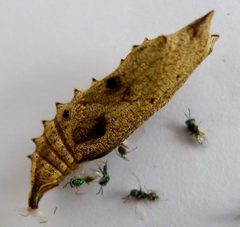
Pteromalus puparum is a gregarious endoparasitoid that attacks the pupal stage of butterflies, particularly pierids and papilionids. It is widely distributed and has been extensively studied for of agricultural pests, notably Pieris rapae, the small white cabbage butterfly. The exhibits sophisticated manipulation through venom injection during oviposition, which suppresses host and regulates development. It is a model organism for studying venom biochemistry, reproductive strategies, and innate immunity.
Pronunciation
How to pronounce Pteromalus puparum: //ˌtɛrəˈmɑːləs pjuːˈpɛərəm//
These audio files are automatically generated. While they are not always 100% accurate, they are a good starting point.
Identification
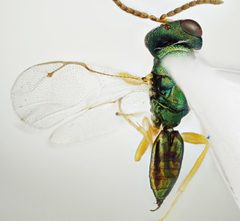
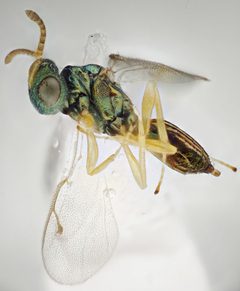
Members of the Pteromalus are morphologically similar and require careful examination for -level identification. Pteromalus puparum can be distinguished from related species through interactive identification keys that incorporate quantitative morphological measurements. The species belongs to the Pteromalus albipennis species group, which contains numerous cryptic species distinguishable by subtle morphological differences and body measurements.
Images
Habitat
Associated with pupae on plants; laboratory colonies maintained at 25 ± 1°C with 70% relative humidity and 14:10 light:dark . Natural include agricultural and natural environments where host butterflies occur.
Distribution
Widely distributed globally. Documented from the Azores (Corvo, Faial, São Miguel), Italy (Toscana), and Australia (South Australia). Studied in laboratory in Hangzhou, China.
Diet
feed on nectar, specifically observed consuming 20% honey solution in laboratory settings. Larvae are endoparasitoids that feed internally on pupal tissues.
Host Associations
- Pieris rapae - primary small white cabbage butterfly; major target for
- Papilio xuthus - Asian swallowtail; used in reproductive strategy studies
- Papilionidae - at least 11 parasitized
- Pieridae - pierid pupae frequently parasitized
Life Cycle
Holometabolous with complete . initiates after the pupal stage and completes by 48 hours post- in fed females. Females oviposit into newly pupated pupae. Development occurs within host pupae; can be cold-stored at 10°C for up to 15 months while maintaining viability. Gregarious development with multiple offspring emerging from single host.
Behavior
Females inject venom along with during oviposition to manipulate physiology. Exhibits oosorption—resorption of in response to starvation—as an adaptive physiological response to nutritional stress. Venom components include α-amylases and serpins that suppress host immune responses and alter host metabolism. Larval saliva additionally suppresses host . are gregarious, with males and females held together for mating beginning 48 hours post-.
Ecological Role
Important agent regulating of pest butterflies, particularly in agricultural systems. As a gregarious pupal , it can significantly reduce populations. Contributes to natural enemy complexes in both native and introduced ranges.
Human Relevance
Widely used as a agent against Pieris rapae and other pest butterflies. Extensively studied as a model organism for venom research, reproductive , and immunology. Commercial or research colonies maintained for biocontrol applications and scientific study.
Similar Taxa
- Pteromalus albipennis species groupMorphologically similar cryptic requiring quantitative measurements and interactive keys for reliable identification; P. puparum belongs to this group
- Nasonia vitripennisRelated ectoparasitoid with shared orthologs in immune-related genes; differs in being ectoparasitic rather than endoparasitic
More Details
Venom Composition and Function
Venom contains multiple α-amylases (PpAmy1, PpAmy2, PpAmy3) that influence metabolism. PpAmy3 specifically affects host metabolites and supports offspring development. Venom serpins suppress host prephenoloxidase cascade by complexing with host hemolymph proteinases.
Reproductive Plasticity
Optimal clutch size varies with resource availability: approximately 150 per gram weight maximizes total progeny weight, while 300 eggs per gram maximizes female progeny when food is available. When females lack food, optimal drops to approximately 70 eggs per gram.
Immune System Characteristics
and transcriptome analyses identified 216 immune-related genes operating in Toll, IMD, JAK/STAT, and JNK . Recognition molecules and effector proteins are more expanded than signaling genes, reflecting adaptations for immune evasion and defense.
Sources and further reading
- BugGuide
- Wikipedia
- GBIF taxonomy match
- iNaturalist taxon
- NCBI Taxonomy
- Catalogue of Life
- Interactive species ID with advanced software | Blog
- new species | Blog - Part 20
- Oosorption in the Endoparasitoid,Pteromalus puparum
- The reproductive strategy of the gregarious parasitoid, Pteromalus puparum (Hymenoptera: Pteromalidae)
- Immune signaling pathways in the endoparasitoid, Pteromalus puparum
- The reproductive strategy of the gregarious parasitoid, Pteromalus puparum (Hymenoptera: Pteromalidae)
- The reproductive strategy of the gregarious parasitoid, Pteromalus puparum (Hymenoptera: Pteromalidae)
- Venom of the Endoparasitoid WaspPteromalus puparum: An Overview
- Venom α‐amylase of the endoparasitic wasp Pteromalus puparum influences host metabolism
- Post Refrigeration Viability of Pteromalus puparum (Hymenoptera: Pteromalidae) Prepupae within Host Chrysalids
- Genome-wide characterization of miRNA and siRNA pathways in the parasitoid wasp Pteromalus puparum
- The larval saliva of an endoparasitic wasp, Pteromalus puparum, suppresses host immunity
- Sex-biased expression of microRNAs in an endoparasitoid wasp,Pteromalus puparum
- The genome-wide analysis of innate immunity in a pupal endoparasitoid wasp,Pteromalus puparum
- A venom serpin isoform fromPteromalus puparumsuppresses the host prephenoloxidase cascade by forming complexes with host hemolyph proteinases
- Antennal sensory receptors of Pteromalus puparum female (Hymenoptera: Pteromalidae), a gregarious pupal endoparasitoid of Pieris rapae
- Releases of Pteromalus puparum (LINNE) (Hymenoptera: Pteromalidae), a pupal parasitoid of Papilio xuthus LINNE