
Nasonia vitripennis
(Walker, 1836)
Blowfly Chalcid Wasp
is a small and the best-studied member of the Nasonia. It parasitizes pupae of carrion flies, particularly blowflies (Calliphora spp.) and flesh flies. The exhibits haplodiploid sex determination, with females developing from fertilized and haploid males from unfertilized eggs. It has become a major model organism for studies of genetics, development, , and -mediated . The was fully sequenced in 2010, facilitating research on venom proteins, , and epigenetic mechanisms including methylation.
Pronunciation
How to pronounce Nasonia vitripennis: //nəˈsoʊniə ˌvɪtrɪˈpɛnɪs//
These audio files are automatically generated. While they are not always 100% accurate, they are a good starting point.
Identification
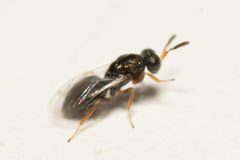
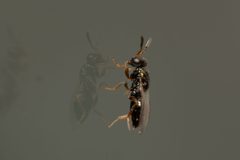
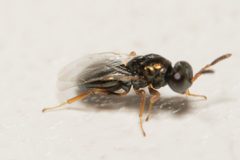
Females distinguished from other Nasonia by straight stigmal (other three species show varying curvature). Males identified by spindle-shaped antennal scape (vs. angulate in N. giraulti and N. oneida, cylindrical in N. longicornis) and shorter, wider antennal . Males also have smaller forewings than other Nasonia species. Species-level identification requires examination of both sexes and comparison with .
Images
Habitat
Associated with carrion and bird nests where blowfly and flesh fly develop; laboratory maintained on blowfly pupae
Distribution
Europe (documented latitudinal from Corsica at 42°N to northern Finland at 65°N); also recorded from Brazil (Goiás, Minas Gerais, Rio de Janeiro, Rio Grande do Sul, São Paulo), Argentina, Australia, and Canada (Alberta)
Seasonality
Activity patterns show circadian rhythmicity with latitudinal variation; photoperiodic induction varies with latitude
Host Associations
- Calliphora spp. - primary for laboratory rearing; females drill into and deposit under puparium
- blowflies - natural in field
- flesh flies - natural in field
Life Cycle
Females drill into and deposit underneath. Development includes embryonic, larval, and pupal stages within host. Larval is maternally induced based on photoperiodic cues; critical and switch point vary latitudinally. Haplodiploid sex determination: unfertilized eggs produce haploid males, fertilized eggs produce females. Non-complementary sex determination system (MEGISD model) involving maternal effect genomic imprinting.
Behavior
Males produce from rectal papillae released through ; strongly attract virgin females but not mated females. Cephalic pheromones released from mouth during courtship. Females contact male mouth with to signal receptivity. After mating, females switch from mate-seeking to -seeking , thought to be triggered by pheromone exposure rather than sperm transfer. Demonstrates associative learning: females form olfactory memories (e.g., cinnamon association) lasting at least 24 hours after single training event. Early memory involves four distinct phases based on CO2 sensitivity. Males show higher circadian rhythmicity than females in constant darkness; mating decreases rhythmicity in both sexes.
Ecological Role
agent of carrion fly ; of blowfly and flesh fly pupae that would otherwise develop in bird nests and carrion
Human Relevance
Model organism for genetic and developmental research; sequenced in 2010. Used in studies of , sex determination, venom evolution, methylation, , learning and memory, and - interactions. Potential for development as and system for filth flies. Used as safety assessment model for pest-specific dsRNA in biological control applications.
Similar Taxa
- Nasonia giraultiMale has angulate (not spindle-shaped) antennal scape; female has curved stigmal
- Nasonia oneidaMale has angulate antennal scape; female has curved stigmal
- Nasonia longicornisMale has cylindrical (not spindle-shaped) antennal scape; female has curved stigmal
More Details
Wolbachia endosymbionts
bacteria (multiple strains from supergroups A and B). Wolbachia causes : sperm from infected males fertilizing uninfected results in paternal fragmentation and conversion of female eggs to haploid males. Bacterial correlates with compatibility differences; higher bacterial titers in males cause stronger incompatibility. Double and supergroup B infections show most pronounced negative effects on host.
Circadian biology
European show latitudinal in circadian rhythmicity. Virgin females from southern populations (Corsica) have shorter free-running periods (~24.6h) than northern populations (Oulu, ~25.4h). Southern show earlier activity onset, peak, and offset under long ; under short photoperiod, southern wasps begin activity in darkness while northern wasps start at light onset. Circadian clock gene period (per) haplotype frequencies correlate with this clinal variation.
Epigenetics
methylation varies across development: highest in embryo, lowest in larva. of methylation (NvTet, NvDnmt) complements observed patterns. Differentially methylated sites show enrichment for developmentally linked factors, though no clear link with gene expression has been established.
Male fertility and temperature
is synchronized and includes intermediate sperm storage system between and seminal vesicles. Elevated temperature during development alters spermatogenesis and can shift sex ratios through changes in female sex allocation decisions.
Oösorption
Females resorb unlaid when deprived of . Process involves leucine aminopeptidase and esterase from follicle degrading and . Oösorption begins earlier in older females with depleted reserves compared to younger females.
Sources and further reading
- BugGuide
- Wikipedia
- GBIF taxonomy match
- iNaturalist taxon
- NCBI Taxonomy
- Catalogue of Life
- How Jeff Smith’s 'Neighborly' Project Will Benefit the Bohart Museum of Entomology | Bug Squad
- Publications | Entomology Research Museum
- Homalodisca vitripennis Archives - Entomology Today
- A New Guide for Understanding Insect Vectors of Plant Pathogen Xylella fastidiosa
- Pierce's Disease: Areawide Project Shows IPM Success for 20 Years
- Cytoplasmic incompatibility and bacterial density in Nasonia vitripennis.
- Latitudinal Variation in Circadian Rhythmicity in Nasonia vitripennis
- Early memory in the parasitoid wasp Nasonia vitripennis
- Oösorption in Nasonia vitripennis (Hymenoptera: Pteromalidae)
- Decision letter for "Nasonia vitripennis males exhibit greater effort and competency in detecting hosts with conspecific females than other Nasonia males"
- Review for "Nasonia vitripennis males exhibit greater effort and competency in detecting hosts with conspecific females than other Nasonia males"
- Decision letter for "Nasonia vitripennis males exhibit greater effort and competency in detecting hosts with conspecific females than other Nasonia males"
- Miniature masterminds : neurobiology of brain scaling in the parasitic wasp Nasonia vitripennis
- The mandibular gland in Nasonia vitripennis (Hymenoptera: Pteromalidae)
- Nasonia vitripennis as a parasitoid wasp model for pest-specific dsRNA safety assessment
- Developmental DNA Methylation in the Parasitoid Wasp Nasonia vitripennis
- Etudes physiologiques et comportemenales de la fertilité mâle chez un hyménoptère parasitoïdique, nasonia vitripennis
- Exploring the potential of genetic improvement of insects : a case study using the haplodiploid parasitoid wasp Nasonia vitripennis
- Author response for "Nasonia vitripennis males exhibit greater effort and competency in detecting hosts with conspecific females than other Nasonia males"
- Bacterial supergroup specific “Cost” of Wolbachia infections in Nasonia vitripennis
- Novel structure and composition of the unusually large germline determinant of the wasp Nasonia vitripennis.