
Nasonia
Ashmead, 1904
jewel wasp
Species Guides
1- Nasonia vitripennis(Blowfly Chalcid Wasp)
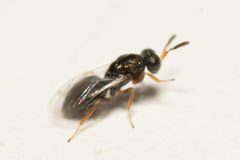
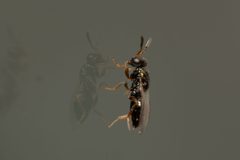
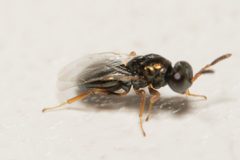
Nasonia is a of small pteromalid comprising four described : N. vitripennis, N. giraulti, N. longicornis, and N. oneida. These wasps are ectoparasitoids of fly pupae, primarily targeting blow flies and flesh flies. The genus has become a prominent model system in behavioral genetics and evolutionary due to its short time, ease of laboratory rearing, and the ability to hybridize species in controlled crosses. Nasonia wasps exhibit a distinctive emerald sheen on their , earning them the 'jewel wasps.'
Pronunciation
How to pronounce Nasonia: //nəˈsoʊniə//
These audio files are automatically generated. While they are not always 100% accurate, they are a good starting point.
Identification
The four can be distinguished by geographic distribution, preferences, and male courtship . N. vitripennis is ; N. giraulti occurs in eastern North America; N. longicornis in western North America; and N. oneida is microsympatric with N. giraulti. N. longicornis males have longer . Molecular identification may be necessary for definitive determination where ranges overlap. Species-specific cuticular hydrocarbon profiles serve as chemical recognition signals.
Images
Appearance
Small approximately match- sized with a distinctive emerald or metallic green sheen on the . Females possess an ovipositor modified for drilling through . Body size and antennal proportions vary among ; N. longicornis has notably longer relative to body size compared to .
Habitat
supporting of blow flies and flesh flies, including carrion-associated environments, animal nesting sites, and anthropogenic settings with decaying organic matter. Specific microhabitat requirements beyond availability are not documented in available sources.
Distribution
N. vitripennis: worldwide distribution. N. giraulti: eastern North America. N. longicornis: western North America. N. oneida: microsympatric with N. giraulti in eastern North America, distinguished as a separate in 2010.
Diet
Larvae feed on tissues of fly pupae. The venom primes the host by causing developmental arrest, redirecting host energy toward nutrient production for larval consumption.
Host Associations
- blow flies - Primarily Calliphora and Protophormia
- flesh flies - Sarcophaga
- house flies - Musca
- other muscoid flies - Various in pupal stage
Life Cycle
Females drill through with ovipositor and inject venom, then lay 20-40 on host . Eggs hatch in approximately 36 hours. Larvae feed ectoparasitically on host for 7 days, then pupate for another 7 days. Total developmental time from egg to is approximately 14 days at 25°C. Males emerge before females and chew exit holes in puparium.
Behavior
Females use ovipositor to drill into and inject venom that arrests host development. Males perform stereotyped involving wing vibrations and nods. N. vitripennis males exhibit greater search effort and competency in detecting hosts containing females compared to heterospecific females, using cuticular hydrocarbon cues. Males wait at exit holes for emerging females and immediately attempt mating. show strong mate discrimination despite genetic compatibility.
Ecological Role
agent of pest flies. As , they regulate of blow flies and flesh flies that are nuisance pests and . Ectoparasitic lifestyle on pupal represents a specialized feeding strategy within the parasitoid guild.
Human Relevance
Used as biocontrol agents against pest flies. Extensively employed as a model organism in behavioral genetics, evolutionary , and research. The 2010 sequencing of the Nasonia by an international consortium has enabled applications in pest control research. Laboratory rearing is straightforward due to short time and available cultures.
Similar Taxa
- other PteromalidaeNasonia can be distinguished by its small size, metallic emerald coloration, and specific association with fly pupae; many pteromalids lack the distinctive jewel-like sheen and have different associations
- other parasitoid wasps attacking fly pupaeNasonia is distinguished by its combination of ectoparasitic development ( laid externally, larvae do not enter body), venom-induced host developmental arrest, and male- of waiting at exit holes
More Details
Wolbachia associations
Different Nasonia harbor different strains of endosymbionts, which cause and contribute to reproductive isolation between species. Wolbachia has been hypothesized to contribute to the rapid evolutionary rate observed in Nasonia and other parasitic Hymenoptera.
Genomic features
The Nasonia has acquired genes from Pox virus and through within the last 100,000 years. The exhibits faster evolutionary rates than most other insect orders. The genome was sequenced in 2010 and has facilitated research in genetics and pest control applications.
Hybridization potential
All four Nasonia are interfertile in laboratory crosses, making the exceptionally valuable for studying the genetics of species differences in and for mapping traits related to preference, mate recognition, and morphological variation.
Sources and further reading
- BugGuide
- Wikipedia
- iNaturalist taxon
- NCBI Taxonomy
- Catalogue of Life
- Nasonia Wasp Behavior Genetics
- Nasonia Wasp Behavior Genetics
- Genetics of cuticular hydrocarbon differences between males of the parasitoid wasps Nasonia giraulti and Nasonia vitripennis
- Behavioral and spermatogenic hybrid male breakdown in Nasonia
- Decision letter for "Nasonia vitripennis males exhibit greater effort and competency in detecting hosts with conspecific females than other Nasonia males"
- Review for "Nasonia vitripennis males exhibit greater effort and competency in detecting hosts with conspecific females than other Nasonia males"
- Decision letter for "Nasonia vitripennis males exhibit greater effort and competency in detecting hosts with conspecific females than other Nasonia males"
- Author response for "Nasonia vitripennis males exhibit greater effort and competency in detecting hosts with conspecific females than other Nasonia males"
- THE ROLES OF HOST EVOLUTIONARY RELATIONSHIPS (GENUS: NASONIA) AND DEVELOPMENT IN STRUCTURING MICROBIAL COMMUNITIES
- Polyploidy and host specificity genetics in Nasonia parasitoid wasps
- Miniature masterminds : neurobiology of brain scaling in the parasitic wasp Nasonia vitripennis
- Natural variation in memory formation among Nasonia parasitic wasps : from genes to behaviour
- Nasonia vitripennis males exhibit greater effort and competency in detecting hosts with conspecific females than other Nasonia males
- The mandibular gland in Nasonia vitripennis (Hymenoptera: Pteromalidae)
- Nasonia vitripennis as a parasitoid wasp model for pest-specific dsRNA safety assessment
- Novel structure and composition of the unusually large germline determinant of the wasp Nasonia vitripennis.