
Protophormia
Townsend, 1908
Northern blow flies
Species Guides
1- Protophormia terraenovae(northern blowfly)
Protophormia is a of blow flies (Calliphoridae) containing two recognized : P. atriceps and P. terraenovae. These flies are distributed across Eurasia and Northern America. The genus has been extensively studied in laboratory settings for , , and reproductive physiology, particularly in P. terraenovae.
Pronunciation
How to pronounce Protophormia: /ˌproʊtəˈfɔrmiə/
These audio files are automatically generated. While they are not always 100% accurate, they are a good starting point.
Identification
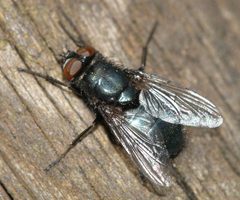
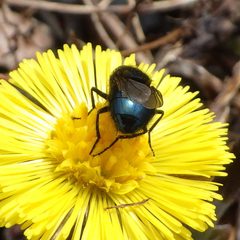
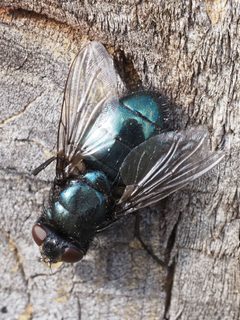
-level identification requires examination of microscopic characters including patterns of setae and coloration of thoracic . P. terraenovae and P. atriceps are distinguished by subtle morphological features not reliably visible in photographs. The is characterized by metallic coloration, typically deep blue or green.
Images
Habitat
Associated with carrion and decomposing organic matter. Observed on fish carcasses and winter-killed animal remains.
Distribution
Eurasia and Northern America. Specific records include Denmark, Norway, Sweden, and the northeastern United States (Vermont, Kansas).
Seasonality
P. terraenovae shows photoperiodic responses with activity patterns tied to seasonal day length variation. active in spring following snow melt, with timed to expose carcasses of winter-killed animals.
Diet
Larvae feed on decomposing animal tissues. require protein sources for reproductive development; laboratory studies indicate yeast extract and milk solutions support sexual maturation.
Life Cycle
Complete . Development temperature-dependent; used in for postmortem interval inference. Reproductive condition regulated by : long-day conditions ( 18:6) at 25°C support , while short-day conditions (LD 12:12) at 20°C induce reproductive .
Behavior
Males exhibit courtship beginning with running toward females, followed by mounting, orientation, and copulation. Sexual activity commences 2 days after when adequate nutrition provided. Males engage in encounters with both males and females; attractive females increase probability of courtship completion. Females reject further male attention after copulation through horizontal wing vibration across the . Circadian activity patterns regulated by specific neural clusters (s-LNv ) that also mediate photoperiodic responses.
Ecological Role
Carrion decomposer; larvae contribute to breakdown of animal remains. Forensically significant for estimating time of death.
Human Relevance
Used extensively in for postmortem interval (PMI) estimation based on temperature-dependent developmental models. Laboratory model organism for studying , , and neuroendocrine control of .
Similar Taxa
- PhormiaBoth are calliphorid blow flies with metallic coloration and similar carrion-breeding habits; distinguished by thoracic color and setal patterns requiring microscopic examination.
Sources and further reading
- BugGuide
- Wikipedia
- GBIF taxonomy match
- iNaturalist taxon
- NCBI Taxonomy
- Catalogue of Life
- Bug Eric: Strange Flies on a Fish Carcass
- Photoperiodic control of reproduction in the blow fly, Protophormia terraenovae
- The Sexual Behaviour of the Blowfly, Protophormia Terrae-Novae R. -D
- Roles of PER immunoreactive neurons in circadian rhythms and photoperiodism in the blow fly, Protophormia terraenovae
- Effects of ablation of the pars intercerebralis on ecdysteroid quantities and yolk protein expression in the blowfly Protophormia terraenovae
- Temperature-dependent developmental modeling of protophormia terraenovae (Diptera: Calliphoridae) and its application in PMI inference.