
Phormia
Robineau-Desvoidy, 1830
black blow fly
Species Guides
1- Phormia regina(Black Blow Fly)
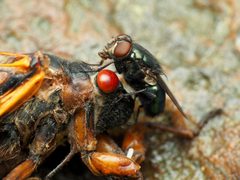
Phormia is a of blow flies in the Calliphoridae. The genus contains a single , Phormia regina, commonly known as the black blow fly. This species is native to North America and is among the most important insects in due to its predictable of carrion and well-documented developmental rates. are metallic blue or green in coloration and are distinguished by several morphological features including black gena, mostly white calypters, and orange-yellow thoracic surrounded by bright orange setae.


Pronunciation
How to pronounce Phormia: //ˈfɔːr.mi.ə//
These audio files are automatically generated. While they are not always 100% accurate, they are a good starting point.
Identification
Phormia is distinguished from similar blow fly by the following combination of characters: black gena (side of below level), mostly white calypters, and thoracic that appear orange-yellow due to surrounding bright orange setae. The wings possess a sharp bend. exhibit metallic blue or green coloration. The genus is , containing only Phormia regina, which separates it from multi- genera such as Lucilia, Calliphora, and Chrysomya.
Images
Habitat
Found on carrion, animal carcasses, and . Exhibits preference for rural areas near water sources over urban environments. In the northwestern United States, shows documented preference for human, mink, and swine feces. Seasonally migrates northward during spring and summer, retreating to southern regions in winter, with distribution limited by temperature thresholds for development.
Distribution
North America. Documented across the entirety of the United States and other regions of North America. Records from Vermont, Sweden, and Norway likely represent introductions or vagrant individuals rather than established .
Seasonality
Active primarily during spring and fall months in temperate regions; avoids extreme heat and cold. In the northern United States, predominantly present during spring and summer; in winter, contract to southern regions. Development ceases below 12.5°C and becomes lethal above 40°C.
Human Relevance
Phormia regina is critically important to . The is among the first to colonize human remains, often arriving within minutes of death. Its predictable developmental rates and temperature-dependent growth allow forensic entomologists to estimate postmortem intervals with high . Larvae are used in maggot debridement therapy to clean necrotic tissue from wounds. The species has also been used as a model organism in physiological and toxicological research.
Similar Taxa
- LuciliaBoth contain metallic blow flies with forensic importance; Lucilia typically exhibit green coloration and lack the black gena and white calypters diagnostic of Phormia
- CalliphoraSimilar size and metallic coloration; Calliphora generally have blue or bronze coloration and lack the distinctive orange thoracic setae of Phormia
- ChrysomyaOverlapping as carrion-breeding blow flies; Chrysomya are generally larger, exhibit different color patterns, and have different seasonal activity patterns
- ProtophormiaClosely related with similar ; separation requires examination of fine setal patterns and thoracic characteristics not visible without specimen collection
Sources and further reading
- BugGuide
- Wikipedia
- GBIF taxonomy match
- iNaturalist taxon
- NCBI Taxonomy
- Catalogue of Life
- Integrated Pest Management of Flies in Texas Dairies - AgriLife Extension Entomology
- How Blow Flies Compete (or Not) for Decomposition Duties
- Why Forensic Entomologists Say Crime-Scene Investigators Should Carry Cans of Tuna
- Bug Eric: What's on Dat Scat?
- Bug Eric: Strange Flies on a Fish Carcass
- They eat dead things, Part II - Blow flies, Calliphoridae — Bug of the Week
- Phormia (Phormia regina). Roles of recurrent nerve for feeding behavior adjustment of phormia.
- Effect of Thalidomide on the Growth and Reproduction of Phormia regina1
- The impact of relative humidity on Phormia regina (Diptera Calliphoridae) oviposition