
Chrysomyinae
Shannon, 1923
blow flies
Genus Guides
8- Chloroprocta
- Chrysomya(Old World blow fly)
- Cochliomyia(New World screwworm flies)
- Compsomyiops
- Phormia(black blow fly)
- Protocalliphora(bird blowflies)
- Protophormia(Northern blow flies)
- Trypocalliphora
Chrysomyinae is a of blow flies (Diptera: Calliphoridae) distinguished by a setose stem . The subfamily includes approximately 11 , with some groups to the Neotropical region and others exhibiting broader distributions. Members are primarily necrophagous and hold significant forensic importance as indicators for estimating time of and post-mortem intervals. The Neotropical lineage likely originated during the Middle Miocene, with subsequent to Nearctic and Paleotropical regions.
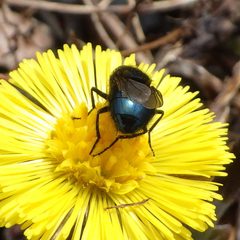
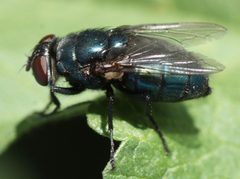
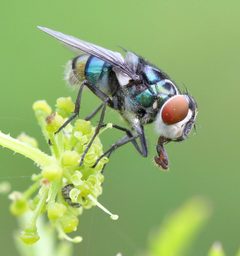
Pronunciation
How to pronounce Chrysomyinae: /ˌkrɪsəˈmaɪɪniː/
These audio files are automatically generated. While they are not always 100% accurate, they are a good starting point.
Identification
The setose stem is the primary diagnostic feature distinguishing Chrysomyinae from other Calliphoridae . This character is visible under magnification on the wing venation. within the subfamily can be distinguished by additional morphological characters: Chrysomya typically show metallic green or blue coloration with distinct thoracic stripes; Cochliomyia species often exhibit reduced bristling on the postalar wall; Protocalliphora species are associated with bird nests and show corresponding morphological adaptations.
Images
Appearance
possess the diagnostic setose stem on the wing—a row of bristles along the stem vein between the and subcosta. Body typically metallic blue, green, or bronze, though coloration varies among . Larvae are typical maggot-form with reduced capsules and .
Habitat
associations vary by and region. In northern Thailand, forensically significant were predominantly restricted to mixed deciduous forests, especially in mountainous areas, with no specimens collected in urban environments. Some genera occupy broader habitats including mixed orchards, paddy fields, and lowland villages. Neotropical lineages occupy diverse across the region.
Distribution
Widespread distribution with regional variation. Present in the Neotropical region (primary origin with including Chloroprocta, Cochliomyia, Compsomyiops, Hemilucilia, and Paralucilia), with to Nearctic and Paleotropical regions. Documented in northern Thailand (Chiang Mai province), Japan, and across North America. Predictive modeling indicates association with specific climatic zones, particularly mixed deciduous forest at moderate to high elevations.
Seasonality
Activity patterns vary by and climate. In northern Thailand, peak abundance occurred during summer (April–May), with reduced numbers in rainy season and winter for some species. Other species maintained activity throughout the year. Flying activity and trap attractiveness were reduced at lower temperatures (16.7–20°C); no specimens collected when temperature exceeded 40°C.
Diet
Necrophagous and saprophagous; feed on soft tissues of animal carcasses. Larvae develop in decomposing animal matter. Some (Protocalliphora, Trypocalliphora) are associated with bird nests and may exhibit more specialized feeding habits.
Life Cycle
Complete with , larval, pupal, and stages. Larvae develop in carrion or decomposing organic matter. Specific developmental rates vary by and temperature, with forensic applications based on predictable progression through instars.
Behavior
are attracted to carrion for oviposition, with baited traps using tainted meat effective for collection. Seasonal fluctuation patterns vary depending on fly . Activity influenced by climatic factors including temperature, relative humidity, and light intensity, with species-specific responses documented.
Ecological Role
Primary agents of carrion decomposition, accelerating nutrient cycling through consumption of soft tissues. Forensic indicators for estimating time of and post-mortem interval (PMI) in legal investigations. Potential of human and livestock through contact with carrion and animal wounds.
Human Relevance
Significant forensic importance: are routinely used as evidence in criminal investigations to estimate time of death based on larval development stage and sequence. Some species are pests of livestock (Cochliomyia hominivorax, the , historically caused major economic damage before programs). Used in maggot debridement therapy for wound cleaning in medical applications.
Similar Taxa
- LuciliinaeAnother of Calliphoridae; distinguished by absence of setose stem and typically different coloration patterns (often more uniformly metallic green).
- Calliphorinae of Calliphoridae; generally larger body size, different wing venation without setose stem , and often associated with different .
More Details
Taxonomic history
Authorship attributed to Shannon, 1923. The concept has been refined through morphological and molecular studies, with the setose stem remaining the consistent diagnostic character.
Forensic significance
Chrysomyinae are among the most important forensically relevant blow flies globally. Their predictable patterns and developmental rates make them reliable indicators for minimum post-mortem interval estimation. Geographic distribution studies using predictive modeling (ArcGIS) have been applied to aid forensic investigations in understudied regions.
Phylogenetic research
Recent molecular phylogenetic studies using concatenated data from COI, COII, Cytb, CAD, EF-1α, ITS2, 16S, and 28S markers support monophyly of the and its Neotropical lineage, with divergence dating indicating Middle Miocene origin for Neotropical diversification.
Sources and further reading
- BugGuide
- Wikipedia
- iNaturalist taxon
- NCBI Taxonomy
- Catalogue of Life
- Biogeography of Neotropical Chrysomyinae (Diptera, Oestroidea, Calliphoridae)
- Notes on distribution and morphology of Chrysomyinae in Japan
- Predicting Geographic Distribution of Forensically Significant Blow Flies of Subfamily Chrysomyinae (Diptera: Calliphoridae) in Northern Thailand