
Phormia regina
(Meigen, 1826)
Black Blow Fly, Black Blowfly
Phormia regina, commonly known as the black blow fly, is a forensically important necrophagous in the Calliphoridae. It is widely distributed across the Holarctic region and is considered one of the most important forensic in the United States for estimating postmortem intervals. The species exhibits temperature-dependent development with a biological minimum between 10.0–12.5°C. are attracted to decomposing tissue and carrion for oviposition. P. regina is primarily active during cooler seasons, earning it the designation of a "cold weather fly" that moves northward as temperatures increase.


Pronunciation
How to pronounce Phormia regina: /ˈfɔːr.mi.ə rɪˈdʒaɪ.nə/
These audio files are automatically generated. While they are not always 100% accurate, they are a good starting point.
Identification
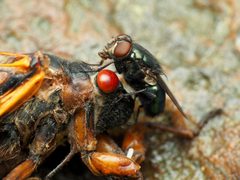
Distinguished from other blow flies by its dark metallic bronze-black to blue-black coloration without the green or blue metallic sheen of Lucilia or the gray with black stripes of Calliphora species. Larger than horn flies and stable flies. Differs from the secondary screwworm (Cochliomyia macellaria) in coloration and development rate—P. regina develops more slowly at 27°C. The black coloration separates it from "greenbottle" and "bluebottle" blow flies.
Images
Appearance
Robust fly with metallic bronze-black or deep blue-black body coloration. lack thoracic stripes characteristic of some related blow flies. The body has a metallic sheen ranging from green to blue to bronze-black. Size is comparable to or slightly larger than the house fly. Larvae (maggots) are cream-colored with spiracular slits used for morphological staging.
Habitat
Associated with decomposing animal tissue and carrion. Found in environments containing fresh carcasses, afterbirth, and decaying organic matter with high protein content. In agricultural settings, occurs in confined animal production facilities where carrion or decomposing tissue is present. practices that remove carcasses reduce suitable .
Distribution
Holarctic distribution. Very common throughout the United States except southern Florida. Considered a "cold weather fly" that shifts northward as temperatures increase, yet maintains large in the central U.S. during summer months. Field populations established from Lancaster County, Nebraska. Present in Japan, Norway, Sweden, Vermont, and Hawaii based on distribution records.
Seasonality
Primarily active during spring and fall, avoiding peak summer and winter extremes. Seasonal activity patterns result in limited overlap with summer-active such as Chrysomya rufifacies and Lucilia sericata, potentially reducing . Timing of oviposition is influenced by temperature and may shift based on maternal exposure to environmental conditions during larval development.
Diet
Necrophagous. Larvae feed on decomposing animal tissue and carrion. feed on protein sources including raw beef liver and decomposing tissue; also require from sources such as granulated sugar and water.
Life Cycle
Complete with seven stages: → first instar larva (L1) → second instar larva (L2) → third instar feeding larva (L3f) → third instar post-feeding/migratory larva (L3m) → pupa → . Development rate is profoundly temperature-dependent, with a biological minimum between 10.0–12.5°C. No egg occurs at 7.5°C; no maturation past L1 at 10.0°C. At 32.5°C, development proceeds without increased mortality. The post-feeding third instar enters a migratory stage before . models are applicable for the linear portion of the temperature-development curve.
Behavior
Females locate carrion using olfactory stimuli detected by on , , and ovipositor pegs. Oviposition is mediated by temperature and humidity conditions experienced during larval development; females exposed to low humidity as larvae shift -laying to evening hours. Lab-adapted show reduced behavioral sensitivity to humidity extremes compared to wild-caught individuals. Third instar migratory larvae may extend their bodies and crawl when disturbed rather than immediately pupating. Feeding is regulated by neural mechanisms including the recurrent nerve.
Ecological Role
Primary forensic for postmortem interval estimation in . Serves as a necrophagous decomposer of carrion, contributing to nutrient cycling. with other blow flies is mediated through temporal separation of oviposition; delayed oviposition relative to Lucilia sericata reduces direct competition. Vulnerable to by Chrysomya rufifacies larvae when ranges overlap.
Human Relevance
Critical tool in forensic investigations for estimating time of death through development modeling and pattern analysis. Collected larvae can be reared on canned tuna as a practical preservation method for evidence transport. In livestock operations, maggots may infest wounds if carcasses or afterbirth are not promptly removed. protocols for controlling blow flies in dairies and feedlots target this and related .
Similar Taxa
- Lucilia sericataGreen bottle fly with metallic green coloration versus bronze-black; develops faster and oviposits immediately on carrion, whereas P. regina delays oviposition; prefers warmer summer months with limited temporal overlap.
- Chrysomya rufifaciesHairy maggot blow fly with predatory larvae that kill and consume P. regina when sympatric; summer-active with limited current range overlap due to seasonal and geographic separation.
- Cochliomyia macellariaSecondary screwworm with similar carrion association but faster development rate at equivalent temperatures; differences in larval and coloration.
- Calliphora speciesBluebottle flies typically larger with gray and black stripes, blue metallic ; similar carrion-breeding habits but distinct coloration.
More Details
Forensic Rearing Protocol
Research demonstrates that canned tuna serves as an effective, cost-efficient alternative to beef liver for rearing collected larvae to adulthood for identification, facilitating evidence preservation in criminal investigations.
Neurophysiological Research Importance
P. regina has served as a model organism for studies on feeding neurophysiology, including the role of the recurrent nerve in behavioral regulation, contributing to broader understanding of dipteran sensory systems.
Climate Change Implications
As global temperatures rise, seasonal range overlap with predatory Chrysomya rufifacies may increase, potentially threatening P. regina through larval or requiring evolutionary in .
Sources and further reading
- BugGuide
- GBIF taxonomy match
- iNaturalist taxon
- NCBI Taxonomy
- Catalogue of Life
- Integrated Pest Management of Flies in Texas Dairies - AgriLife Extension Entomology
- Bohart Museum Features UC Davis Forensic Entomologist Bob Kimsey | Bug Squad
- Managing External Parasites of Texas Cattle - AgriLife Extension Entomology
- How Blow Flies Compete (or Not) for Decomposition Duties
- Why Forensic Entomologists Say Crime-Scene Investigators Should Carry Cans of Tuna
- Bug Eric: What's on Dat Scat?
- Phormia (Phormia regina). Roles of recurrent nerve for feeding behavior adjustment of phormia.
- Development Modeling of Phormia regina (Diptera: Calliphoridae)
- The impact of relative humidity on Phormia regina (Diptera Calliphoridae) oviposition
- Oviposition behavior ofPhormia regina(Diptera: Calliphoridae) is mediated by temperature and the presence of other species
- Olfactory Stimuli and Oviposition in the Blowfly, Phormia Regina Meigen