
Chrysomya
Robineau-Desvoidy, 1830
Old World blow fly
Species Guides
2- Chrysomya megacephala(oriental latrine fly)
- Chrysomya rufifacies(hairy maggot blow fly)
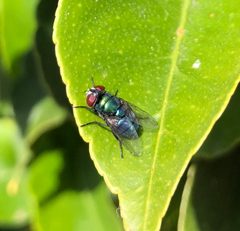
Chrysomya is a of blow flies in the Calliphoridae, native to the Old World. The genus is distinguished by metallic blue-green coloration, thick setae on the meron, and . Several have become forensically significant due to their predictable developmental rates and association with carrion, with some species recently expanding into North America.
Pronunciation
How to pronounce Chrysomya: /ˈkrɪsoʊmaɪə/
These audio files are automatically generated. While they are not always 100% accurate, they are a good starting point.
Identification
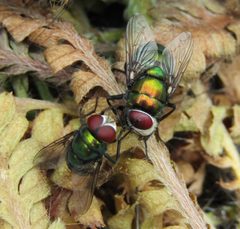
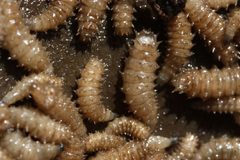
Distinguish from other Calliphoridae by the combination of metallic coloration, thick setae on the meron, and . Separate from Lucilia by meron setae arrangement and thoracic coloration. C. rufifacies is distinguished from C. megacephala by pale thoracic spiracle (versus dark) and three faint thoracic stripes; C. megacephala has a larger and prominent red . Larval identification relies on presence (C. rufifacies) versus spiracle hair thickness (C. megacephala).
Images
Habitat
Associated with carrion, decaying organic matter, and human dwellings. Larvae develop in decomposing animal remains, fish, , and discarded organic materials. Some occupy forests (normal form of C. megacephala), while others are and abundant in urban environments.
Distribution
Native to the Old World (Asia, Africa, Australia, Pacific Islands). C. rufifacies now established in southern United States (California, Arizona, Texas, Louisiana, Florida), Central America, and recently detected in Ontario, Canada. C. megacephala widespread in Asia, South Africa, South America, and established in southern United States.
Seasonality
Activity patterns vary by and climate. C. rufifacies is primarily active in summer months. C. megacephala prefers higher temperatures and peaks during afternoon heat periods. P. regina overlaps seasonally with Chrysomya species in spring and fall, though warming climates may extend seasonal overlap.
Diet
feed on decaying matter, excreta, and flowers. Larvae feed on carrion and decomposing organic material. C. rufifacies larvae are facultative of other dipteran larvae and may become cannibalistic when resources are scarce. C. albiceps feeds on diseased tissue.
Host Associations
- Carrion/decomposing vertebrate remains - breeding substrateprimary oviposition site for most
- Live mammals - oviposition siteC. bezziana lays exclusively on live mammals, causing myiasis
- Cattle - main for C. bezziana myiasis
- Humans - myiasis caused by several , particularly C. bezziana
- Other domestic animals - myiasis in various
Life Cycle
Holometabolous with four stages: , larva, pupa, . Eggs are approximately 1 mm, yellowish-white, laid in masses of 50–200 eggs (thousands in group oviposition). Eggs hatch in 8+ hours depending on temperature. Larvae progress through three instars, with post-feeding third instars dispersing to pupate in soil. lasts 7–12 days. Complete cycle: 190–598 hours depending on temperature. Adult lifespan approximately 6 weeks. C. rufifacies females oviposit approximately 5 days after mating.
Behavior
are attracted to carrion immediately upon death, with some colonizing within minutes to hours. Larvae exhibit post-feeding , moving away from carcasses to find sites; C. megacephala disperses farther and buries deeper than C. albiceps. C. albiceps and C. rufifacies larvae are aggressive , attacking other maggot species during dispersal. C. rufifacies third instars can expel other maggots from feeding sites using fleshy . C. albiceps maintains aggregated dispersal patterns regardless of photophase or species presence; C. megacephala shifts from aggregated to random distribution when C. albiceps is present.
Ecological Role
Primary colonizers of carrion, facilitating decomposition. Predatory (C. rufifacies, C. albiceps) regulate of other blow fly species through intraguild , potentially altering carrion insect composition and patterns. Mechanical of due to association with filth and human dwellings.
Human Relevance
Critical to for postmortem interval estimation due to predictable developmental rates and early of corpses. C. bezziana is a major cause of myiasis in livestock and humans in the Old World. C. megacephala serves as fish in India. Potential through mechanical transmission. C. rufifacies was historically used to treat osteomyeliasis through .
Similar Taxa
- LuciliaSimilar metallic coloration and carrion association; distinguished by meron setae and characteristics
- PhormiaOverlapping forensic significance and carrion ; Phormia regina has delayed oviposition compared to Chrysomya
- CochliomyiaSimilar blow fly and ; Chrysomya rufifacies significantly reduces Cochliomyia macellaria
Misconceptions
The 'hairy maggot blow fly' for C. rufifacies refers to fleshy , not true hairs. Not all Chrysomya conform to the 10–12 mm body size guideline. The is not exclusively Old World in distribution due to recent introductions to the Americas.
More Details
Forensic Significance
The is among the most important in due to reliable temperature-dependent development allowing accurate postmortem interval calculation. C. rufifacies predatory can complicate PMI estimates by eliminating earlier-arriving .
Global Spread
Multiple have expanded beyond native ranges through human commerce. C. rufifacies was first detected in the United States in 1980; C. megacephala has established throughout the southern United States. Climate warming predicted to expand ranges northward.
Species Diversity
The contains 12 described including C. albiceps, C. bezziana, C. chloropyga, C. fulvicruris, C. inclinata, C. marginalis, C. megacephala, C. obscura, C. pinguis, C. putoria, C. rufifacies, and C. villeneuvi.
Sources and further reading
- BugGuide
- Wikipedia
- GBIF taxonomy match
- iNaturalist taxon
- NCBI Taxonomy
- Catalogue of Life
- Chrysomya rufifacies Archives - Entomology Today
- How Blow Flies Compete (or Not) for Decomposition Duties
- Uncategorized | Blog - Part 21
- Dead body feeding larvae useful in forensic investigations | Blog
- Three Blow Fly Species - Entomology Today
- Dispersal and Predation Behavior in Larvae of Chrysomya albiceps and Chrysomya megacephala (Diptera: Calliphoridae)
- Chrysomya rufifacies: Developmental Analysis Over Range of Temperature
- Dispersal and Burial Behavior in Larvae of Chrysomya megacephala and Chrysomya albiceps (Diptera, Calliphoridae)
- Effect of carcass model on maggot distribution and thermal generation of two forensically important blowfly species, Chrysomya megacephala (Fabricius) and Chrysomya rufifacies (Macquart)
- The Blowfly Chrysomya megacephala as a Vector of Pathogens Associated with Infectious Diseases.