
Cochliomyia macellaria
(Fabricius, 1775)
secondary screwworm, secondary screwworm fly
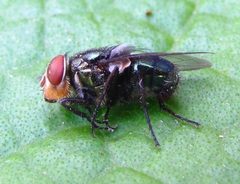
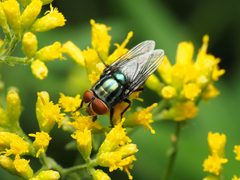
Cochliomyia macellaria, the secondary , is a blow fly in the Calliphoridae distributed throughout the Americas from southern Canada to Patagonia. The is a carrion colonizer whose larvae feed on necrotic tissue, distinguishing it from the primary screwworm (C. hominivorax) which attacks living tissue. exhibit metallic blue-green coloration with orange-red and . The species holds significant forensic importance for postmortem interval estimation and has medical-veterinary relevance as a cause of secondary myiasis in livestock and humans.
Pronunciation
How to pronounce Cochliomyia macellaria: //ˌkɒ.kli.ˈoʊ.mi.ə mæs.əˈlɛə.ri.ə//
These audio files are automatically generated. While they are not always 100% accurate, they are a good starting point.
Identification
Distinguished from the closely related primary Cochliomyia hominivorax by three key features: (1) pale setae on fronto-orbital plate versus black hairs in C. hominivorax; (2) central black thoracic stripe extends well in front of the mesonotal versus only slightly in front in C. hominivorax; (3) larvae lack pigmented tracheal trunks and possess V-shaped spines on the anal versus pigmented tracheal trunks in C. hominivorax. C. macellaria larvae also lack an oral present in C. hominivorax.
Images
Habitat
Associated with carrion and decomposing organic matter in terrestrial environments. In the Pantanal region of Brazil, most abundant in open pasture areas with sparse trees (35.57% of captures) compared to forested savanna (8.07%), likely due to better odor in open areas. Predominantly rural in distribution (97.96% of captures in one study) versus urban (1.37%) and forested (0.69%) areas. Found in slaughterhouses, outdoor markets in tropics, and areas with garbage accumulation.
Distribution
Americas from southern Canada through the United States, American tropics, and southern South America to Patagonia, excluding Chile and Argentina. Most common in southeastern United States (Florida, Louisiana, Georgia). Present in Caribbean Islands, Central America, and northern South America. Also recorded from Galápagos Islands and West Indies. GBIF records confirm presence across Brazil in multiple states including Amazonas, Pará, São Paulo, and Rio Grande do Sul.
Seasonality
Year-round activity in tropical and subtropical regions. In Southern Pantanal, Brazil, exhibits bimodal peaks: May–July (late autumn/early winter) and October–December (spring). Population increases during periods of extended rainfall. In southeastern United States, attracted to dead tissue within minutes of death in some regions, with 24-hour delay in other regions.
Diet
Larvae feed exclusively on necrotic (dead) tissue and decaying flesh of animal carcasses. males feed on vegetation and nectar from flowers. Adult females feed on tissue fluids from live wounds and necrotic tissue, requiring protein for development.
Host Associations
- cattle - livestock for myiasislarvae infest wounds and necrotic tissue; causes secondary cutaneous myiasis
- humans - accidental can cause myiasis in wounds
Life Cycle
Complete with four stages. : laid in groups of 40–250 on carrion or wounds; approximately 1 mm, white to pearl white; hatch in 4–24 hours depending on temperature and moisture. Larvae: three instars over 4–7 days; feed on necrotic tissue; third instar reaches 17 mm; fall from food source to pupate in soil. Pupae: formed in top layer of soil, leaves, or garbage; outer skin hardens and turns brown; duration 7 days to 2 months depending on temperature. : emerge after 1–2 days maturation; sexually mature within 4 days; lifespan 2–6 weeks; females may lay 1000+ eggs in lifetime.
Behavior
Females release that stimulate male copulatory attempts on contact. Males mate rapidly and remain near females during mating period, staying within a couple meters. Females travel long distances to find mates and oviposition sites. Females commonly oviposit in with other females, leading to thousands of on single carcasses. No parental care provided by either sex; females strategically oviposit in dead tissue to ensure larval nutrition. Exhibits oviposition preference for aged carcasses over fresh carrion, with higher oviposition after 8-hour exposure time. No preference shown between previously colonized or uncolonized carcasses.
Ecological Role
carrion decomposer facilitating nutrient recycling and removal of carcasses and organic wastes. Serves as prey for other organisms including competing calliphorid larvae (Chrysomya albiceps larvae have been observed attacking C. macellaria larvae). Acts as for of (human bot fly), contributing to economic losses in livestock. Important in for estimating postmortem intervals and determining time of .
Human Relevance
Forensic importance: most common blow fly on carrion in southern United States; used for postmortem interval estimation in criminal investigations. Medical-veterinary importance: causes secondary myiasis in livestock and humans; poses economic risks to cattle industry through wound and transmission (carries Salmonella and swine influenza virus). potential: larvae consume necrotic tissue and secrete antibacterial compounds, though less commonly used than Lucilia sericata. Management requires proper carcass disposal and wound treatment to prevent infestations.
Similar Taxa
- Cochliomyia hominivoraxPrimary ; distinguished by black fronto-orbital setae, limited extension of thoracic stripe, pigmented larval tracheal trunks, and presence of oral ; attacks living tissue versus necrotic tissue
- Chrysomya rufifaciesHairy maggot blow fly; introduced to Americas that competes with C. macellaria and may reduce its abundance in some regions
- Chrysomya albiceps calliphorid; larvae prey on C. macellaria larvae during ; interspecific competitor
- Lucilia sericataCommon green bottle fly; used in ; similar metallic coloration but different and larval
- Phormia reginaBlack blow fly; forensic indicator with slower development rate than C. macellaria at equivalent temperatures
Sources and further reading
- BugGuide
- Wikipedia
- GBIF taxonomy match
- iNaturalist taxon
- NCBI Taxonomy
- Catalogue of Life
- Bohart Museum Features UC Davis Forensic Entomologist Bob Kimsey | Bug Squad
- Managing External Parasites of Texas Cattle - AgriLife Extension Entomology
- Why Forensic Entomologists Say Crime-Scene Investigators Should Carry Cans of Tuna
- They eat dead things, Part II - Blow flies, Calliphoridae — Bug of the Week
- Carp diem: Fish and blow flies, Calliphoridae — Bug of the Week
- How Entomologists Design the Diet for Mass-Reared Screwworm Flies
- Secondary Screwworm,Cochliomyia macellaria (Fabricius) (Insecta: Diptera: Calliphoridae)
- Abundance and seasonality of Cochliomyia macellaria (Diptera: Calliphoridae) in Southern Pantanal, Brazil
- Influence of Substrate Age on Oviposition Behavior of a Specialist Carrion Colonizer, Cochliomyia macellaria (Diptera: Calliphoridae)
- Physical and Physiological Factors Influence Behavioral Responses of Cochliomyia macellaria (Diptera: Calliphoridae) to Synthetic Attractants
- Life History of Cochliomyia macellaria (Fabricius, 1775) (Diptera, Calliphoridae), a Blowfly of Medical and Forensic Importance