
Chrysomya rufifacies
(Macquart, 1844)
hairy maggot blow fly, hairy maggot blowfly
Chrysomya rufifacies is a blow fly native to Australasia and Southeast Asia that has become established across the Americas, Africa, and parts of Europe through human-mediated . It is one of the most forensically significant insects due to its highly predictable developmental timing and tendency to colonize human remains within minutes of death. The exhibits facultative on other carrion-feeding larvae, which can alter postmortem patterns and confound time-of-death estimates. are medium-sized with metallic blue-green coloration; larvae are distinguished by prominent fleshy that give the species its .
Pronunciation
How to pronounce Chrysomya rufifacies: /ˈkrɪ.soʊ.maɪə ˌruː.fɪˈfeɪ.siːz/
These audio files are automatically generated. While they are not always 100% accurate, they are a good starting point.
Identification
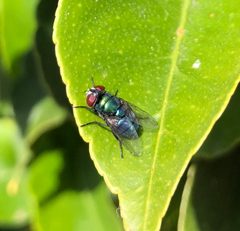
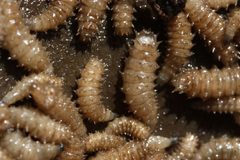
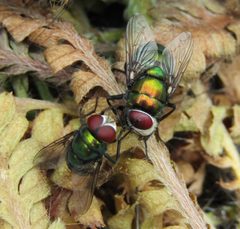
identified by combination of metallic blue-green coloration, pale thoracic , and three faint pronotal stripes. Microscopic examination required for definitive identification: examine meronal setae, greater ampulla setation, and abdominal tergite coloration. Differentiation from Chrysomya albiceps problematic due to morphological similarity; prostigmatic bristle presence/absence historically used but considered unreliable. Larvae unmistakable due to prominent fleshy absent in other calliphorids. Molecular identification via mtCOI barcode sequencing recommended where morphological characters ambiguous.
Images
Habitat
Strongly associated with carrion, particularly large vertebrate carcasses. Colonizes garbage, refuse, and decomposing organic matter in human-modified environments. In urban and rural settings, found near improper waste disposal sites and livestock facilities. Requires warm temperatures for optimal activity; avoids shaded, cool microhabitats.
Distribution
Native to Australia and Southeast Asia. Introduced and established in North America (first detected continental US 1982; now present in Southern California, Arizona, Texas, Louisiana, Florida, Tennessee, and predicted to expand throughout most of US), Central and South America (including Galápagos Islands and mainland Ecuador), Africa, and parts of southern Europe. Documented in Canada (Ontario) as seasonal migrant with predicted permanent establishment under climate warming. facilitated by air, sea, and road transport.
Seasonality
Active year-round in tropical and subtropical regions. In temperate zones, primarily active during warmer months; in southwestern Ontario, Canada, documented only in fall season, suggesting northward range expansion during spring-summer with subsequent retreat or local extinction. Seasonal activity patterns vary by latitude and may shift with climate change.
Diet
feed on nectar and other sugar sources. Larvae primarily necrophagous, consuming carrion tissue. Second- and third-instar larvae facultatively , feeding on other dipteran larvae when carrion resources limited; documented to kill and consume Phormia regina and other calliphorid in mixed . observed when alternative food sources absent.
Life Cycle
Holometabolous development: , three larval instars, , pupa, . Total development time 190–598 hours (approximately 6.5 days under optimal conditions) depending on temperature. Female lays average 210 eggs (maximum recorded 368) on fresh carrion, often during daylight. Eggs hatch in ~12 hours at 29°C. Larval development: first instar 12 hours, second instar 12 hours, third instar 24 hours, third instar post-feeding 12 hours; total 60 hours at 29°C. Prepupal stage 1.5 days, characterized by from food source; restriction of movement causes 24-hour delay. Pupal stage 3 days at 29°C. Adults emerge and mate 3–7 days after in summer, 9–10 days in autumn. Adult lifespan 23–30 days; oviposition begins ~5 days after mating. Accumulated degree-hours required: 4642.8 ADH for complete cycle.
Behavior
arrive at carrion within minutes to hours of death, among first colonizers of fresh remains. Larvae thermoregulate by positioning within maggot masses to maintain preferred developmental temperature of ~35.1°C. Facultative on other carrion-feeding larvae represents major behavioral shift under resource limitation; predatory larvae wrap around prey and secrete digestive to liquefy tissues for consumption. observed when no other food available. Larval during prepupal stage represents obligate shift for site selection.
Ecological Role
Primary carrion decomposer facilitating nutrient recycling. Facultative influences composition on carrion, potentially excluding native blow fly through competitive interference and intraguild predation. Documented to kill Phormia regina in experimental conditions; predicted to impact native Cochliomyia macellaria through competition. Predatory late instars may reduce populations of -transmitting and myiasis-producing flies, conferring potential benefit.
Human Relevance
: primary for postmortem interval estimation due to predictable developmental timing, minimal intraspecific variation, and rapid of human remains. Predictable pupal development (134–162 hours) and timing (237–289 hours) enable precise calculations. However, predatory can alter successional patterns and confound PMI estimates if unaccounted for. Medical: used in maggot debridement therapy for osteomyelitis; of including Bacillus bacteria, roundworms, and pinworms in India and Australia. Economic: causes cutaneous myiasis in sheep ('sheep strike') and cattle in Australia, Texas, and Arizona; reported from improperly cleaned newborn calves. Veterinary significance secondary to Lucilia cuprina and L. sericata. Expanding distribution reduces utility as geographic indicator in forensic cases involving postmortem body movement.
Similar Taxa
- Chrysomya albicepsTaxonomic status disputed; some authorities consider . Biological, ecological, distributional, and morphological similarities extensive. Larvae nearly indistinguishable; differ by unreliable prostigmatic bristle character.
- Chrysomya megacephalaSympatric in many regions; distinguished by dark brown/orange versus pale thoracic . Both early colonizers of carrion with similar forensic importance.
- Phormia reginaNative North American blow fly with which C. rufifacies competes; C. rufifacies exhibits predatory superiority in mixed cultures, potentially displacing P. regina with climate change.
- Lucilia sericataCo-occurs on carrion; exhibits temporal partitioning in oviposition that may reduce competition. C. rufifacies does not affect L. sericata, possibly due to larval clustering .
Sources and further reading
- BugGuide
- Wikipedia
- GBIF taxonomy match
- iNaturalist taxon
- NCBI Taxonomy
- Catalogue of Life
- Bohart Museum Features UC Davis Forensic Entomologist Bob Kimsey | Bug Squad
- How Blow Flies Compete (or Not) for Decomposition Duties
- Three Blow Fly Species - Entomology Today
- Uncategorized | Blog - Part 21
- Dead body feeding larvae useful in forensic investigations | Blog
- Chrysomya rufifacies: Developmental Analysis Over Range of Temperature
- Hairy Maggot Blow Fly, Chrysomya rufifacies (Macquart)
- THE HAIRY MAGGOT BLOW FLY CHRYSOMYA RUFIFACIES (MACQUART)1 CONFIRMED IN ARIZONA
- Effect of carcass model on maggot distribution and thermal generation of two forensically important blowfly species, Chrysomya megacephala (Fabricius) and Chrysomya rufifacies (Macquart)
- Chrysomya rufifacies (Macquart) (Diptera: Calliphoridae) Established in the Vicinity of Knoxville, Tennessee, USA
- Larval Competition ofChrysomya megacephalaandChrysomya rufifacies(Diptera: Calliphoridae): Behavior and Ecological Studies of Two Blow Fly Species of Forensic Significance
- An update of the blow flies (Diptera: Calliphoridae) of the Galápagos Islands, and first record of Chrysomya rufifacies (Macquart) from mainland Ecuador
- Life Cycle of Chrysomya rufifacies (Diptera: Calliphoridae) Under Semi-Controlled Laboratory Conditions
- New record ofChrysomya rufifacies(Diptera: Calliphoridae) in Canada: predicted range expansion and potential effects on native species
- Effects of Photoperiod on the Development of Forensically Important Blow Fly Chrysomya rufifacies (Diptera: Calliphoridae)
- Competition Among Three Forensically Important Blow Fly Species (Diptera: Calliphoridae):Phormia regina, Lucilia sericata, andChrysomya rufifacies
- A Comparative Analysis of the Responses of Lucilia cuprina (Wiedemann) and Chrysomya rufifacies (Macqart) (Calliphoridae) to Different Reflectance Levels of Green and Yellow Light Hues.