
Chrysomya megacephala
(Fabricius, 1794)
oriental latrine fly, oriental blue fly
Chrysomya megacephala is a warm-weather blowfly with metallic blue-green coloration, notable for its forensic importance in estimating post-mortem intervals due to its rapid of corpses. The exhibits two distinct forms: a normal forest-dwelling form restricted to South Pacific Islands, and a derived form that has spread globally from Papua New Guinea and is closely associated with human environments. It serves as a significant public health concern through its role in causing accidental myiasis and mechanically transmitting to human food.
Pronunciation
How to pronounce Chrysomya megacephala: //krɪˈsɒmi.ə ˌmɛɡəˈsɛfələ//
These audio files are automatically generated. While they are not always 100% accurate, they are a good starting point.
Identification
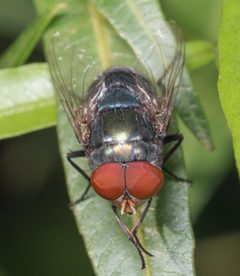
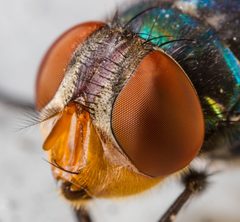
Distinguished from similar blowflies by the combination of metallic blue-green and with yellow cheeks (genae). Males can be separated from females by the closer spacing of the large red and the longer . Differentiated from Chrysomya rufifacies by larval —C. megacephala larvae show aggregated patterns while C. rufifacies exhibits predatory behavior on other maggots. The derived form can be identified by its association with human environments, contrasting with the forest-restricted normal form.
Images
Appearance
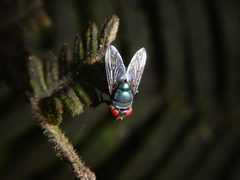
display a metallic blue-green coloration on the and with yellow genae (cheeks). The body has a box-like shape. Males possess large red that are close together, while females have eyes spaced farther apart. The male is longer than that of the female. are oval with one flat and one convex face. Larvae vary in size by instar and are thicker towards the rear.
Habitat
The normal form inhabits tropical forests on Pacific Islands such as Samoa. The derived form occupies human-associated environments including urban areas, fishing harbors, and locations with decaying organic matter. In the United States, it has been found in California, Texas, Louisiana, and Hawaii, typically entering through harbors and airports.
Distribution
Native to the Oriental and Australasian realms, including Japan and the Palearctic region. The derived form has expanded significantly since the 1970s into New Zealand, Africa, and the Americas (South, Central, and North). In India, it has been reported from Tamil Nadu. The continues to spread through human-mediated transport.
Seasonality
Activity correlates with warm temperatures; are higher in warm weather and lower in cold weather. In tropical populations, remains relatively constant throughout the year without pronounced seasonal variation in body size, unlike many other dipteran .
Diet
Larvae feed on necrophagous material including decaying fish, meat, and human . are attracted to high-protein olfactory stimuli, with strongest behavioral responses to 1-day-tainted pork viscera and beef liver.
Host Associations
- humans - causes accidental myiasis; for transmission to food derived form closely associated with human dwellings
- fish - larval development substrate; economic damage through of sun-dried fishmajor problem for fish preservation in Asia, Africa, and Pacific regions
- livestock - causes myiasisimplicated in cattle industry losses
Life Cycle
Development includes , three larval instars, pupa, and stages. Eggs hatch in approximately 18 hours at 27°C (11.9±0.14 hours at 30°C; 19.16±0.3 hours at 25°C). Larval development takes 5.4 days at 27°C (97.96±0.47 hours at 30°C; 131.3±1.54 hours at 25°C). lasts 5.3 days at 27°C (114.6±1.64 hours at 30°C; 126.25±1.88 hours at 25°C). Adults emerge after approximately 234 hours total at 27°C. Males typically emerge 2-3 hours before females. Adult lifespan is approximately 7 days in laboratory conditions, with females living longer than males. Higher temperatures accelerate development and increase , hatchability, pupation, and rates.
Behavior
Larvae exhibit aggregated patterns near the food source when alone, but shift to random distribution in the presence of competing such as Chrysomya albiceps. When facing larval competition or risk from C. rufifacies or C. albiceps, larvae tend to disperse early and pupate prematurely, resulting in smaller . Adults show optimal response to olfactory stimuli at wind speeds of 0.5 m/s. Parents remain present to rear offspring due to relatively long adult lifespan, contributing to success.
Ecological Role
Primary colonizer of carrion and decaying organic matter, facilitating decomposition. Serves as prey for predatory blowfly larvae including Chrysomya rufifacies and Chrysomya albiceps, as well as beetles. Acts as a for mangoes in Australian agricultural systems. Functions as a forensic for post-mortem interval estimation.
Human Relevance
Critical forensic tool for estimating time of death based on predictable timing and developmental rates on corpses. Can be used to detect poisoning in decomposed remains through larval tissue analysis. Causes economic losses in fish and livestock industries through myiasis and of preserved fish. Serves as a mechanical for including bacteria, protozoan cysts, and helminth . Deliberately cultivated by Taiwanese farmers for mango pollination. Subject to control efforts using attractant traps and , though resistance has developed.
Similar Taxa
- Chrysomya rufifaciesOverlapping distribution and forensic importance; distinguished by predatory larval —C. rufifacies second and third instar larvae feed on C. megacephala larvae when resources are limited, whereas C. megacephala is not . C. rufifacies also known as 'hairy maggot blow fly' for distinctive larval .
- Chrysomya albicepsCo-occurs on carrion; distinguished by predatory attacks on C. megacephala larvae during , causing altered dispersal patterns in the latter .
- Phormia reginaForensically important blowfly with different seasonal activity; P. regina is primarily spring and fall active, avoiding temperature extremes, while C. megacephala prefers warm conditions year-round in tropical regions.
- Lucilia sericataForensically important blowfly that lays immediately on carrion, avoiding competition with later-arriving , whereas C. megacephala colonizes rapidly but shows different competitive dynamics.
More Details
Forensic applications
The ' predictable developmental timing and tendency to be among the first flies on corpses makes it valuable for post-mortem interval calculation. Larval patterns—moving away from food sources to pupate—provide additional forensic clues. Mitochondrial analysis is used to distinguish it from co-occurring Chrysomya species when morphological identification is uncertain.
Forms and evolution
Two distinct forms are recognized: the normal (plesiomorphic) form restricted to tropical forests of Pacific Islands, and the derived form that has spread globally from Papua New Guinea and is ecologically associated with humans. A third derived form, morphologically intermediate, has been reported from Himalayan forests of India.
Competitive interactions
Larval competition with C. rufifacies leads to reduced feeding time, early , and smaller size in C. megacephala. When C. rufifacies is present, C. megacephala survival decreases due to , though C. rufifacies also experiences reduced survival under high- conditions. These interactions must be considered in cases to avoid inaccurate post-mortem interval estimates.
Sources and further reading
- BugGuide
- Wikipedia
- GBIF taxonomy match
- iNaturalist taxon
- NCBI Taxonomy
- Catalogue of Life
- Uncategorized | Blog - Part 21
- A “Really” Big-headed Tiger Beetle | Beetles In The Bush
- How Blow Flies Compete (or Not) for Decomposition Duties
- Big-headed Ants Are Biggest in Australia Due to Competition
- On the Biology of Chrysomya megacephala (Fabricius) (Diptera: Calliphoridae)
- Behavioral responses of Chrysomya megacephala to natural products
- Dispersal and Predation Behavior in Larvae of Chrysomya albiceps and Chrysomya megacephala (Diptera: Calliphoridae)
- Dispersal and Burial Behavior in Larvae of Chrysomya megacephala and Chrysomya albiceps (Diptera, Calliphoridae)
- "On the Biology of Chrysomya megacephala (Fabricius) (Diptera: Calliphoridae)"
- "On the Biology of Chrysomya megacephala (Fabricius) (Diptera: Calliphoridae)"
- Effect of carcass model on maggot distribution and thermal generation of two forensically important blowfly species, Chrysomya megacephala (Fabricius) and Chrysomya rufifacies (Macquart)
- The Blowfly Chrysomya megacephala as a Vector of Pathogens Associated with Infectious Diseases.