
Cochliomyia hominivorax
(Coquerel, 1858)
New World screwworm fly, New World screwworm, screwworm, screw-worm
Cochliomyia hominivorax, the New World fly, is an obligate parasitic blowfly whose larvae feed exclusively on living tissue of warm-blooded vertebrates. It is the only parasitic in its ; other Cochliomyia species are facultative or carrion feeders. The species was eradicated from the United States, Central America, and much of the Caribbean through the sterile insect technique beginning in the 1950s, though it persists in tropical and subtropical South America and portions of the Caribbean. A 2016 in the Florida Keys was successfully eliminated, but detections in southern Mexico in 2024–2025 triggered renewed efforts and trade restrictions.
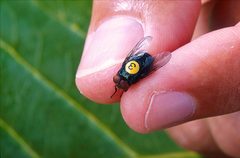
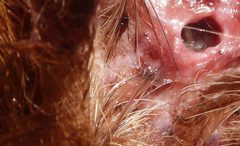
Pronunciation
How to pronounce Cochliomyia hominivorax: //ˌkɒk.li.oʊˈmaɪ.ə ˌhɒm.ɪˈnɪv.əˌræks//
These audio files are automatically generated. While they are not always 100% accurate, they are a good starting point.
Identification
resemble other metallic blowflies but are distinguished by thoracic striping pattern and association with living . Larvae are definitively identified by examining : C. hominivorax has a complete peritreme with a distinct button, and the spiracular slits are straight or slightly sinuous. This contrasts with Cochliomyia macellaria (secondary screwworm), which has an incomplete peritreme and more sinuous slits, and feeds on necrotic tissue rather than living flesh. Genetic identification via COI sequencing is standard for confirmation in programs.
Images
Habitat
Tropical and subtropical environments where warm-blooded vertebrate are present. Requires temperatures above 10°C for sustained activity; collapse in winter in marginal areas. Associated with agricultural landscapes, rangelands, and natural areas supporting mammal populations. Cannot persist without access to living hosts, as larvae are obligate .
Distribution
Currently to tropical and subtropical South America, including Brazil, Uruguay, Paraguay, Bolivia, Peru, Colombia, Venezuela, and the Guianas; also present in parts of the Caribbean including Cuba, Jamaica, Hispaniola, and Trinidad. Eradicated from the United States (1966, with isolated 2016 Florida ), Mexico (previously, though re-detected 2024–2025), Central America to the Panama Canal zone, and most Caribbean islands. A permanent sterile fly barrier is maintained in eastern Panama to prevent northward spread.
Seasonality
Year-round activity in tropical core range with continuous breeding. In subtropical marginal areas, activity peaks during warm months; decline or disappear in winter. In southern Argentina, cease during winter and early spring. time is approximately 20 days under favorable conditions.
Diet
Larvae feed exclusively on living and subdermal tissues of warm-blooded vertebrates. Cannot develop in carrion or on cold-blooded animals. feed on nectar, honeydew, and other sugar sources; do not feed on blood or protein.
Host Associations
- Bos taurus - larval major economic ; cattle industry losses historically severe
- Ovis aries - larval sheep and goats susceptible
- Sus scrofa - larval domestic and swine
- Equus caballus - larval horses and other equids
- Canis lupus familiaris - larval domestic dogs
- Felis catus - larval domestic cats
- Odocoileus virginianus - larval white-tailed deer; 80% fawn mortality reported in Texas historically
- Pteronura brasiliensis - larval giant otter; first documented case 2022, Pantanal, Brazil
- Panthera onca - larval jaguar; documented in endangered
- Homo sapiens - larval human myiasis documented but less frequent than livestock
Life Cycle
Females deposit 250–500 in exposed wounds or body orifices of warm-blooded ; can lay up to 3,000 eggs in lifetime. Eggs hatch in 12–24 hours. Larvae burrow into living tissue, feeding and growing through three instars over 3–7 days. Third instar larvae exit wound and drop to ground to pupate in soil. Pupal stage lasts approximately 7 days. emerge, mate on vegetation, and females seek hosts within 4–5 days. Total time approximately 20 days at optimal temperatures. Females mate once and store sperm for life; males mate up to 10 times.
Behavior
Females are attracted to wounds by olfactory cues including ammonia and carbon dioxide. They exhibit strong capacity, dispersing 80–160 km per ; individual females can fly up to 200 km in lifetime. Males are relatively sedentary, hiding in vegetation until detecting females via visual and chemical cues. Larvae exhibit negative geotaxis, burrowing deeper into tissue when disturbed— that gives the its . Obligate means larvae cannot survive in necrotic tissue or carrion, distinguishing this species from facultative .
Ecological Role
are driven entirely by availability; no significant role as decomposer or in nutrient cycling due to inability to use carrion. In areas, acts as control on wild mammals, particularly and individuals with wounds. Absence of natural enemies effective at ; fire ants and other may take some pupae but do not regulate populations. programs have eliminated the from most of its former range, demonstrating that function is not dependent on this .
Human Relevance
One of the most economically significant livestock pests in history. Prior to , cost U.S. cattle industry hundreds of millions of dollars annually; current prevention saves estimated $1.3 billion yearly. Eradication via sterile insect technique (SIT) pioneered on this , now applied globally to , fruit flies, and mosquitoes. Trade restrictions and animal inspections are required to prevent reintroduction. Human myiasis occurs but is rare; cases require surgical removal of larvae and wound treatment. 2016 Florida Keys threatened endangered Key deer; 2024–2025 Mexico detections triggered emergency USDA response and livestock import bans.
Similar Taxa
- Cochliomyia macellariaSecondary screwworm; larvae feed on necrotic tissue and carrion, not living flesh. Distinguished by larval (incomplete peritreme) and facultative rather than obligate . Often found in wounds already infested with C. hominivorax.
- Chrysomya bezzianaOld World ; convergent ecological role but different , geographically separated. Occurs in Africa, Asia, and Papua New Guinea. Morphologically similar but not present in the Americas.
- Lucilia sericataCommon green bottle fly; metallic green blowfly that may cause facultative myiasis in wounds but primarily breeds on carrion. Larvae do not attack healthy tissue.
More Details
Etymology
name from Greek kochlias (snail with spiral shell) + myia (fly); epithet from Latin hominis (man) + vorax (consuming), reflecting human potential. Formerly placed in genus Callitroga (Greek kallos, beautiful + trogein, to gnaw) as C. americana.
Sterile Insect Technique
First on which SIT was developed and deployed. Mass-reared males are sterilized by ionizing radiation and released to mate with wild females, producing no offspring. COPEG facility in Panama produces ~20 million sterile flies weekly for barrier maintenance and response. Technique requires females to mate only once, which C. hominivorax does naturally.
Mass Rearing Diet
Larvae in production facilities are reared on formulated diets containing dried bovine blood components. Current COPEG uses 8:2 hemoglobin-to-plasma ratio, replacing earlier whole blood preparations that became unavailable commercially.
Sources and further reading
- BugGuide
- Wikipedia
- GBIF taxonomy match
- iNaturalist taxon
- NCBI Taxonomy
- Catalogue of Life
- Managing External Parasites of Texas Cattle - AgriLife Extension Entomology
- Bohart Museum Features UC Davis Forensic Entomologist Bob Kimsey | Bug Squad
- How Entomologists Design the Diet for Mass-Reared Screwworm Flies
- Fighting Flies With Flies: 2016's Florida Screwworm Outbreak Response
- How Sex and Scientific Research Saved Your Steak Dinner (and Bambi) From the Screwworm Fly—Again
- Edward Knipling and Raymond Bushland Win Award for the Sterile Insect Technique
- Microhimenopteros parasitoides de Cochliomyia hominivorax Coq. (Diptera: Calliphoridae)
- First report of myiasis caused by Cochliomyia hominivorax in free-ranging giant otter (Pteronura brasiliensis)
- Thermal Ecology of the Screwworm Larva, Cochliomyia hominivorax (Coquerel) (Diptera: Calliphoridae)
- Management Practices for the Control of Haematobia irritans, Dermatobia hominis, and Cochliomyia hominivorax in Cattle Across Latin America: A Sustainable, Collective Approach.
- Nasal Rhinomyiasis Caused by Cochliomyia hominivorax Complicated by a Parapharyngeal Abscess: A Case Report.