
Cochliomyia
Townsend, 1915
New World screwworm flies, screwworm flies
Species Guides
2- Cochliomyia hominivorax(New World screwworm fly)
- Cochliomyia macellaria(secondary screwworm)
Cochliomyia is a of blowflies ( Calliphoridae) comprising four : C. macellaria, C. hominivorax, C. aldrichi, and C. minima. The genus is commonly known as New World flies, distinguished from Old World screwworms. C. hominivorax, the primary screwworm, is an obligate whose larvae feed on living tissue, causing severe myiasis in livestock, wildlife, and humans. C. macellaria, the secondary screwworm, feeds only on necrotic tissue and carrion. The primary screwworm has been eradicated from North America through the sterile insect technique, though it persists in parts of Central and South America.
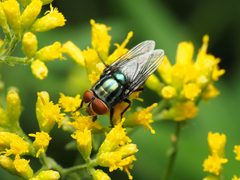
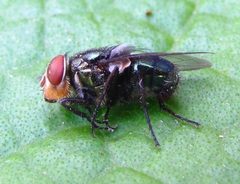
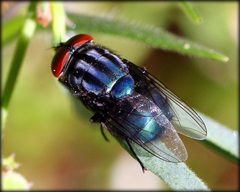
Pronunciation
How to pronounce Cochliomyia: //ˌkoʊ.kli.oʊˈmaɪ.jə//
These audio files are automatically generated. While they are not always 100% accurate, they are a good starting point.
Images
Habitat
Tropical and subtropical environments with warm, humid conditions. thrive in areas supporting livestock and wildlife that provide wound sites for oviposition. C. macellaria is associated with carrion, garbage, and decomposing organic matter.
Distribution
Native to the Americas. C. macellaria occurs throughout northern South America, Central America, Caribbean Islands, the United States, and southern Canada. C. hominivorax has been eradicated from the United States, Mexico, and much of Central America through sterile insect technique programs, but persists in in parts of Central and South America. A permanent sterile fly barrier is maintained in eastern Panama to prevent northward reinfestation.
Human Relevance
C. hominivorax is a major veterinary and medical pest causing primary myiasis in livestock, wildlife, and humans. The was eradicated from North America through a sustained sterile insect technique program, saving an estimated $1.3 billion annually in livestock damage. The 2016 Florida Keys demonstrated ongoing reinvasion risk. C. macellaria has forensic importance for postmortem interval estimation and was historically used in surgical for debridement of necrotic wounds.
Misconceptions
The term '' is often applied indiscriminately to both C. hominivorax and C. macellaria, leading to confusion. C. macellaria, the secondary screwworm, is frequently blamed for damage actually caused by C. hominivorax. Unlike the primary screwworm, C. macellaria cannot initiate myiasis in healthy tissue and poses minimal risk to living animals. The negative connotation of 'screwworm' has impeded recognition of C. macellaria's beneficial role in carrion decomposition and its historical medical applications.
Sources and further reading
- BugGuide
- Wikipedia
- GBIF taxonomy match
- iNaturalist taxon
- NCBI Taxonomy
- Catalogue of Life
- Bohart Museum Features UC Davis Forensic Entomologist Bob Kimsey | Bug Squad
- Managing External Parasites of Texas Cattle - AgriLife Extension Entomology
- How Entomologists Design the Diet for Mass-Reared Screwworm Flies
- Fighting Flies With Flies: 2016's Florida Screwworm Outbreak Response
- Edward Knipling and Raymond Bushland Win Award for the Sterile Insect Technique
- How Sex and Scientific Research Saved Your Steak Dinner (and Bambi) From the Screwworm Fly—Again
- Microhimenopteros parasitoides de Cochliomyia hominivorax Coq. (Diptera: Calliphoridae)
- Secondary Screwworm,Cochliomyia macellaria (Fabricius) (Insecta: Diptera: Calliphoridae)
- First report of myiasis caused by Cochliomyia hominivorax in free-ranging giant otter (Pteronura brasiliensis)
- Management Practices for the Control of Haematobia irritans, Dermatobia hominis, and Cochliomyia hominivorax in Cattle Across Latin America: A Sustainable, Collective Approach.