
Protophormia terraenovae
(Robineau-Desvoidy, 1830)
northern blowfly, blue-bottle fly, blue-assed fly, blackbottle
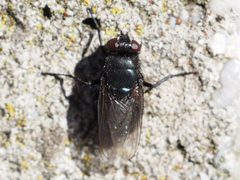
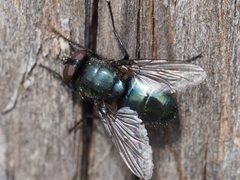
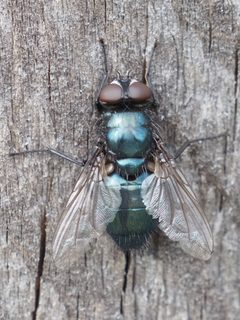
Protophormia terraenovae is a large, metallic blue-green blowfly with a Holarctic distribution. It is the most cold-tolerant calliphorid , occurring from the Arctic to temperate regions. The species is economically significant as a cause of myiasis in livestock and valuable in maggot debridement therapy due to its selective consumption of necrotic tissue and secretions. Its temperature-dependent development makes it a key forensic indicator for post-mortem interval estimation.
Pronunciation
How to pronounce Protophormia terraenovae: /ˌproʊtoʊˈfɔːr.mi.ə ˌtɛr.i.nəˈveɪ/
These audio files are automatically generated. While they are not always 100% accurate, they are a good starting point.
Identification
Distinguished from Protophormia atriceps by flat (vs. protruding), , and up to 2 additional pairs of setae along scutellar margin. Third instar larvae distinguished from Phormia regina by spines on segment 10 margin. identified by combination of black basicosta, brown wing , dark calypters with black setae, and metallic blue-green / with black /legs. Sex determination by width ratio and presence/absence of fronto-orbital lateroclinate setae.
Images
Habitat
Cool regions throughout the Northern Hemisphere; found in Arctic tundra, temperate zones, and subarctic environments. Associated with carrion, decaying organic matter, and animal wounds. Maintains in slaughterhouses and poultry houses where refuse and carcasses are present.
Distribution
Holarctic distribution throughout the Northern Hemisphere. Recorded from Arctic regions (within 550 miles of North Pole), North America (Mexico to Canada), Europe, and Asia. Rare in warm regions such as Texas and Florida, where appearance confined primarily to winter months. Spring or summer at high latitudes and elevations. GBIF records include Belgium, Denmark, and Falkland Islands.
Seasonality
Active primarily in spring and summer at high latitudes and elevations. In warm temperate regions, appears mainly during winter months. Year-round activity possible in appropriate temperature conditions; development rate inversely related to temperature with minimum threshold of 8.95°C for stages.
Diet
Necrophagous. Larvae feed on necrotic tissues of dead vertebrates. First instar larvae obtain liquid diet from orifices or wounds; subsequent instars digest body tissues directly. do not feed on carrion; larval diet exclusively necrotic tissue with selective consumption that preserves healthy tissue.
Life Cycle
Holometabolous development with three larval instars, pupal stage, and . First instar up to 2.63 mm; third instar up to 11.87 mm with pointed on terminal segment and spines on segment 10. At 25°C: to first instar ~1.83 days; first to second instar ~2.92 days; second to third instar ~6.17 days; third instar to post-feeding ~8.0 days; wandering to ~9.67 days; pupal stage ~15.83 days. Total development from oviposition to adult ranges from 9.19 days at 35°C to 37.78 days at 15°C. Pupation occurs on or within 0.5 meters of decaying body; pupal stage occupies 43% of total cycle.
Behavior
Larvae exhibit predatory when competing for necrotic tissue and documented . Post-feeding third instar larvae enter wandering stage, seeking dry, safe sites away from carcass. exhibit regulated by PER-immunoreactive ; photoperiodic response controls reproductive . Reproductive diapause mediated by secretory neurons in pars intercerebralis.
Ecological Role
Primary colonizer of carrion, forming first wave of fauna on corpses. Facultative causing secondary myiasis in livestock wounds. Predatory larval influences composition on carrion through competition and intraguild .
Human Relevance
Economic pest causing facultative cutaneous myiasis (wound strike) in cattle, sheep, reindeer, horses, goats, and pigs in northern Holarctic region; causes distress, wool loss, and potential death from toxemia and sepsis. Used in maggot debridement therapy for chronic wounds due to selective necrotic tissue consumption and secretions effective against Streptococcus pyogenes and Streptococcus pneumoniae; requires sterile rearing to prevent sepsis. Forensically critical for minimum post-mortem interval estimation based on temperature-dependent development and predictable timing.
Similar Taxa
- Protophormia atriceps sharing dark metallic blue-green-black coloration; distinguished by protruding (vs. flat), non- , and fewer scutellar marginal setae
- Phormia reginaSimilar calliphorid with overlapping carrion ; third instar larvae distinguished by absence of spines on segment 10 margin
- Lucilia sericataAnother calliphorid used in maggot debridement therapy and ; differs in bronze-green coloration and morphological details
Sources and further reading
- BugGuide
- Wikipedia
- GBIF taxonomy match
- iNaturalist taxon
- NCBI Taxonomy
- Catalogue of Life
- Bug Eric: Strange Flies on a Fish Carcass
- Photoperiodic control of reproduction in the blow fly, Protophormia terraenovae
- Roles of PER immunoreactive neurons in circadian rhythms and photoperiodism in the blow fly, Protophormia terraenovae
- Effects of ablation of the pars intercerebralis on ecdysteroid quantities and yolk protein expression in the blowfly Protophormia terraenovae
- Temperature-dependent developmental modeling of protophormia terraenovae (Diptera: Calliphoridae) and its application in PMI inference.