
Omus
Eschscholtz, 1829
Night-stalking Tiger Beetles
Species Guides
7- Omus audouini(Audouin's Night-stalking Tiger Beetle)
- Omus californicus(California night-stalking tiger beetle)
- Omus cazieri(Mount Ashland Night-stalking Tiger Beetle)
- Omus dejeanii(Greater Night-stalking Tiger Beetle)
- Omus laevis(Night-stalking Tiger Beetle)
- Omus sequoiarum
- Omus submetallicus(Lustrous Night-stalking Tiger Beetle)
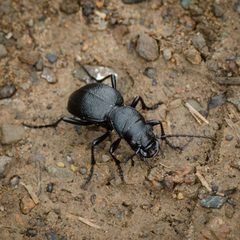
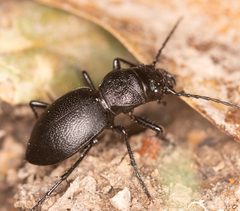
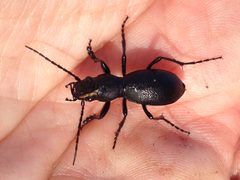
Omus is a of flightless, tiger beetles ( Cicindelinae) to the west coast of North America. Members are uniformly dark-colored and characterized by reduced or absent hind wings, restricting them to ground-dwelling locomotion. The genus comprises at least five recognized , including O. audouini, O. californicus, O. cazieri, O. dejeanii, and O. submetallicus. These beetles occupy diverse from forest floors to upper salt marshes, with some species showing strong associations with specific plant .
Pronunciation
How to pronounce Omus: /ˈoː.mʊs/
These audio files are automatically generated. While they are not always 100% accurate, they are a good starting point.
Identification
Omus are distinguished from other tiger by their flightless condition, uniformly dark coloration, and activity pattern. lack functional hind wings. Larvae possess three pairs of hooks on the 5th abdominal segment (outer, middle, and inner hooks), whereas all other North American tiger beetle genera have lost the outer pair and retain only two pairs. Larval burrows are smaller than those of Amblycheila and lack the distinctive engineering modifications seen in some Cicindela species.
Images
Habitat
Forest floor , upper salt marshes, and coastal areas along the west coast of North America. Omus audouini shows strong association with upper salt marsh plant dominated by Douglas aster (Symphyotrichum subspicatum) approximately 15 m from flood-protection dikes. Other occupy forested areas and rain shadow zones on west slopes of the Sierra Nevada, Cascades, and Coast Ranges.
Distribution
Restricted to the west coast of North America, from southwestern British Columbia, Canada, south through Washington, Oregon, and California. occur on the west slopes of the Sierra Nevada and Cascade ranges, the Coast Ranges, and coastal plain .
Seasonality
active primarily from May through September, with peak activity varying by and locality. Some may be encountered as early as April at lower elevations. Larvae present year-round in burrows.
Life Cycle
Larvae construct burrows in soil and are known to plug burrow entrances for extended periods. Development from 2nd instar to has been documented to require nearly four years in related tiger beetles, suggesting potentially prolonged larval development in Omus. occurs within the burrow.
Behavior
Strictly , actively foraging at night. are capable of rapid running but cannot fly. Mating involves male-superior mounted amplexus with exceptionally prolonged copulation durations: 10.6±1.8 hours in O. audouini and 29.4±5.6 hours in O. dejeanii. Syn-copulatory courtship has been proposed as a female-choice reproductive mechanism. partitioning through morphological character displacement occurs between sympatric .
Ecological Role
Conspicuous within terrestrial , occupying predatory roles in forest floor and salt marsh .
Human Relevance
Subject to conservation concern in Canada; Omus audouini is listed as a at risk with limited distribution in southwestern British Columbia. mapping using indicator plant species (Douglas aster) has been developed to locate unknown and assess potential habitat.
Similar Taxa
- AmblycheilaBoth are flightless, , and have large body size, but Amblycheila larvae have only two pairs of abdominal hooks with distinctly separated middle and inner hooks, and are significantly larger with reddish elytral coloration
- CicindelaSympatric tiger beetles that are primarily , possess functional wings for , and have larvae with only two pairs of abdominal hooks; larval burrows often show distinctive engineering modifications absent in Omus
- Tetracha tiger beetles with similar activity period, but possess functional wings and larvae have two pairs of abdominal hooks with middle and inner hooks touching at the base rather than separated
Sources and further reading
- BugGuide
- Wikipedia
- GBIF taxonomy match
- iNaturalist taxon
- NCBI Taxonomy
- Catalogue of Life
- A rare opportunity to do fall insect collecting in western North America | Beetles In The Bush
- Amblycheila cylindriformis on white | Beetles In The Bush
- Diversity in Tiger Beetle Larval Burrows | Beetles In The Bush
- How to collect larvae of Amblycheila cylindriformis | Beetles In The Bush
- The Coleopterists Bulletin | Beetles In The Bush
- Distribution and Conservation Status ofOmus submetallicusG. Horn and Its Confusion withOmus californicus leconteiG. Horn (Coleoptera: Carabidae)
- Ecomorphology and Mating Behavior of Two Species of Night-stalking Tiger Beetles, Omus audouini and O. dejeanii
- Plant communities associated with a species at risk: Omus audouini (Coleoptera: Cicindelidae) in upper salt marsh habitat at Boundary Bay, British Columbia