
Notonecta irrorata
Uhler, 1879
backswimmer
Notonecta irrorata is a North American backswimmer first described in 1879. It is a predatory aquatic insect known for its distinctive upside-down swimming posture. Research has demonstrated that its presence in ponds repels oviposition by Culex mosquitoes, and that its patterns show a hump-shaped relationship with isolation.
Pronunciation
How to pronounce Notonecta irrorata: //ˌnoʊtəˈnɛktə ɪˈroʊrətə//
These audio files are automatically generated. While they are not always 100% accurate, they are a good starting point.
Identification
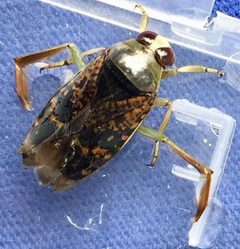
Notonecta irrorata has the triangular, boat-shaped body typical of the Notonecta, with a keel-like surface adapted for rapid upside-down swimming. The can be distinguished from water boatmen ( Corixidae) by its triangular cross-section versus the flattened body of Corixidae, and by its shorter unmodified front legs versus the spoon-shaped tarsal segments of water boatmen used for scooping food.
Images
Habitat
Freshwater aquatic environments including ponds and slow-moving streams; occupies open water rather than bottom substrates. Has been observed in artificial water environments including fountains and swimming pools.
Distribution
Native to North America; documented in the eastern Nearctic region including Mississippi and Missouri, USA, and Vermont.
Diet
; feeds on mosquito larvae and other small aquatic insects.
Behavior
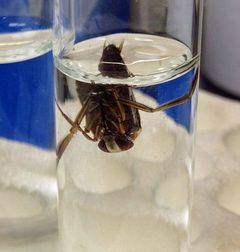
Swims upside-down using long, oar-like hind legs modified for rowing. are capable of and can disperse between water bodies. Exhibits activity patterns and is rarely attracted to lights at night. Surfaces to take in air using hydrophobic hairs around the rear end and along the middle of the underside of the , which trap air for underwater respiration.
Ecological Role
in aquatic that affects mosquito through both consumptive effects on larvae and non-consumptive effects on mosquito oviposition .
Human Relevance
Similar Taxa
- Corixidae (water boatmen)Superficially similar oval body shape and aquatic , but water boatmen have flattened bodies (versus triangular), spoon-shaped front legs for feeding (versus unmodified), and are primarily that cruise the bottom (versus predatory backswimmers in open water).
- Notonecta glauca (European backswimmer)Congeneric with similar and ; N. irrorata is distinguished by its North American distribution.
Sources and further reading
- BugGuide
- Wikipedia
- GBIF taxonomy match
- iNaturalist taxon
- NCBI Taxonomy
- Oedemeridae | Beetles In The Bush
- Buprestidae type specimens at Fundación Miguel Lillo, Argentina | Beetles In The Bush
- Bug Eric: Backswimmer or Water Boatman?
- A hump‐shaped relationship between isolation and abundance ofNotonecta irroratacolonists in aquatic mesocosms
- Geographic variation in Culex oviposition habitat selection responses to a predator, Notonecta irrorata