
Buenoa
Kirkaldy, 1904
backswimmer
Species Guides
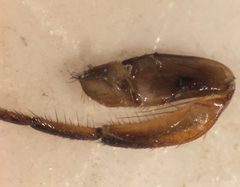
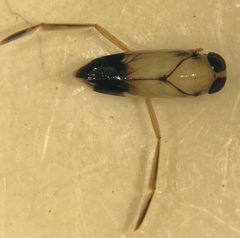
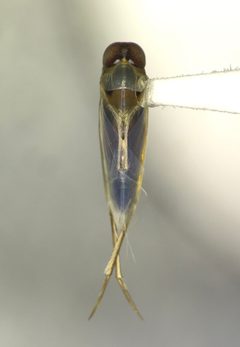
7Buenoa is a of backswimmers ( Notonectidae) established by George Willis Kirkaldy in 1904 to accommodate Western Hemisphere formerly placed in Anisops. The genus is distinguished from Anisops by males having a two-segmented front , versus one-segmented in the latter genus. Buenoa contains 69 described species distributed across the Americas. Members are aquatic inhabiting diverse freshwater and saltwater environments.
Pronunciation
How to pronounce Buenoa: //ˈbwɛ.no.a//
These audio files are automatically generated. While they are not always 100% accurate, they are a good starting point.
Identification
Males possess a two-segmented front , the diagnostic character separating Buenoa from the Eastern Hemisphere Anisops, which has a one-segmented front tarsus in males. As backswimmers, members swim side up using modified hind legs as oars.
Images
Habitat
Aquatic environments including freshwater lakes and saltwater lakes with conductivities ranging from 1–621 S/m. Documented from shrimp farming impoundments in coastal Colombia and diverse lentic waters across the Americas.
Distribution
Western Hemisphere. Recorded from Colombia (Tumaco municipality, Nariño; Valle del Cauca), with distribution extending across the Americas. Specific new distribution records documented in recent taxonomic revisions.
Diet
Predatory. Buenoa fuscipennis preys on mosquito stages and alternative prey. Buenoa scimitra and Buenoa tarsalis are documented of Aedes aegypti larvae.
Host Associations
- Hydrachna virella - Water mite that parasitizes instars 2–5 and of Buenoa scimitra, attaching primarily to and ; reattaching mites after found primarily on dorsum of thorax. reduces host survival and .
Life Cycle
Five instars precede the stage in Buenoa scimitra. Parasitized immature individuals exhibit extended intermolt periods compared to unparasitized individuals.
Behavior
Swims side up, characteristic of Notonectidae. documented in Buenoa scimitra. on mosquito larvae influenced by complexity.
Ecological Role
Human Relevance
Investigated as agent for mosquito . Buenoa tarsalis maintains capability on Aedes aegypti larvae after exposure to diflubenzuron, suggesting compatibility with certain treatments.
Similar Taxa
- AnisopsEastern Hemisphere distinguished from Buenoa by males having one-segmented versus two-segmented front ; historically contained Western Hemisphere now placed in Buenoa
- MartaregaAnother New World notonectid ; distinguished by morphological characters and distribution patterns, with first U.S. record documented separately from Buenoa distribution records
More Details
Taxonomic history
Established in 1904 by George Willis Kirkaldy to resolve the geographic split in Anisops, which was found to comprise two distinct groups based on male tarsal segmentation.
Sources and further reading
- BugGuide
- Wikipedia
- GBIF taxonomy match
- iNaturalist taxon
- NCBI Taxonomy
- Catalogue of Life
- SPATIAL DISTRIBUTION OF THE SPECIES OF THE GENUS BUENOA (HEMIPTERA: NOTONECTIDAE) IN TUMACO (NARIÑO, COLOMBIA)
- New distribution data for Martarega, Buenoa and Abedus, including the first record of the genus Martarega in the United States (Hemiptera: Notonectidae, Belostomatidae)
- Frequency Distributions of the Parasitic Water Mite Hydrachna virella (Acariformes: Hydrachnidae) on the Host Buenoa scimitra (Hemiptera: Notonectidae)
- Parasite-mediated reductions in the survival and reproduction of the backswimmer Buenoa scimitra (Hemiptera: Notonectidae)
- Notes on Behavior and Colonization of Buenoa scimitra (Hemiptera: Notonectidae), a Predator of Mosquito Larvae 1
- Parasitism of the backswimmer Buenoa scimitra (Hemiptera: Notonectidae) by the water mite Hydrachna virella (Acari: Hydrachnellae)
- Effect of habitat complexity on the predation ofBuenoa fuscipennis(Heteroptera: Notonectidae) on mosquito immature stages and alternative prey
- Diflubenzuron Did Not Affect the Abilities of the Backswimmer Buenoa tarsalis to Survive and Prey Upon Larvae of Aedes aegypti.