
Aedes aegypti
(Linnaeus, 1762)
yellow fever mosquito, dengue mosquito, Egyptian mosquito
Aedes aegypti is a small, dark mosquito and the primary global of fever, , Zika virus, and . Native to Africa, it has become established in tropical, subtropical, and temperate regions worldwide through human commerce and travel. The is highly adapted to urban environments, breeding in artificial water containers and feeding preferentially on humans. Females require blood meals for development and are responsible for transmission. The species exhibits significant resistance, particularly to , complicating control efforts.
Pronunciation
How to pronounce Aedes aegypti: //ˈaɪdiːz iːˈdʒɪptaɪ//
These audio files are automatically generated. While they are not always 100% accurate, they are a good starting point.
Identification
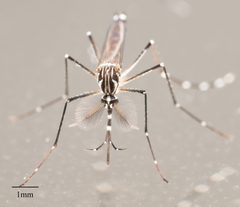
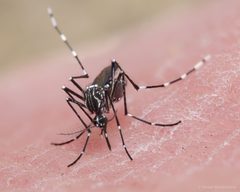
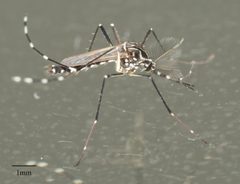
are 4–7 mm in length with a dark body. The legs display conspicuous black and white banding. The ( ) bears a distinctive silvery-white lyre-shaped marking. Females possess short-sparse and small palps tipped with white or silver ; males have (feathery) antennae. Distinguished from the similar Aedes albopictus by the lyre-shaped thoracic marking—Ae. albopictus has a single white stripe on the scutum instead.
Images
Habitat
Highly ; occurs almost exclusively in or near human settlements outside its native range. Breeds in artificial water containers including flowerpots, discarded tires, uncovered barrels, buckets, water storage vessels, and cryptic sites such as wet shower floors and toilet tanks. Also utilizes natural tree holes where available. In temperate regions, persist in underground refugia during cold periods.
Distribution
Native to tropical and subtropical regions of Africa. Established throughout the tropical and subtropical Americas, the entire Mediterranean region, southern Europe, the Middle East, South and Central America, the southern United States, southern China, and Japan. In Russia, present on the Black Sea coast (Sochi area, detected 2001–2005). In California, detected 2013 and now present in more than 300 cities across at least 17 counties. Expanding northward in temperate regions due to climate warming.
Seasonality
Active year-round in tropical climates. In temperate regions, activity occurs primarily during warmer months, with capable of in protected microhabitats. remain viable in dry conditions for over a year, enabling rapid resurgence following drought or cold periods.
Diet
Females blood-feed on mammals, with strong anthropophilic preference mediated by odorant receptor AaegOr4. Males do not blood-feed; they feed on nectar and fruit juices. Larvae consume bacteria, , and organic detritus in aquatic .
Life Cycle
are laid singly on damp surfaces just above the water line in containers; they hatch upon flooding. Larvae pass through four instars over several weeks, feeding on microorganisms and organic matter. occurs in water. emerge and mate; females require blood meals to initiate and egg development. Under favorable conditions, a female can produce a full cohort of 50–100 eggs within 3 days of blood feeding. Adult lifespan is 2–4 weeks.
Behavior
Females are day-biters with peak activity at dawn and dusk, though they will bite throughout the day in shaded or indoor environments. -seeking is guided by chemical cues including carbon dioxide, lactic acid, ammonia, and octenol, with demonstrated stereochemical preference for dextrorotatory octenol. Females exhibit skip-oviposition, distributing among multiple containers. Eggs are desiccation- and can undergo until rehydrated.
Ecological Role
Primary for virus, virus, Zika virus, virus, and Mayaro virus. Also transmits West Nile virus, virus, and other . Mechanical vector of myxoma virus and lumpy skin virus. Serves as definitive for Plasmodium gallinaceum and P. lophurae ( , not human ). disrupt local mosquito dynamics and expand disease risk zones.
Human Relevance
Major of human viral causing substantial morbidity and mortality worldwide; WHO estimates alone causes approximately 40,000 deaths annually. Presence in California and other temperate regions represents significant emerging public health threat. Control relies on source reduction, , adulticides, and emerging technologies including release of genetically modified sterile males (OX513A strain) and -infected mosquitoes. resistance, particularly resistance (kdr) mutations to and , severely limits chemical control options.
Similar Taxa
- Aedes albopictusSimilar size and black-and-white leg banding, but distinguished by single white stripe on versus lyre-shaped marking; more cold-tolerant and expanding into temperate regions faster; also a but generally less efficient for and .
- Aedes (Ochlerotatus) caspiusHistorical nomenclatural confusion; Linnaeus's original description of Culex aegypti actually referred to this , later corrected by ICZN ruling in 1964.
Sources and further reading
- BugGuide
- Wikipedia
- GBIF taxonomy match
- iNaturalist taxon
- NCBI Taxonomy
- Doctoral Candidate Lindsey Mack: Zeroing in on the Yellow Fever Mosquito | Bug Squad
- Taylor Kelly's Exit Seminar: Targeting Yellow Fever Mosquito and Pyrethroid Resistance | Bug Squad
- Targeting the Yellow Fever Mosquito in California | Bug Squad
- Olivia Winokur: Targeting the Yellow Fever Mosquito | Bug Squad
- Geoffrey Attardo: Invasive Mosquito Populations Moving Throughout California | Bug Squad
- Geoffrey Attardo: Growing Presence of This Mosquito: 'A Major Public Health Threat' | Bug Squad
- Pest control of Aedes Aegypti and Aedes Albopictus mosquitoes
- About modern areal of mosquito Aedes (Stegomyia) aegypti i Aedes (Stegomyia) albopictus in Europe and Russia
- About modern areal of mosquitoes Aedes (Stegomyia) aegypti and Aedes (Stegomyia) albopictus in Europe and Russia
- Distribution of Aedes aegypti and Aedes albopictus in Turkey, determination of vector status and population genetics
- Competition among Aedes aegypti larvae in microcosms v1
- Aedes aegypti Mosquitoes from Central Vietnam Feature Specific Viromic Profiles Linked to Dengue Virus Coinfection.
- Host-Seeking and Sugar-Feeding Behaviors of Aedes aegypti in Nouakchott, Mauritania: Implications for Dengue Transmission.