
Aedini
Genus Guides
3- Aedes(tiger mosquito)
- Ochlerotatus
- Psorophora(gallinipper)
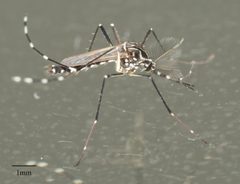
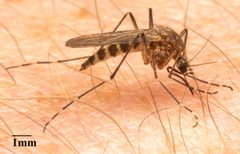
Aedini is the largest tribe of mosquitoes in the Culicinae, comprising approximately 1,256 across 81 . Members include many medically important such as Aedes aegypti and Aedes albopictus, which transmit , Zika, , and viruses. The tribe exhibits considerable diversity in , ranging from container-breeding species to floodwater mosquitoes, with many species adapted to temperate climates through embryonic .
Pronunciation
How to pronounce Aedini: /aɪˈdaɪnaɪ/
These audio files are automatically generated. While they are not always 100% accurate, they are a good starting point.
Identification
Aedini mosquitoes are distinguished from other Culicinae tribes primarily by phylogenetic and morphological characters, including features of the male genitalia and larval chaetotaxy. Many formerly classified in Aedini have been reclassified based on molecular phylogenetic studies. , particularly chorionic sculpturing patterns visible under scanning electron microscopy, is useful for -level identification from field-collected material.
Images
Habitat
vary widely among : container-breeding utilize artificial and natural water-holding containers (tree holes, leaf axils, discarded tires); floodwater species inhabit coastal and inland salt marshes, with deposited on substrates subject to periodic inundation; forest-dwelling species occupy tree holes and ground-level microhabitats in tropical and temperate forests.
Distribution
distribution with highest diversity in tropical and subtropical regions. The Haemagogus (within Aedini) is centered in Central America, with 19 of 28 occurring there. Aedes albopictus and Aedes japonicus japonicus are in the United States, including the Appalachian region. Danielsia species occur in the Oriental Region. Multiple Aedini genera are present in India and the Afrotropical Region.
Seasonality
Activity patterns vary by and latitude. Temperate species such as Aedes japonicus japonicus exhibit facultative induced by short-day , with as desiccation- . In tropical regions, breeding may occur year-round with peaks during rainy seasons.
Diet
females of most are , requiring blood meals for development. associations vary: many Aedes species feed on mammals including humans; some species feed on birds or reptiles. Males and non-gravid females typically feed on nectar and other sugar sources.
Host Associations
- Humans - blood meal For many including
- Dengue virus - Primarily Aedes aegypti and Aedes albopictus
- Zika virus - Primarily Aedes aegypti and Aedes albopictus
- Chikungunya virus - Primarily Aedes aegypti and Aedes albopictus
- Yellow fever virus - Primarily Aedes aegypti and Haemagogus in forest cycles
- La Crosse virus - Aedes japonicus japonicus implicated
- Cache Valley virus - Aedes japonicus japonicus implicated
- Eastern Equine Encephalitis virus - Some floodwater Aedes
- Venezuelan Equine Encephalitis virus - Some floodwater Aedes
- Dirofilaria immitis - Ochlerotatus taeniorhynchus and other
- Everglades virus - Ochlerotatus taeniorhynchus
Life Cycle
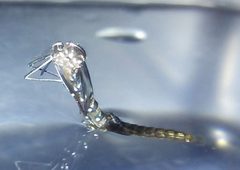
are deposited singly or in rafts depending on ; many produce desiccation- eggs with hardened that withstand dry periods. Floodwater species deposit eggs on moist substrates that hatch upon inundation. Embryonic occurs in temperate species, with first-instar larvae remaining within the egg until environmental cues trigger hatching. Larval development occurs in aquatic ; follows four larval instars. emerge from pupae at the water surface.
Behavior
Oviposition varies: some exhibit height preferences (ground level versus elevated sites in forest ), with Aedes albopictus and Haemagogus leucocelaenus showing differential exploitation of vertical space. Species may share oviposition sites, with co-occurrence patterns suggesting rather than random distribution. Maternal induction of embryonic occurs in some temperate species, where females detect short-day (beginning in the pupal stage and continuing into adulthood) to produce diapausing .
Ecological Role
Significant of human and animal including and filarial . Aedini alter local mosquito dynamics through competition and exploitation. Larval stages serve as prey for aquatic in container and wetland .
Human Relevance
Major public health importance due to transmission of , Zika, , , and viruses. Control efforts target breeding sites, , and competence. such as Aedes albopictus and Aedes japonicus japonicus expand transmission risk into temperate regions.
Similar Taxa
- CuliciniAnother tribe in Culicinae; distinguished by phylogenetic relationships and morphological characters of male genitalia and larvae
- SabethiniTribe of specialized container-breeding mosquitoes often with predatory larvae; distinguished by morphological and ecological specialization
More Details
Taxonomic instability
The classification of Aedini has undergone substantial revision based on molecular phylogenetic studies. Many formerly placed in Aedini have been reclassified, and the tribe now contains 81 genera plus two groups incertae sedis. The genus Aedes in particular has been split, with former subgenera elevated to generic status in some classifications.
Diapause evolution
Ancestral state reconstruction suggests that the ancestral prediapause condition in Aedini is maternally controlled, with embryonic prediapause potentially representing an intermediate stage in the evolution of obligate . This has been experimentally demonstrated in Aedes japonicus japonicus but remains hypothetical for the tribe as a whole due to limited data across .
Sources and further reading
- BugGuide
- Wikipedia
- iNaturalist taxon
- NCBI Taxonomy
- Catalogue of Life
- Scanning electron microscopy of eggs of Ochlerotatus taeniorhynchus (Diptera: Culicidae, Aedini)
- New records of Haemagogus (Haemagogus) from Northern and Northeastern Brazil (Diptera: Culicidae, Aedini)
- The Prediapause Stage of Aedes japonicus japonicus and the Evolution of Embryonic Diapause in Aedini
- An update on the distribution of mosquitoes of the Tribe Aedini in India (Diptera: Culicidae)
- Descriptions of Danielsia Theobald, a genus recently resurrected from synonymy (Diptera: Culicidae: Aedini), and its type species Dn. albotaeniata Leicester
- Spawning behavior of Aedini (Diptera: Culicidae) in a remnant of Atlantic Forest in the state of Rio de Janeiro