
Psorophora
Robineau-Desvoidy, 1827
gallinipper
Species Guides
10- Psorophora ciliata(Gallinipper)
- Psorophora columbiae(dark ricefield mosquito)
- Psorophora cyanescens
- Psorophora ferox(White-footed Woods Mosquito)
- Psorophora horrida
- Psorophora howardii(Howard's Gallinipper)
- Psorophora longipalpus
- Psorophora mathesoni(Matheson's Mosquito)
- Psorophora signipennis(Mottled Mosquito)
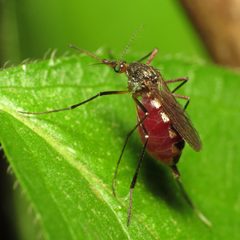
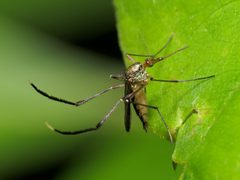
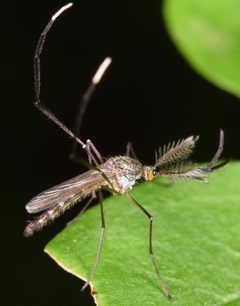
Psorophora is a of large mosquitoes in the Culicinae, tribe Aedini, described by Robineau-Desvoidy in 1827. The genus comprises approximately 50 distributed across the Americas, with three recognized subgenera: Psorophora, Janthinosoma, and Grabhamia. Several species, notably Psorophora ciliata and P. ferox, are among the largest mosquitoes in the world and are known for aggressive biting . Larvae of some species are obligate with specialized anatomical adaptations for capturing prey.
Pronunciation
How to pronounce Psorophora: /sɔːˈrɒfərə/
These audio files are automatically generated. While they are not always 100% accurate, they are a good starting point.
Identification
are distinguished from other culicine mosquitoes by their large size; Psorophora ciliata and related are among the largest mosquitoes globally. Larvae of predatory species can be identified by their robust capsules and specialized mouthpart structures adapted for prey capture. Species-level identification relies on coloration patterns of the and , male genitalia , and larval characters of the head, , and abdomen.
Images
Habitat
Floodwater environments including wetlands, floodplains, and woodland pools with intermittent water. occupy diverse aquatic from natural floodplains to artificial containers. Psorophora ferox is specifically associated with woodland environments containing intermittent pools.
Distribution
North, Central, and South America. Documented from the United States (including Florida, Tennessee, Virginia, Mississippi, New York, Connecticut, Maine, Maryland, South Carolina, Iowa, Illinois, and Massachusetts), Canada, Colombia, and Argentina. Range expansion has been observed, with P. ferox and P. ciliata increasingly documented in New England.
Seasonality
Activity peaks following rainfall and flooding events. In temperate regions, floodplain show abundance peaks closely correlated with major precipitation events, including hurricane remnants. Multiple may occur in a single season when conditions permit.
Diet
Larvae of some are obligate , feeding on other aquatic insect larvae including other mosquitoes. of most species feed on blood; specific vary by species.
Life Cycle
are laid in dry floodplain areas and hatch upon flooding. Larval development occurs in aquatic ; some have predatory larvae with specialized prey-capture adaptations. emerge from pupal stage in water.
Behavior
Larvae of predatory exhibit a unique harpoon-like strike mechanism: sudden neck extension launches the away from the body toward prey, with and brush-like structures spreading open then snapping closed on impact. This fixed-action pattern takes approximately 15 milliseconds and is generated by building and rapidly releasing pressure within abdominal segments. of several species are aggressive human biters with persistent biting . Psorophora ferox exhibits swarming behavior.
Ecological Role
Larvae of predatory function as in aquatic , potentially regulating of other mosquito species. Some species have been evaluated as agents due to their consumption of larval mosquitoes. serve as potential for including West Nile virus, , and western equine , though vector competence varies by species.
Human Relevance
Several are significant nuisance pests due to large size, aggressive biting, and painful bites. Psorophora ciliata, known as the "," has a reputation for intimidating appearance and legendary aggressiveness. Psorophora ferox has become increasingly in floodplain mosquito in the northeastern United States, replacing Aedes vexans in some areas. Management recommendations include avoiding outdoor activity during peak activity periods and using EPA-registered repellents.
Similar Taxa
- ToxorhynchitesBoth contain large mosquitoes with predatory larvae that use harpoon-like extension to capture prey; however, Toxorhynchites lacks blood-feeding and has been more extensively studied for applications.
- AedesBoth are culicine mosquitoes with floodwater breeding habits, but Psorophora are generally larger, with predatory larvae in some species, and exhibit more aggressive biting .
- SabethesBoth have predatory larvae, but Sabethes uses a fundamentally different prey-capture mechanism (tail-sweeping rather than -extension) and is a facultative rather than obligate .
Sources and further reading
- BugGuide
- Wikipedia
- GBIF taxonomy match
- iNaturalist taxon
- NCBI Taxonomy
- Catalogue of Life
- Harpoon Heads, Sweeping Tails: How Predatory Mosquito Larvae Capture Prey
- Mosquito Management in the Era of Extreme Weather
- The Best of 2022 on Entomology Today
- Morphological description of the pupa and fourth-instar larva and redescription of the adults of Psorophora (Psorophora) pallescens Edwards (Diptera: Culicidae)
- A Mosquito Psorophora ciliata (Fabricius) (Insecta: Diptera: Culicidae)
- A Mosquito Psorophora ferox (Humboldt 1819) (Insecta: Diptera: Culicidae)
- Psorophora columbiae (Dyar & Knab), Dark rice field mosquito
- Host Preference of Psorophora confinnis and P. discolor1