
Aedes
Meigen, 1818
tiger mosquito, dengue mosquito
Species Guides
7- Aedes aegypti(yellow fever mosquito)
- Aedes albopictus(Asian tiger mosquito)
- Aedes cinereus(Minute Floodwater Mosquito)
- Aedes epactius(Western Rock Pool mosquito)
- Aedes increpitus
- Aedes japonicus(Asian bush mosquito)
- Aedes vexans(inland floodwater mosquito)
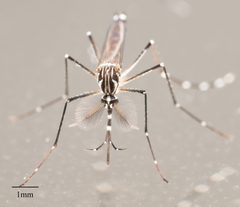
Aedes is a large of mosquitoes containing over 950 , originally native to tropical and subtropical regions but now established on all continents except Antarctica. The genus is distinguished by black and white banding on the body and legs, and by biting that differs from most mosquito genera. Several species are significant , transmitting fever, , Zika virus, and . such as Aedes aegypti and Aedes albopictus have expanded their ranges dramatically through human activity, particularly via the international trade in used tires.
Pronunciation
How to pronounce Aedes: /ˈeɪdiːz/
These audio files are automatically generated. While they are not always 100% accurate, they are a good starting point.
Identification
Distinguished from other mosquito by the combination of biting and conspicuous black and white banding on the body and legs. Culex mosquitoes typically bite at night and lack such bold patterning. Anopheles mosquitoes have spotted wings and rest with the body angled relative to the surface. Aedes can be further differentiated by larval characters including the position and structure of the siphon and comb , though species-level identification often requires examination of genitalia or genetic analysis.
Images
Appearance
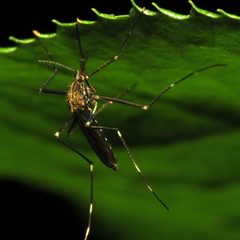
Medium-sized mosquitoes with distinctive black and white or silver banding patterns on the legs and body. Many display patches or stripes of pale against a dark background. The often shows characteristic markings. Wing typically bear dark and pale scales in distinct patterns.
Habitat
Diverse ranging from natural tree holes and rock pools to artificial containers in urban environments. Many thrive in human-modified landscapes, breeding in flowerpots, water storage containers, discarded tires, and other water-holding objects. Native occupy tropical and subtropical forests, savannas, and coastal zones.
Distribution
Originally tropical and subtropical zones worldwide; now present on all continents except Antarctica. Aedes aegypti and Aedes albopictus have established in the southern United States, with suitability extending to 71% and 75% of counties respectively. In Europe, Ae. albopictus occurs along the Mediterranean coast and has expanded northward to Switzerland, Germany, and the Netherlands. In Russia, both occur on the Black Sea coast. In China, Ae. aegypti is restricted to tropical regions and the Yunnan border, while Ae. albopictus is widespread south of 41°N latitude.
Seasonality
Activity periods vary by and climate. In temperate regions, active primarily during warmer months. In China, Ae. aegypti is present April through October with peak activity May-June. In Italy, Ae. albopictus is active June through October. Year-round activity occurs in tropical regions. can survive extended dry periods, allowing rapid increase following rainfall.
Diet
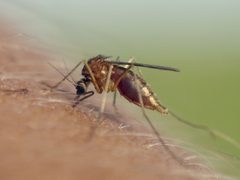
Females are blood-feeders, requiring blood meals for development. Both sexes feed on nectar and other sugar sources. Specific associations vary by ; many are feeders while others show preference for humans.
Host Associations
- Humans - blood Primary for many including Ae. aegypti and Ae. albopictus
- Arboviruses - Transmit , , Zika, , and other viruses
Life Cycle
Complete with four stages: , larva, pupa, and . Eggs are laid singly on damp surfaces just above the water line, hatching when flooded. Larvae pass through four instars, feeding on organic matter in water. Pupae are mobile but non-feeding. Adults emerge from pupae at the water surface. Many produce eggs that withstand desiccation for months or years.
Behavior
biting activity with peak periods in early morning and late afternoon to dusk, contrasting with the habits of most mosquitoes. Some are strongly , breeding exclusively in artificial containers near human habitation. are relatively weak fliers, typically traveling short distances, though passive via human transportation has facilitated long-range invasion. Males do not bite.
Ecological Role
of some plants through nectar feeding. Larvae serve as food for aquatic including fish and aquatic insects. As , they maintain transmission cycles of between humans and non-human primates in enzootic settings. alter local mosquito dynamics through competition.
Human Relevance
Major of human including fever, , Zika virus, and . The WHO estimates dengue causes approximately 40,000 deaths annually. Control efforts include , source reduction of breeding containers, mosquito traps, insect repellents, and emerging genetic technologies such as sterile male release. spread has been facilitated by the international used-tire trade and other human activities.
Similar Taxa
- Culex biting ; lacks bold black and white banding; rests with body parallel to surface
- AnophelesSpotted wings; rests with body at angle to surface; typically
- OchlerotatusHistorically treated as subgenus of Aedes; some authorities now recognize as separate ; morphological and genetic distinctions exist
More Details
Taxonomic instability
The classification of Aedes has undergone significant revision. Several subgenera including Stegomyia and Ochlerotatus have been elevated to rank by some authorities, though this remains contentious. The 2009 revision substantially altered the circumscription of the genus.
Insecticide resistance
of Ae. aegypti in California and elsewhere show increasing resistance to , limiting control options for mosquito management agencies.
Genetic control technologies
Oxitec has developed genetically modified male Ae. aegypti carrying a self-limiting gene that prevents female offspring from surviving. This -specific approach targets only the while preserving non-target insects.
Sources and further reading
- BugGuide
- Wikipedia
- GBIF taxonomy match
- iNaturalist taxon
- NCBI Taxonomy
- Catalogue of Life
- Geoffrey Attardo: Invasive Mosquito Populations Moving Throughout California | Bug Squad
- Geoffrey Attardo: Growing Presence of This Mosquito: 'A Major Public Health Threat' | Bug Squad
- Three-Quarters of U.S. Has Suitable Climate for Aedes aegypti and Aedes albopictus Mosquitoes
- Edible Plant Oils Show Potential for Management of Aedes aegypti
- Another Invasive Mosquito Species Arrives in Florida
- Scientists Track Mosquitoes that Transmit Zika and Dengue by County
- Pest control of Aedes Aegypti and Aedes Albopictus mosquitoes
- Distribution areas and monthly dynamic distribution changes of three Aedes species in China: Aedes aegypti, Aedes albopictus and Aedes vexans
- About modern areal of mosquito Aedes (Stegomyia) aegypti i Aedes (Stegomyia) albopictus in Europe and Russia
- Aedes aegypti Mosquitoes from Central Vietnam Feature Specific Viromic Profiles Linked to Dengue Virus Coinfection.
- Host-Seeking and Sugar-Feeding Behaviors of Aedes aegypti in Nouakchott, Mauritania: Implications for Dengue Transmission.