
Aedes japonicus
(Theobald, 1901)
Asian bush mosquito, Asian rock pool mosquito
Aedes japonicus is an mosquito native to East Asia, first described from Tokyo in 1901. It has established in North America, Europe, and Hawaii through human-mediated transport of in used tires and containers. The species is a competent for West Nile virus, La Crosse virus, virus, and St. Louis virus, with experimental evidence for and viruses. Its cold-hardiness, ecological plasticity, and ability to exploit diverse container contribute to its invasive success.
Pronunciation
How to pronounce Aedes japonicus: //ˈeɪdiːz dʒəˈpɒnɪkəs//
These audio files are automatically generated. While they are not always 100% accurate, they are a good starting point.
Identification
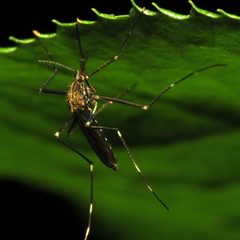
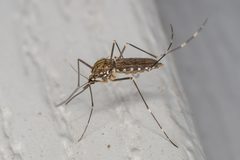
Distinguished from similar Aedes by the bronze lyre-shaped pattern on the . Can be reliably separated from Aedes koreicus using geometric wing morphometrics based on wing shape rather than size. Molecular confirmation via COI gene sequencing is effective for identification.
Images
Appearance
have a distinctive bronze-colored, lyre-shaped pattern on the . Larvae possess a linear arrangement of branched frontal setae and a strongly spiculated anal saddle. Geometric wing morphometrics can distinguish Aedes japonicus from the closely related Aedes koreicus with 96.5% in females and 91.3% in males based on wing shape, though wing size overlaps between .
Habitat
Occupies diverse container including natural rock pools, tree holes, and artificial containers such as used tires, buckets, and cans. Found in forested areas, suburban environments, and rural settings. In native Japan, it has disappeared from metropolitan areas due to urban heat-island effects and reduced mammalian , whereas it persists in suburban and rural settings.
Distribution
Native to East Asia including Japan, Korea, China, Taiwan, Hong Kong, and parts of Russia. established in North America (first detected New York/New Jersey 1998, now widespread across USA and Canada), Europe (first detected 2000, now in Belgium, Germany, Switzerland, Austria, Slovenia, Netherlands, Hungary, France, Croatia, Bosnia-Herzegovina, Serbia, Italy, Liechtenstein, Spain), and Hawaii. Predicted to continue expanding across temperate regions globally under climate change scenarios.
Seasonality
Active from early spring through early autumn in native . In temperate ranges, are active spring through fall with as diapausing . Larvae are notably active in early spring in snowy waters, earlier than most other mosquito .
Diet
Females blood-feed on mammals including humans, deer, and livestock; birds play a minor role in -feeding patterns. In laboratory settings, feed on chicks and mice but not reptiles or amphibians. Larvae filter-feed on organic detritus, microorganisms, and particulate matter in container .
Host Associations
- humans - blood Day biter but reportedly reluctant to bite humans in some
- deer - blood
- livestock - blood
- small mammals - blood Important for La Crosse virus transmission cycle
- birds - minor blood Play minor role in -feeding patterns
Life Cycle
Multivoltine with 2-3 oviposition events per gonotrophic cycle, producing approximately 114 per female. Eggs are deposited singly on container walls above the waterline, to desiccation, and hatch upon flooding. Four larval instars followed by pupal stage; time approximately 2-3 weeks under favorable conditions. Overwinters as eggs in cooler regions and as larvae in warmer regions; embryonic enables survival in temperate climates. Autogeny (egg production without blood meal) reported in some .
Behavior
Daytime biting activity with peak activity during daylight hours. are strong fliers with considerable capacity. show ecological plasticity and aggressive competitive interactions with native container mosquitoes such as Aedes atropalpus, often displacing them in cooler rock pool . Maternal life stage is the prediapause stage sensitive to environmental cues inducing .
Ecological Role
Human Relevance
Public health concern as a competent for West Nile virus, La Crosse virus, virus, and St. Louis virus; field-collected specimens have been found infected with La Crosse virus. Experimental transmission demonstrated for and viruses. Listed as by Global Invasive Species Database. Spread facilitated by international trade in used tires. Subject of active surveillance and potential using parasitic water mites (Hydrachnidae), which reduce .
Similar Taxa
- Aedes koreicusClosely related occurring in sympatry in Europe; morphologically similar but distinguishable by geometric wing morphometrics; Aedes koreicus females have larger wing size on average
- Aedes albopictusCo-occurring container mosquito; Aedes japonicus is more cold-hardy and occupies forested/rock pool whereas Aedes albopictus thrives in urban environments; Aedes albopictus has higher to hot, dry conditions
- Aedes atropalpusNative North American rock pool mosquito displaced by Aedes japonicus in cooler ; Aedes japonicus outcompetes and reduces Aedes atropalpus growth at lower temperatures
Misconceptions
Despite being described as 'reluctant to bite humans' in some early literature, field evidence demonstrates regular human blood-feeding and significant public health relevance as a . The was initially considered a secondary vector but is now recognized as contributing to transmission of La Crosse virus and West Nile virus in field settings.
More Details
Genomic characteristics
assembly reveals very high presence of repetitive , thermal genes, and -resistance genes. RNAseq analysis identifies temperature-dependent gene activation patterns.
Citizen science monitoring
Successfully monitored through citizen science projects such as Germany's 'Mueckenatlas,' where public submissions of specimens have detected spreading and provided early warning of range expansion.
Climate adaptation
Mortality rates increase around 28°C (82.5°F), limiting survival in hot conditions, but cold-hardiness enables establishment in temperate climates unavailable to many other Aedes .
Sources and further reading
- BugGuide
- Wikipedia
- GBIF taxonomy match
- iNaturalist taxon
- NCBI Taxonomy
- Catalogue of Life
- Winter Wonderland of Seminars | Bug Squad
- Researchers Find La Crosse Virus in Aedes japonicus Mosquitoes
- Water Mites Discovered Parasitizing Two Mosquito Species in Pennsylvania
- Entomologists Discuss Discovery's "Mosquito" Documentary: A Live-Tweet Recap
- Citizen Scientists Collect 29,000 Mosquitoes in Germany and Help Detect Spreading Populations of Invasive Species
- Vexing rains spawn vexing mosquitoes: inland floodwater mosquito, Aedes vexans — Bug of the Week
- Using geometric wing morphometrics to distinguish Aedes japonicus japonicus and Aedes koreicus
- Using geometric wing morphometrics to distinguish Aedes japonicus japonicus and Aedes koreicus
- Invasion Biology of Aedes japonicus japonicus (Diptera: Culicidae)
- Presence and Potential Distribution of Aedes albopictus and Aedes japonicus japonicus (Diptera: Culicidae) in Slovenia
- Aedes Vector Surveillance in the Southeastern United States Reveals Growing Threat of Aedes japonicus japonicus (Diptera: Culicidae) and Aedes albopictus
- Aedes (Ochlerotatus) scapularis, Aedes japonicus japonicus, and Aedes (Fredwardsius) vittatus (Diptera: Culicidae): Three Neglected Mosquitoes with Potential Global Health Risks
- Differences in Responses to Urbanization Between Invasive Mosquitoes, Aedes japonicus japonicus (Diptera: Culicidae) and Aedes albopictus, in Their Native Range, Japan
- Population Growth Rates of Aedes atropalpus (Diptera: Culicidae) Are Depressed at Lower Temperatures Where Aedes japonicus japonicus (Diptera: Culicidae) Are Naturally Abundant in Rock Pools
- Asian Bush Mosquito, Asian Rock Pool Mosquito Aedes japonicus japonicus (Theobald, 1901) (Insecta: Diptera: Culicidae)
- Invasive Aedes japonicus mosquitoes dominate the Aedes fauna collected with gravid traps inWooster, northeastern Ohio, USA
- Modeled distributions ofAedes japonicus japonicusandAedes togoi(Diptera: Culicidae) in the United States, Canada, and northern Latin America
- The Prediapause Stage of Aedes japonicus japonicus and the Evolution of Embryonic Diapause in Aedini
- De-novo genome assembly of the invasive mosquito species Aedes japonicus and Aedes koreicus
- De-novo genome assembly of the invasive mosquito species Aedes japonicus and Aedes koreicus.
- Global potential distribution of three underappreciated arboviruses vectors (Aedes japonicus, Aedes vexans and Aedes vittatus) under current and future climate conditions