
Aedes albopictus
(Skuse, 1894)
Asian tiger mosquito, forest mosquito, tiger mosquito
Aedes albopictus, the Asian tiger mosquito, is a highly native to tropical and subtropical Southeast Asia. It has spread globally through human commerce, particularly via used tires and shipping containers. The species is distinguished by striking black and white banded legs and a white thoracic stripe. It is a significant public health threat as an efficient vector for , , Zika, and other . Unlike many mosquitoes, it bites during daytime hours and thrives in urban environments, breeding in small artificial water containers.


Pronunciation
How to pronounce Aedes albopictus: //ˈiːdiːz ˌælboʊˈpɪktəs//
These audio files are automatically generated. While they are not always 100% accurate, they are a good starting point.
Identification
The single white thoracic stripe is the most reliable field character, separating Ae. albopictus from similar lacking this continuous marking. In North America, Ochlerotatus canadensis shares banded legs but lacks dorsal thoracic markings. In Europe, Culiseta annulata has banded legs but is larger, beige-grey rather than black and white, and lacks the thoracic stripe. Aedes cretinus (eastern Mediterranean) has a white scute stripe that ends before the and has two additional lateral stripes. Aedes aegypti (yellow fever mosquito) is morphologically similar but has a lyre-shaped pattern on the rather than a single straight line. Microscopic examination of patterns on the and wing venation may be required for definitive identification in areas of sympatry.
Images
Appearance
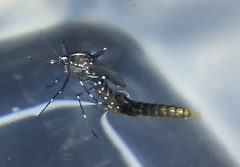
are small mosquitoes, typically less than 10 mm in length, with a distinctive black and white color pattern. The most prominent feature is a single silvery-white line of tight running from between the down the midline of the —this is the most reliable identification character. Legs display conspicuous white bands on tarsomeres I–IV, with the hind leg tarsomere V completely white. The has dark with triangular silvery-white markings on segments II–VI. Wings are transparent with white spots at the base of the . Males are approximately 20% smaller than females and have bushier with more prominent auditory receptors; their maxillary palps exceed the length, unlike in females.
Habitat
In its native range, occupies tropical and subtropical forests. In invaded regions, strongly associated with human-modified environments: urban and suburban areas, parks, cemeteries, and residential neighborhoods. Breeds in small, often temporary water bodies—natural tree holes and bamboo internodes, but predominantly artificial containers: discarded tires, cans, plastic containers, gutters, flower pots, bird baths, and rain-filled trash. Prefers shaded locations with vegetation. Can utilize water volumes as small as 30 ml. Tolerates running water better than many Aedes .
Distribution
Native to tropical and subtropical Southeast Asia. Established throughout much of the world through human-mediated : widespread in the United States (eastern seaboard, Gulf Coast, Midwest, and expanding westward), southern Europe (Italy, France, Spain, Greece, Balkans), Mediterranean region, Middle East, Latin America (Brazil, Argentina, Mexico, Caribbean), Africa (South Africa, Nigeria, Cameroon, Gabon), and the Pacific. In the United States, present in at least 40 states and 1,368 counties as of 2017. Range continues expanding northward with climate warming.
Seasonality
In tropical and subtropical native range, active year-round. In temperate invaded regions, active primarily during warmer months (spring through fall), with in protected microhabitats. can survive freezing temperatures and snow cover; temperate strains show greater cold than tropical . Peak biting activity varies regionally but generally occurs during daylight hours with peaks in early morning and late afternoon.
Diet
Females are blood-feeding (), requiring blood meals for development. Both sexes feed on nectar and plant sugars. Females are feeders, biting humans, other mammals, and birds. Multiple blood meals from different may be taken during a single gonotrophic cycle, enhancing potential for zoonotic .
Host Associations
- Humans - primary blood and biting targetStrongly anthropophilic in urban environments
- Domestic and wild mammals - blood Includes dogs, cats, and various wildlife
- Birds - blood Contributes to bridge potential for
- Wolbachia - endosymbiontNatural with wAlbB and other strains; affects and potentially transmission
Life Cycle
Complete : → larva → pupa → . Eggs are laid singly on moist surfaces just above water line, not directly in water; they hatch upon flooding. Larvae develop in aquatic , passing through four instars. Development rate depends on temperature and food availability. Adults emerge from pupae in 2–3 days under optimal conditions. Short range (<200 m lifetime), so breeding sites are typically near biting locations. time can be as short as 7–10 days in warm conditions.
Behavior
biting activity with peaks in morning and late afternoon; bites during full daylight unlike many mosquito . Rapid, agile makes it difficult to swat. Weak flier with limited range. Strongly associated with human dwellings, resting outdoors in shaded vegetation rather than indoors. Exhibits
Ecological Role
competitor that can displace native mosquito through larval competition and satyrization (interspecific mating interference). Serves as bridge between zoonotic and humans due to feeding habits. Natural influences through . Prey for various including spiders, nymphs, and predatory aquatic insects, though efficacy remains limited.
Human Relevance
Major public health pest and . Transmits virus, virus, Zika virus, virus, and West Nile virus to humans; also vectors Dirofilaria immitis (). Responsible for chikungunya in Italy (2007) and La Réunion (2005–2006). Nuisance biting during daytime hours affects outdoor recreation and work. Difficult to control due to cryptic breeding sites in residential areas. Subject to intensive surveillance and integrated vector management programs. Genetic and methods under development including -based suppression and sterile male techniques.
Similar Taxa
- Aedes aegyptiOverlapping range and importance; distinguished by lyre-shaped scutal pattern versus single straight stripe, and more strictly urban/domestic preference
- Aedes cretinusSympatric in eastern Mediterranean; distinguished by scute stripe ending before and two additional lateral stripes
- Culiseta annulataEuropean with banded legs but larger size, beige-grey coloration, and lack of thoracic stripe
- Aedes pseudalbopictusSoutheast Asian morphologically similar; molecular differentiation often required
More Details
Invasion biology
Listed among the 100 world's worst . Spread primarily through international trade in used tires and lucky bamboo. Can establish from very small founder numbers due to parthenogenetic-like reproductive strategies and desiccation resistance.
Satyrization
Interspecific mating with Aedes aegypti produces no offspring but sterilizes Ae. aegypti females, contributing to competitive displacement. Ae. albopictus females can remate after such encounters, suffering no reproductive cost.
Insecticide resistance
show increasing resistance to , with kdr mutations (F1534C/S) documented. Gut symbiotic bacteria (Bacillus cereus) may enhance deltamethrin resistance.
Sources and further reading
- BugGuide
- Wikipedia
- GBIF taxonomy match
- iNaturalist taxon
- NCBI Taxonomy
- Geoffrey Attardo: Invasive Mosquito Populations Moving Throughout California | Bug Squad
- Chikungunya virus in the United States and its vectors: Yellow Fever Mosquitoes, Aedes aegypti, and Asian tiger mosquito, Aedes albopictus — Bug of the Week
- Three-Quarters of U.S. Has Suitable Climate for Aedes aegypti and Aedes albopictus Mosquitoes
- Neighborhood Watch: How Asian Tiger Mosquito Habitat Varies From Block to Block in an Urban Setting
- Controlling the Asian Tiger Mosquito, a Potential Zika Vector, is Possible but Difficult
- Satyrization is No Laughing Matter for Aedes Aegypti Mosquitoes, But Pickiness Has a Price
- Habitat characterization of Aedes albopictus
- Microhabitat preference of Aedes albopictus
- Pest control of Aedes Aegypti and Aedes Albopictus mosquitoes
- About modern areal of mosquitoes Aedes (Stegomyia) aegypti and Aedes (Stegomyia) albopictus in Europe and Russia
- About modern areal of mosquito Aedes (Stegomyia) aegypti i Aedes (Stegomyia) albopictus in Europe and Russia
- Distribution of Aedes aegypti and Aedes albopictus in Turkey, determination of vector status and population genetics
- Actualización de la distribución espaciotemporal de Aedes albopictus en Ecuador Update of the spatiotemporal distribution of Aedes albopictus in Ecuador
- Peer Review Report For: Geographical distribution of Aedes aegypti and Aedes albopictus (Diptera: Culicidae) and genetic diversity of invading population of Ae. albopictus in the Republic of the Congo [version 1; peer review: 2 approved]
- The Effect of dengue and chikungunya virus mixed infection in Aedes albopictus (C6/36) cells line and Aedes spp. mosquitoes
- Figure 3: Modelled habitat suitability of the two main vector species (A) Aedes aegypti and (B) Aedes albopictus .
- Is Aedes nr. albopictus synonymous with Aedes pseudalbopictus?
- Peer Review Report For: Geographical distribution of Aedes aegypti and Aedes albopictus (Diptera: Culicidae) and genetic diversity of invading population of Ae. albopictus in the Republic of the Congo [version 2; peer review: 3 approved]
- Peer Review Report For: Geographical distribution of Aedes aegypti and Aedes albopictus (Diptera: Culicidae) and genetic diversity of invading population of Ae. albopictus in the Republic of the Congo [version 1; peer review: 2 approved]
- Life Cycle, Bio-ecology and DNA Barcoding of mosquitoes Aedes aegypti (Linnaeus) and Aedes albopictus (Skuse)
- Vector competence and correlation of midgut microbiota of Aedes albopictus for Chikungunya virus
- Comparative vector competence analysis reveals differential Tembusu virus transmission efficiency between Aedes albopictus and Culex quinquefasciatus.
- Continued range expansion of Aedes albopictus (Diptera: Culicidae) in Iowa, United States.
- Stage-specific impacts of a simulated natural heatwave on Aedes albopictus.
- F1534S kdr mutation drives the geographical heterogeneity of pyrethroid resistance in Aedes albopictus from Hangzhou, China.
- Establishment of a Cell-Fusing Agent Virus Infection Model in Aedes albopictus and Its Impact on Vector Competence for Zika Virus.
- Natural infection of Aedes albopictus with the wAlbB strain and Ae. aegypti with the wPip strain of Wolbachia in Iran.
- Altitudinal and household breeding patterns of the medically important mosquitoes Aedes aegypti, Aedes albopictus and Culex quinquefasciatus in Nepal.
- Immature development time and survivorship of the dengue vectors Aedes aegypti, Aedes vittatus, and the invasive Aedes albopictus in Ghana.
- Distribution of Aedes aegypti and Aedes albopictus, and the current situation of dengue fever and chikungunya in Iran and neighboring countries: a review study.
- Population differences in reproductive resource allocation and heterosis in the invasive vector Aedes albopictus.
- Analyzing the influence of environment, demographic and socio-economic factors on Aedes albopictus (Diptera: Culicidae) mosquito density at the micro-level using XGBoost and SHAP.
- Aedes albopictus gut symbiotic bacterium Bacillus cereus improves its deltamethrin resistance.
- Insecticidal potential of Areca catechu nut extract against multiple life stages of Aedes aegypti and Aedes albopictus.
- Spatiotemporal variation in abundance and genetic structure in an urban-rural landscape: Aedes albopictus (Skuse, 1894) (Diptera: Culicidae) in Wake County, NC.
- Physicochemical and typological insights into Aedes albopictus and Aedes aegypti larval habitats in a sub-Saharan African urban gradient setting.