
Aedes cinereus
Meigen, 1818
Minute Floodwater Mosquito
Aedes cinereus, commonly known as the minute floodwater mosquito, is a widespread mosquito found across northern North America and Europe. It is notable for its aggressive biting toward humans and its role as a for , particularly Ockelbo virus in northern Europe. The species thrives in wetland with semi-permanent water bodies and demonstrates adaptability by occasionally breeding in artificial containers. Research has also demonstrated its competence for Lammi virus, an insect-specific orthoflavivirus with possible .
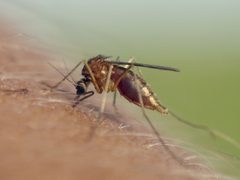
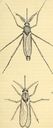
Pronunciation
How to pronounce Aedes cinereus: /ˈaɪdiːz sɪˈnɛriəs/
These audio files are automatically generated. While they are not always 100% accurate, they are a good starting point.
Images
Habitat
Prefers wetland environments including semi-permanent bogs, swamps, and temporary floodwater areas with dense vegetation such as cattails and sedges. Also utilizes woodland pools, marshes, and can breed in artificial containers, showing adaptability to urban settings. In the Leningrad region and Saint Petersburg, Russia, predominates in forests, parks, and most .
Distribution
Transcontinental distribution spanning North America and Europe. North America: widespread across Canada (Ontario, Quebec, British Columbia), Alaska, and northern United States (Minnesota, Wisconsin, Michigan); less common in arid southern regions. Europe: present in Belgium, Estonia, Germany, Ireland, Netherlands, Norway, Sweden, Finland, Russia, and United Kingdom, with notable presence in northern Europe.
Seasonality
Active from May to September in the Leningrad region and Saint Petersburg, Russia. Most active during dawn and dusk, though will bite throughout the day in shaded areas.
Diet
feed opportunistically on humans, birds, and mammals. Larvae in laboratory rearing fed on crushed daphnia.
Host Associations
- Humans - Biting ; aggressive biterPrimary human pest in many parts of range
- Birds - Blood
- Mammals - Blood
- Ockelbo virus - Primary in northern Europe (Sweden, Finland, Russia); causes Ockelbo with fever, rash, and arthritis
- Lammi virus - Demonstrated competence with evidence for possible and trans-stadial survival; insect-specific orthoflavivirus
- Jamestown Canyon virus - Suspected May transmit; role secondary to other
- West Nile virus - Suspected Potential secondary role in transmission
Life Cycle
Complete : , larva, pupa, . Larvae and pupae develop in temporary and permanent water bodies. In laboratory conditions at 15°C average daily air temperature, field-collected larvae and pupae from Saint Petersburg developed to adults. Evidence suggests possible of Lammi virus, with virus detected in adults hatched from field-collected stages.
Behavior
Exhibits aggressive biting toward humans. Most active during periods (dawn and dusk) but will bite diurnally in shaded areas. Ability to feed on both avian and mammalian facilitates role as bridge in transmission.
Ecological Role
Serves as prey for birds, bats, and aquatic insects. Competes with other mosquito , influencing local . Acts as for multiple including Ockelbo virus and Lammi virus. As a bridge vector between avian and mammalian , contributes to potential spread of zoonotic . Lammi virus may modulate by reducing West Nile virus replication during superinfection.
Human Relevance
Significant nuisance pest due to aggressive biting. Medical importance as primary of Ockelbo virus in northern Europe. Potential vector for Jamestown Canyon virus and secondary vector for West Nile virus. Subject to control measures including reduction, , adulticides, and . Research interest due to demonstrated competence for insect-specific viruses with possible .
More Details
Virus Interactions
Lammi virus, an insect-specific orthoflavivirus carried by Aedes cinereus, has been shown to reduce of West Nile virus during superinfection in laboratory conditions, suggesting potential for this virus to influence transmission dynamics of pathogenic mosquito-borne viruses in areas where it circulates.
Research Significance
Studies in Saint Petersburg, Russia, provide some of the strongest evidence for and trans-stadial survival of in this , with Lammi virus detected in that developed from field-collected larvae and pupae.
Sources and further reading
- BugGuide
- Wikipedia
- GBIF taxonomy match
- iNaturalist taxon
- NCBI Taxonomy
- Catalogue of Life
- Geoffrey Attardo: Invasive Mosquito Populations Moving Throughout California | Bug Squad
- Geoffrey Attardo: Growing Presence of This Mosquito: 'A Major Public Health Threat' | Bug Squad
- Three-Quarters of U.S. Has Suitable Climate for Aedes aegypti and Aedes albopictus Mosquitoes
- Edible Plant Oils Show Potential for Management of Aedes aegypti
- Flower Pots a Common Breeding Site for Aedes aegypti Mosquitoes
- Dengue Virus Effects on Aedes aegypti Mosquitoes: Genetic Manipulation or Byproduct?
- Orthoflavivirus Lammi in Russia: Possible Transovarial Transmission and Trans-Stadial Survival in Aedes cinereus (Diptera, Culicidae)