
Aedes vexans
(Meigen, 1830)
inland floodwater mosquito, tomguito
Aedes vexans is a floodwater mosquito native to North America, Europe, Asia, and Africa, and is now established in Australia. It is frequently the most abundant mosquito across much of its range, particularly in northern latitudes. Females are aggressive human biters active at dusk, while males feed exclusively on nectar. The species is a documented for multiple including , Tahyna virus, and West Nile virus, and has demonstrated laboratory competence for Zika virus transmission. Its survive winter in dry flood-prone soils, hatching when inundated by rainfall.
Pronunciation
How to pronounce Aedes vexans: /ˈiː.diːz ˈvɛksænz/
These audio files are automatically generated. While they are not always 100% accurate, they are a good starting point.
Identification
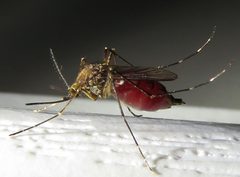
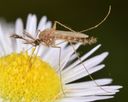
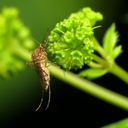
female Aedes vexans is distinguished by a bandless with white , short brown scales on the , and B-shaped markings on each abdominal tergite when viewed from the side. The lacks the distinctive white bands on the legs seen in Aedes aegypti and the bold black-and-white patterning of Aedes albopictus. It is generally smaller and less ornamented than Psorophora ferox, with which it often co-occurs in floodplain .
Images
Habitat
Temporary aquatic in floodplains, including grassy pools, partially shaded woodland pools, roadside ditches, cultivated fields, and wet-prairie areas. In China, construction land is the land cover factor associated with its distribution. Oviposition sites are characterized by specific indicator plants: barnyard grass (Echinochloa crusgalli), smartweed (Polygonum pennsylvanicum), yellow nutgrass (Cyperus esculentus), and dense mats of vegetative detritus. Soil moisture between 55% and 69% is optimal for deposition.
Distribution
distribution spanning North America, Europe, Asia, and Africa; present in Australia and recently confirmed in Tahiti, French Polynesia. In North America, it ranges from Canada through the United States and into Mexico. In Europe, it is particularly abundant in northern Italy and other floodplain regions. In China, it is native and primarily distributed in northern regions including Heilongjiang, Jilin, Liaoning, Xinjiang, and the Shandong Peninsula. Climate modeling indicates potential for range expansion into Libya, Egypt, and southern Australia by 2050.
Seasonality
In temperate regions, larvae are present from April to September and are active from May to October. Activity peaks following rainfall events that inundate -bearing soils. In Massachusetts, abundance peaks correlated with summer hurricane remnants and flooding events.
Diet
Females blood-feed preferentially on humans and cattle, but also take blood from other mammals including livestock and deer. Both sexes feed on nectar, honeydew, and plant sap; males feed exclusively on these sugar sources. Females require blood meals for development.
Life Cycle
are deposited on moist soil in areas prone to flooding and remain until inundated by water, triggering hatching. Larvae feed on biofilm of microbes and submerged vegetation in shallow water. Development proceeds through four larval instars before . emerge and disperse; mark-recapture studies document distances up to 11 km with prevailing winds, with 50% of marked females recovered within 2 km of release sites. occurs as eggs.
Behavior
biting activity extends mosquito nuisance into evening hours, unlike day-biting Aedes . disperse primarily with prevailing winds; in Manitoba, northwestward was predominant. Females demonstrate distance-dependent attraction to , with porcine and bovine hosts highly attractive. occur in response to carbon dioxide and host cues.
Ecological Role
Important prey for aquatic including diving beetles (Dytiscidae), which consume larvae; mosquito has been detected in 14% of field-caught diving beetles. serve as when feeding on nectar. As a , transmits among wildlife, domestic animals, and humans. Competent vector for multiple ; laboratory studies show higher Zika virus transmission than Aedes aegypti, though field vector status remains unconfirmed.
Human Relevance
Major nuisance pest due to aggressive biting and high abundance. Documented for (Dirofilaria immitis), Tahyna virus (causing fever, rarely or meningitis in Europe), myxomatosis in rabbits, and West Nile virus. Laboratory-competent for Zika virus transmission, with potential to extend transmission risk into northern latitudes beyond the range of primary vectors Aedes aegypti and Aedes albopictus. Black virus of honey bees has been detected in this , likely acquired through shared nectar foraging, though vector role is unproven.
Similar Taxa
- Psorophora feroxCo-occurs in floodplain and has recently replaced Ae. vexans as the floodplain in some northeastern US areas; larger size and more painful bite distinguish Ps. ferox.
- Aedes aegyptiAlso a container-breeding Aedes , but Ae. aegypti has distinctive white leg bands, is day-active, and occupies more urban/peridomestic .
- Aedes albopictusAsian tiger mosquito with bold black-and-white patterning, day-biting , and container-breeding ; Ae. vexans lacks leg bands and is .
- Aedes sticticusFellow floodwater mosquito with similar requirements; often sympatric and simultaneously targeted in control programs.
Sources and further reading
- BugGuide
- Wikipedia
- GBIF taxonomy match
- iNaturalist taxon
- NCBI Taxonomy
- Geoffrey Attardo: Invasive Mosquito Populations Moving Throughout California | Bug Squad
- Vexing rains spawn vexing mosquitoes: inland floodwater mosquito, Aedes vexans — Bug of the Week
- Archive — Bug of the Week
- Study Finds Native North American Mosquito Can Transmit Zika
- Mosquito Management in the Era of Extreme Weather
- Honey Bee Virus Found in Mosquitoes
- Distribution areas and monthly dynamic distribution changes of three Aedes species in China: Aedes aegypti, Aedes albopictus and Aedes vexans
- Update on Aedes vexans distribution in the UK
- DISPERSAL BEHAVIOR OF ADULT AEDES STICTICUS AND AEDES VEXANS (DIPTERA: CULICIDAE) IN MANITOBA
- Global potential distribution of three underappreciated arboviruses vectors (Aedes japonicus, Aedes vexans and Aedes vittatus) under current and future climate conditions
- Correction to “Update on Aedes vexans distribution in the UK”
- OVIPOSITION SITES OF AEDES VEXANS (DIPTERA: CULICIDAE): WET-PRAIRIE HABITATS
- Specific detection of the floodwater mosquitoes Aedes sticticus and Aedes vexans DNA in predatory diving beetles
- Delayed identification of long-overlooked Aedes ( Aedimorphus ) vexans in Tahiti Island, French Polynesia
- Distribution and abundance of Aedes caspius (Pallas, 1771) and Aedes vexans (Meigen, 1830) in the Po Plain (northern Italy)