
Psorophora ferox
(Humboldt, 1819)
White-footed Woods Mosquito
Psorophora ferox is a medium-sized floodplain mosquito native to the Americas, commonly known as the white-footed woods mosquito. It inhabits wet woodlands and temporary pools, with requiring flooding to hatch. The has expanded its range northward in recent years, becoming increasingly in floodplain mosquito in the northeastern United States. are aggressive biters with painful bites and are active during both day and night.
Pronunciation
How to pronounce Psorophora ferox: //ˈsɔːrəˌfɔːrə ˈfɛrɒks//
These audio files are automatically generated. While they are not always 100% accurate, they are a good starting point.
Identification
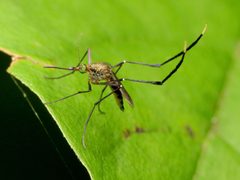
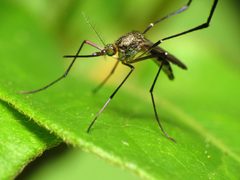
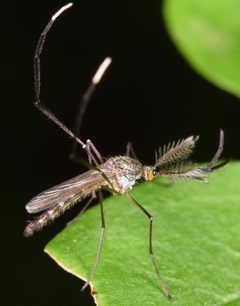
Distinguished from similar floodplain mosquitoes by white restricted to the last two tarsal segments (not entire ), yellowish abdominal scales forming distinct apicolateral triangular patches, and purple iridescence on the . Larger and more robust than Aedes vexans, with which it commonly co-occurs; differs from Psorophora ciliata (the gallinipper) by smaller size and less extensive pale leg markings. are elliptical, deep black, strongly adherent to surfaces, with hexagonal/pentagonal chorionic bearing small irregular and large conical tubercles at one cell extremity.
Images
Appearance
Medium-sized mosquito. covered in dark with flecks of lighter yellowish scales. dark-scaled dorsally with purple iridescence, yellowish ventrally; yellowish scales form apicolateral triangular patches on abdomen. Legs largely dark with white scales on last two tarsal segments. Female wings 3.7–4.0 mm in length. long and dark.
Habitat
Wet woodlands and floodplain environments. Breeds in temporary pools and intermittent woodland pools filled with rainwater. are deposited in dry floodplain areas and require flooding to hatch. In North America, larvae develop during summer months. Associated with Atlantic Forest biome in South America.
Distribution
Eastern United States and southeastern Canada, south through Mexico, Central America, South America to northern Argentina and Uruguay, and the Caribbean. East of the Andes Cordillera. Range has expanded northward in recent decades, with increasing abundance in New England.
Seasonality
Active during summer in North America. activity occurs during both day and night. peaks follow heavy rainfall and flooding events, with multiple peaks possible in seasons with repeated precipitation events.
Host Associations
Life Cycle
are laid on substrates in dry floodplain areas and are strongly adherent to surfaces. Hatching requires flooding with rainwater. Eggs reared in laboratory conditions hatch in 4–5 days. Larvae develop in temporary pools. of microsporidian Amblyospora ferocis documented, with infected females showing reduced (47.6 eggs vs. 82.8 eggs in uninfected females) and reduced hatching success (35.8% vs. 64.1%).
Behavior
Aggressive human biter with painful bites. Active during both and periods. Flood-dependent pattern: remain in dry conditions and hatch in response to flooding. Recent explosions documented in northeastern North America following hurricane-related flooding events.
Ecological Role
of multiple including virus, West Nile virus (minor vector), virus, Rocio virus, Una virus, and Ilheus virus. for microsporidian Amblyospora ferocis. Increasingly in floodplain mosquito , displacing Aedes vexans in some northeastern US locations.
Human Relevance
Significant nuisance pest due to aggressive biting and painful bites. Capable , though not considered a major vector for human . Expanding range and increasing abundance in the northeastern United States associated with climate change and extreme weather events, particularly hurricane-related flooding. Management recommendations include avoiding outdoor activities during peak activity and using EPA-registered repellents.
Similar Taxa
- Aedes vexansCo-occurs in floodplain ; P. ferox is larger and more robust with distinct white tarsal scaling and purple abdominal iridescence not present in Ae. vexans
- Psorophora ciliataBoth in Psorophora and share floodplain ; P. ciliata (gallinipper) is substantially larger with more extensive pale markings on legs and more formidable bite
More Details
Climate change and range expansion
Historical floodplain in the northeastern United States were dominated by Aedes vexans, but Ps. ferox has expanded its range northward and increased in abundance. In Massachusetts, trap collections shifted from low historical numbers to dominance over Ae. vexans by 2013, with 2021 representing the most productive season recorded. This shift correlates with increased frequency and severity of hurricane-related flooding events.
Egg morphology variation
Scanning electron microscopy reveals significant morphometric differences among in Brazil, Florida (USA), and Trinidad, including variation in dimensions, size and number, micropylar collar, and structure.
Sources and further reading
- BugGuide
- Wikipedia
- GBIF taxonomy match
- iNaturalist taxon
- NCBI Taxonomy
- Mosquito Management in the Era of Extreme Weather
- A Mosquito Psorophora ferox (Humboldt 1819) (Insecta: Diptera: Culicidae)
- Comparing the egg ultrastructure of three Psorophora ferox (Diptera: Culicidae) populations
- Life cycle and epizootiology of Amblyospora ferocis (Microspora: Amblyosporidae) in the mosquito Psorophora ferox (Diptera: Culicidae)
- First record of Psorophora ferox (Diptera: Culicidae) infested with eggs of Dermatobia hominis (Diptera: Cuterebridae), in Ucayali: Peru