
Psorophora ciliata
(Fabricius, 1794)
Gallinipper, Shaggy-legged Gallinipper
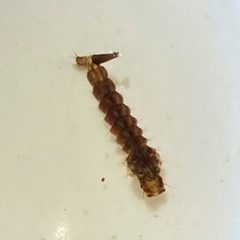
Psorophora ciliata is a notably large mosquito native to eastern North America, recognized for its aggressive biting and intimidating size. are active during spring and summer, with females feeding on large mammals including humans. The species has earned like "gallinipper" and "shaggy-legged gallinipper" due to its appearance and persistent biting. Larvae are obligate of other mosquito larvae and small aquatic organisms. The species has been expanding its range northward into New England in recent years.
Pronunciation
How to pronounce Psorophora ciliata: /sɔˈrɔfɔra sɪˈliːata/
These audio files are automatically generated. While they are not always 100% accurate, they are a good starting point.
Identification
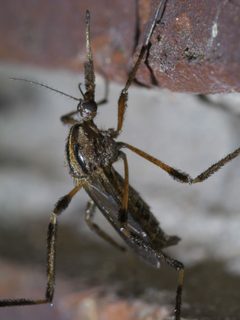
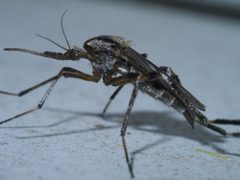
Most reliably distinguished from other Psorophora by the combination of large size (7–9 mm wingspan), yellow and dark brown thoracic pattern with central yellow stripe and two lateral dark stripes, and especially the banded "shaggy" legs. The yellow with black tip and pale with paler tip are additional supporting characters. Similar species include other Psorophora species, but P. ciliata's leg banding and large size are distinctive.
Images
Appearance
Relatively large mosquito with wingspan of 7–9 mm. Both sexes are large and yellow-colored. is yellow with black tip. is pale with paler tip. is dark brown with thin, bright yellow stripe down the middle, flanked by two dark stripes on each side. Legs are distinctly banded and "shaggy" in appearance. Males have bushy () ; females have non-bushy antennae.
Habitat
Woodlands, fields, and floodplain areas. Breeds in ephemeral pools and moist soil areas that flood after rainfall. Larvae occur in shallow aquatic including irrigation ditches and temporary pools, often co-occurring with other floodplain mosquito .
Distribution
Eastern North America from South Dakota and Quebec south to Florida, extending through Central America to South America in tropical and temperate zones. Recently documented expanding northward into New England (Massachusetts), where it was first recorded in Norfolk County in 2020.
Seasonality
most active during spring and summer. Activity occurs during both day and night. In floodplain , abundance peaks following heavy rainfall and flooding events.
Diet
females feed on blood of large mammals, including humans. Adult males and females both feed on flower nectar. Larvae are obligate , feeding on larvae of other mosquito (including Aedes aegypti, Aedes vexans, Psorophora columbiae) and small aquatic organisms including tadpoles.
Life Cycle
laid singly on moist soil or as rafts on ephemeral pools. Eggs can withstand dry conditions and hatch when flooded. Aquatic larval stage includes multiple instars; larvae are predatory throughout development. occurs in water. emerge from pupae. Lifespan may extend up to two years from birth under favorable conditions.
Behavior
Females are aggressive biters, persistently pursuing . Larvae are active using a rapid strike mechanism: generating abdominal hemostatic pressure to propel the toward prey, fanning lateral palatal brushes into basket-like arrangements, and simultaneously opening sharp-toothed . This predatory shows convergence with Toxorhynchites amboinensis.
Ecological Role
Larval that may regulate of other mosquito in aquatic , potentially reducing overcrowding effects. females serve as blood-feeders on large mammals. Both sexes contribute to pollination through nectar feeding. Serves as prey for birds, fish, and predatory insects.
Human Relevance
Significant nuisance pest due to aggressive biting and large size, which produces a painful bite. Historical accounts from the Civil War era document soldiers referring to mosquitoes as "." Expanding range in the northeastern United States may increase encounters. Capable of transmission, though specific competence for human is not well documented in provided sources.
Similar Taxa
- Psorophora feroxBoth are large, aggressive Psorophora found in floodplain and expanding in the northeastern United States; P. ciliata is larger with more distinctive leg banding
- Psorophora columbiaeCo-occurs in larval ; P. ciliata distinguished by larger size and thoracic pattern
- Aedes vexansShares floodplain breeding and aggressive biting ; P. ciliata is substantially larger with different coloration and leg structure
More Details
Predatory larval morphology
Larvae possess curved lateral palatal brushes and heavily-toothed as functional adaptations for , documented through high-speed microcinematography.
Range expansion
First recorded in Norfolk County, Massachusetts in 2020, with increasing numbers in 2021, representing northward range expansion potentially linked to climate change and extreme weather events.
Sources and further reading
- BugGuide
- Wikipedia
- GBIF taxonomy match
- iNaturalist taxon
- NCBI Taxonomy
- Malaria, Memorial Day and Memories of the Civil War | Bug Squad
- Bug Squad
- Gollywhoppers in Love | Bug Squad
- Psorophora ciliata - Entomology Today
- Mosquito Management in the Era of Extreme Weather
- Bug Eric: Mosquitoes
- A Mosquito Psorophora ciliata (Fabricius) (Insecta: Diptera: Culicidae)
- Mosquitoes Eating Mosquitoes: HowToxorhynchites amboinensis,Psorophora ciliata, andSabethes cyaneus(Diptera: Culicidae) Capture Prey