
Aedes epactius
Dyar & Knab, 1908
Western Rock Pool mosquito
Aedes epactius is a North American mosquito in the subgenus Georgecraigius, first described in 1908. It exhibits remarkable altitudinal plasticity, occurring from sea level to over 2,500 meters elevation. The species breeds in both natural rock pools and artificial containers including tires, water tanks, and flower pots. It has been studied for potential transmission, with laboratory evidence of competence for St. Louis and Jamestown Canyon viruses, and field detection of West Nile and Zika virus . Recent research suggests it may compete with Aedes aegypti, potentially limiting its spread in some .
Pronunciation
How to pronounce Aedes epactius: //ˈaɪdiːz ˈɛpæktiˌus//
These audio files are automatically generated. While they are not always 100% accurate, they are a good starting point.
Identification
Distinguished from closely related Aedes atropalpus through modern genetic studies; historically confused with that leading to synonym proposals. Identification confirmed through morphological examination and COX1 with Bayesian phylogenetic analysis. Scutellum pattern resembles Aedes albopictus and Aedes aegypti. Subgenus Georgecraigius placement distinguishes it from many other Aedes species.
Images
Appearance
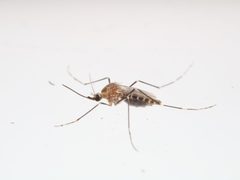
mosquitoes with typical Aedes ; specific distinguishing features include scutellum patterning similar to Aedes albopictus and Aedes aegypti. stages (larvae and pupae) collected from container and reared to adults for identification. of c oxidase I (COX1) used for confirmation, showing low intraspecific (0.018 ± 0.001) among Mexican .
Habitat
Breeds in artificial containers including discarded tires, water tanks in cemeteries, bottles, cans, plastic bags, washing machines, refrigerators, buckets, flowerpots, cement troughs, large clay jars, and drums; also utilizes natural rock pools. found resting indoors in public restrooms. Occupies temperate to subhumid climates across broad elevation gradients from coastal areas to high-altitude cold-temperate regions.
Distribution
Native to North America with range extending from southwestern United States (Utah, Colorado, Kansas, Missouri, with recent records in Otero and Baca counties, Colorado) through Mexico and Central America. In Mexico, documented from sea level in Veracruz to 2,595 meters in Zacatecas city—the highest altitude record for the in the Americas. New state records include Zacatecas (first record) and expanded Chihuahua records. Also present in Rica, El Salvador, Guatemala, Honduras, and Panama. Sightings in Europe suggest potential range expansion.
Seasonality
Active across seasons with influenced by temperature; in Mexico, higher densities observed in September when temperatures range from warm to cold. collected in July and December at high-elevation sites, indicating cold-season activity in some regions.
Diet
Females feed on blood to support production, targeting humans and other animals near breeding sites. Both sexes feed on nectar and sweet plant juices for energy.
Life Cycle
Complete with , larval, pupal, and stages. Eggs laid on water surfaces mid-season; withstand desiccation and freezing, enabling survival through dry periods or cold winters. Larvae develop in artificial containers and natural rock pools; immatures collected and reared to in laboratory settings.
Behavior
Aggressive biter near breeding sites with limited range. Exhibits high plasticity for cold climate , persisting at elevations exceeding 2,500 meters. Shows competitive ecological interactions with Aedes aegypti, achieving higher densities than that in September at some sites. demonstrate to environmental extremes through desiccation and freezing tolerance.
Ecological Role
Occupies temporary aquatic environments including artificial containers. Potential competitor to mosquito Aedes aegypti and Aedes albopictus; may influence mosquito structure and potentially limit spread of through competition.
Human Relevance
Nuisance biter with limited significance compared to other Aedes . Investigated for transmission potential: laboratory studies demonstrate competence for Jamestown Canyon virus and of St. Louis virus; field studies detected West Nile virus and Zika virus RNA in pooled specimens. Not considered a major vector but co-occurrence with Aedes aegypti raises questions about shared disease risks.
Similar Taxa
- Aedes atropalpusHistorically confused with Aedes epactius; modern genetic studies clarified distinction
- Aedes aegyptiShares scutellum pattern and container-breeding ; co-occurs in artificial containers especially in Mexico
- Aedes albopictusSimilar scutellum pattern; both are container-breeding mosquitoes
More Details
Genetic clarification
Modern genetic studies resolved historical taxonomic confusion with Aedes atropalpus, which had led to proposed synonyms Aedes atropalpus nielseni and Aedes atropalpus perichares.
Altitudinal records
Collection at 2,595 meters in Zacatecas city represents the highest documented altitude for this in the Americas, demonstrating exceptional cold-climate .
Virus detection
While laboratory studies show competence for some and field specimens have tested positive for viral , the is not conclusively incriminated as a major vector.
Sources and further reading
- BugGuide
- Wikipedia
- GBIF taxonomy match
- iNaturalist taxon
- Catalogue of Life
- Geoffrey Attardo: Invasive Mosquito Populations Moving Throughout California | Bug Squad
- Geoffrey Attardo: Growing Presence of This Mosquito: 'A Major Public Health Threat' | Bug Squad
- Three-Quarters of U.S. Has Suitable Climate for Aedes aegypti and Aedes albopictus Mosquitoes
- Edible Plant Oils Show Potential for Management of Aedes aegypti
- Flower Pots a Common Breeding Site for Aedes aegypti Mosquitoes
- Dengue Virus Effects on Aedes aegypti Mosquitoes: Genetic Manipulation or Byproduct?
- Aedes (Georgecraigius) epactius from Zacatecas and Chihuahua Mexico: New Geographical Distribution and Altitude Records