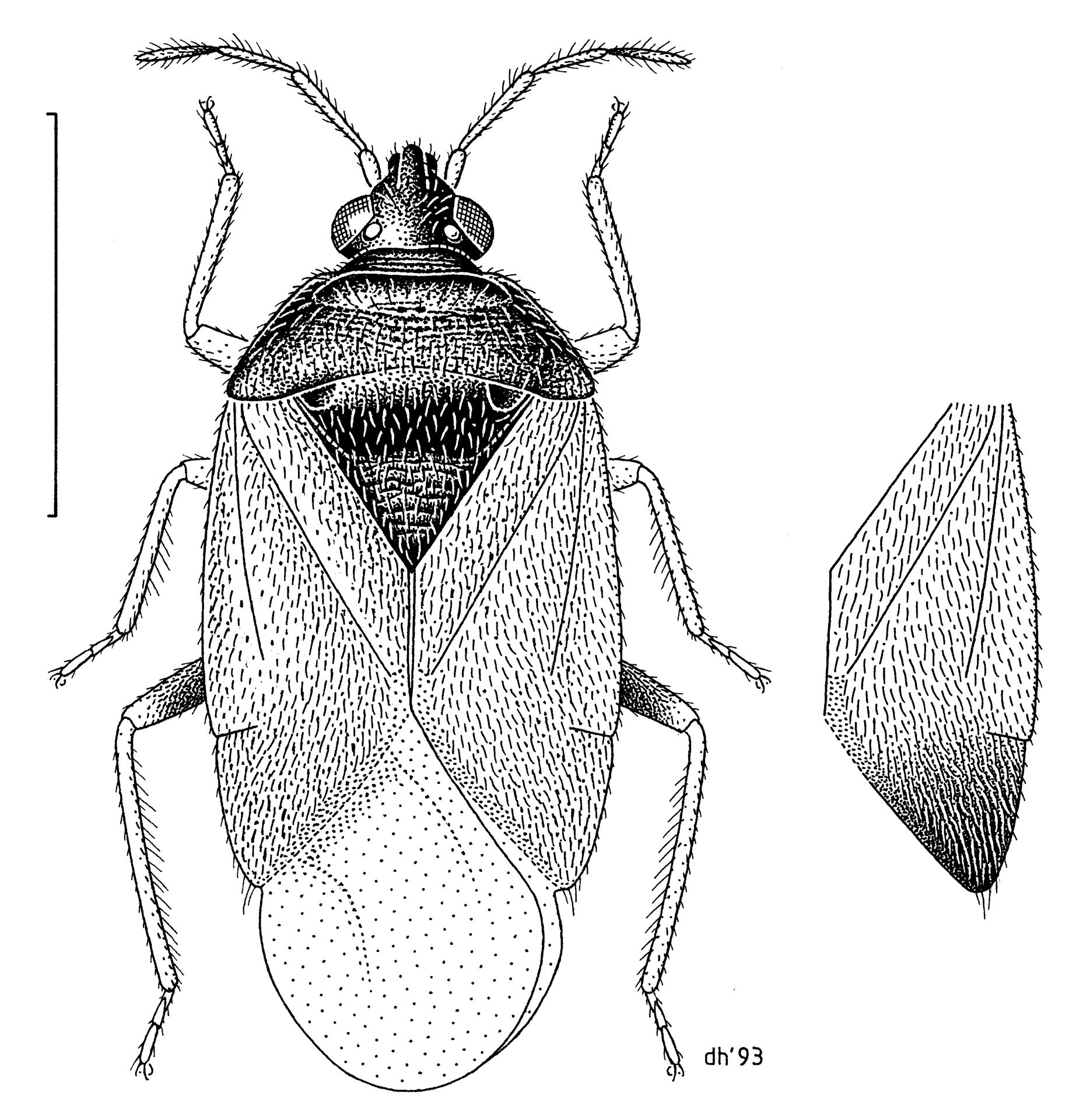
Orius vicinus
(Ribaut, 1923)
minute pirate bug
Orius vicinus is a predatory minute pirate bug (Hemiptera: Anthocoridae) studied extensively for potential. Under laboratory conditions at 26°C, it completes development from to in approximately 18–23 days, with females living 15–17 days and producing 31–61 eggs. The exhibits Type II or Type III functional responses depending on prey stage, with adult prey generally preferred over eggs. It has been observed feeding on spider mites, whiteflies, , and other small arthropods in agricultural settings. Unlike some , O. vicinus does not enter reproductive and continues oviposition through winter conditions.
Pronunciation
How to pronounce Orius vicinus: /ˈoː.ri.us vɪˈkiː.nus/
These audio files are automatically generated. While they are not always 100% accurate, they are a good starting point.
Identification
Distinguishable from such as Orius insidiosus and Orius tristicolor primarily by geographic distribution and subtle morphological features requiring examination; identification to level typically requires dissection or molecular analysis. In Dutch orchards, observed exclusively on apple cultivar 'Beauty of Boskoop'.
Images
Habitat
Agricultural and horticultural environments including orchards, greenhouses, and field crops; in Turkey studied under outdoor eastern Mediterranean conditions; in Netherlands associated with apple orchards. Thrives in environments with dense local vegetation.
Distribution
Recorded from Denmark, Norway, Sweden, Turkey (eastern Mediterranean region), and Netherlands; GBIF records indicate European distribution with presence in Scandinavia.
Seasonality
Active year-round in mild climates; in Turkey observed reproducing continuously from November through April without . Multiple annually with development continuing even at low temperatures and short day lengths.
Diet
of small arthropods including two-spotted spider mite (Tetranychus urticae) , nymphs, and ; sweetpotato whitefly (Bemisia tabaci) stages; rust mite (); predatory mite Typhlodromus pyri; and . Can subsist on pollen (Vicia fabae) but with reduced . Adult prey stages generally preferred over eggs.
Host Associations
- Tetranychus urticae - preyTwo-spotted spider mite; tested in laboratory studies
- Bemisia tabaci - preySweetpotato whitefly; stages consumed
- Aculus schlechtendali - preyRust mite; primary prey identified from gut content analysis in Dutch orchards
- Typhlodromus pyri - preyPredatory mite; occasionally consumed
- Vicia faba - pollen sourceSupports survival but not optimal
Life Cycle
stage: 4–5 days mean duration (range 4.07–4.67 days) with 94.8% hatching success. Nymphal stage: 5 instars, total development 13.7–17.6 days with 75–77% survival. stage: females live 15.3–17.0 days, males 12.3–12.5 days. Total preoviposition period (egg to first ) 21.9–22.7 days. Mean time 26–28.4 days. No pupal stage; hemimetabolous development.
Behavior
Exhibits Type III (sigmoid, -dependent at low prey density) to of some prey and Type II response (hyperbolic, inversely density-dependent) to other prey stages. Prey selectivity varies: mites preferred over nymphs and eggs. Does not undergo reproductive ; continues oviposition at temperatures around 15°C. Tolerant of low temperatures and short , though sudden temperature fluctuations negatively affect nymph survival.
Ecological Role
of agricultural pests, particularly mites and whiteflies. Potential agent for non-diapausing pest in early spring. In Dutch apple orchards, contributes to suppression of rust mite . May engage in intraguild on other predatory mites.
Human Relevance
Used commercially and studied extensively for in programs. No documented reports of biting humans, unlike the Orius insidiosus.
Similar Taxa
- Orius insidiosusWidespread North American with similar and ; distinguished by distribution and known to bite humans, which O. vicinus has not been reported to do
- Orius tristicolorWestern North American sharing 'minute pirate bug'; geographic separation and subtle morphological differences
- Anthocoris spp.Related of minute pirate bugs; generally larger (3–4 mm vs. 2–2.5 mm for many Orius), associated with woody plants rather than herbaceous crops
More Details
Laboratory rearing conditions
Most data derived from controlled environments at 26±1°C, 60±10% relative humidity, and 16:8 light:dark ; field performance may vary
Pesticide compatibility
As a predatory anthocorid, likely shares sensitivity patterns with Orius insidiosus, which has been shown to be less harmed by selective like sulfoxaflor compared to broad-spectrum alternatives
Cultivar specificity
In Dutch study, found exclusively on apple cultivar 'Beauty of Boskoop', suggesting possible plant or specificity not fully understood
Sources and further reading
- BugGuide
- GBIF taxonomy match
- iNaturalist taxon
- NCBI Taxonomy
- Life and death in a cone flower: Minute pirate bugs, Orius spp., and their prey, flower thrips, Frankliniella spp. — Bug of the Week
- Beneficial Insects and Nematodes are not Harmed by Genetically-modified, Insect-resistant Plants
- A Day in the Life of an Urban Insect Ecologist
- Sulfoxaflor Found to Be Less Harmful to Beneficial Predators of Soybean Aphids
- Bug Eric: Little Bugs with a Big Bite: Minute Pirate Bugs
- Hispanic Heritage Month: Publications Showcase
- Functional response and biological characteristics of Orius vicinus (Ribaut) (Hemiptera: Anthocoridae) on Bemisia tabaci (Genn.) (Hemiptera: Aleyrodidae)
- Functional response and life table analysis of Orius vicinus (ribaut) (Hemiptera: Anthocoridae) feeding on Tetranychus urticae Koch (Acari: Tetranychidae)
- Overwintering biology of the predatory bug, Orius vicinus (ribaut) (Hemiptera: Anthocoridae) under outdoor conditions in the eastern mediterranean region of Turkey
- The role of Orius vicinus Ribaut (Heteroptera; Anthocoridae) as a predator of phytophagous and predacious mites in a Dutch orchard