
Bemisia
Quaintance & Baker, 1914
Species Guides
1- Bemisia argentifolii(Silverleaf whitefly)
Bemisia is a of whiteflies in the Aleyrodidae, containing approximately 40 described . The genus includes several economically significant agricultural pests, most notably Bemisia tabaci (sweetpotato whitefly or silverleaf whitefly), which is considered one of the 100 worst globally. Members of this genus are phloem-feeding insects that numerous plant viruses and cause direct damage through sap extraction and honeydew secretion. The genus exhibits complex taxonomic challenges, with B. tabaci alone comprising at least 42 cryptic species distinguishable only through molecular analysis.
Pronunciation
How to pronounce Bemisia: /bɛˈmiː.si.a/
These audio files are automatically generated. While they are not always 100% accurate, they are a good starting point.
Identification
Accurate identification of Bemisia requires molecular techniques due to morphological similarities within the and with related whitefly genera. The mitochondrial oxidase I gene (mtCOI) is the preferred marker for species delimitation and identification. Bemisia tabaci alone contains at least 42 cryptic species; morphological identification alone is insufficient to distinguish these. For B. tabaci specifically, the B (MEAM1 cryptic species) and Q biotype (MED cryptic species) are the most economically important and variants globally. Identification of other Bemisia species to species level generally requires examination and molecular confirmation.
Images
Appearance
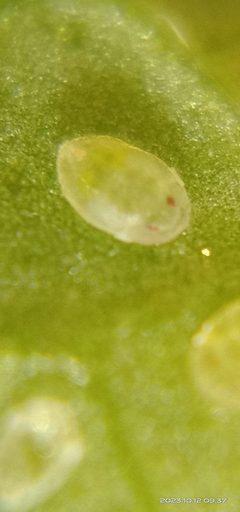
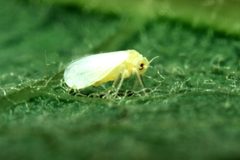
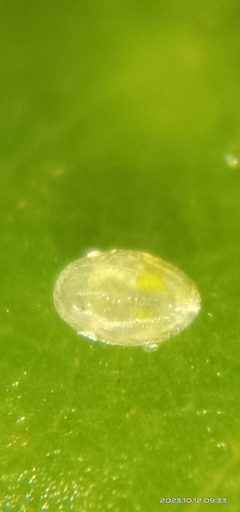
whiteflies are minute insects, typically 1-3 mm in length, with white, powdery wax covering the body and wings. Wings are held roof-like over the body when at rest. Nymphs and pupae are , oval to elliptical, and usually yellowish, whitish, or translucent; red eyespots are visible on pupae shortly before adult . The lacks the diagnostic features to separate it morphologically from related whitefly genera at a glance.
Habitat
Members of the inhabit agricultural and horticultural environments, including open fields, greenhouses, and protected systems. They are associated with the undersides of leaves of their plants. suitability is determined primarily by host plant availability rather than specific abiotic conditions.
Distribution
The has a broad global distribution spanning tropical, subtropical, and temperate regions. Distribution records exist from Europe (Denmark, Norway, Sweden), Asia, Africa, the Americas, and Oceania. Individual have more restricted ranges; B. tabaci has achieved near- distribution through human-mediated transport, while many other Bemisia species have localized distributions.
Diet
Phloem-feeding; and nymphs insert stylets into plant vascular tissue to extract sugar-rich sap. Specific dietary requirements beyond phloem contents are not well documented for the as a whole.
Host Associations
- Tomato - Major crop for B. tabaci; associated with Tomato yellow leaf curl virus transmission
- Cotton - Significant for B. tabaci in agricultural systems
- Cassava - for cassava mosaic virus transmission by B. tabaci
- Poinsettia - Important ornamental , especially for greenhouse
- Legumes - Broad range includes multiple legume
- Cucurbits - Includes summer squash and other cucurbit crops
Life Cycle
Holometabolous development with four stages: , nymph, pupa, and . Eggs are laid on the undersurface of leaves. Mobile first-instar nymphs () disperse briefly before settling to feed. Subsequent nymphal instars are , remaining fixed in place and feeding. The final nymphal instar forms a pupal case, from which the winged adult emerges. Shed pupal skins often remain attached to leaves.
Behavior
are weak fliers that flutter when disturbed. Nymphs and pupae are entirely once settled. Whiteflies are attracted to green light, a trait exploited in trapping and control technologies. Mark-release-recapture studies have been conducted using fluorescent dyes to track patterns.
Ecological Role
Major agricultural pests causing damage through direct feeding, honeydew secretion that supports growth, and transmission of plant viruses. B. tabaci at least 111 known viruses, predominantly geminiviruses including begomoviruses. In invaded regions, B. tabaci have displaced whitefly . Natural enemies include , predatory beetles, and .
Human Relevance
Significant economic impact on global agriculture through crop losses and management costs. Arizona cotton growers saved over $500 million through approaches targeting B. tabaci since 1996. The Q of B. tabaci is to many conventional , complicating control efforts. Research on Bemisia has driven advances in molecular identification techniques, methods, and development of novel control technologies including robotic suction devices.
Similar Taxa
- TrialeurodesAnother whitefly containing agricultural pests such as T. vaporariorum (greenhouse whitefly); distinguished by molecular markers and subtle morphological differences not reliably visible without examination
- AleyrodesType of Aleyrodidae; morphologically similar and requires molecular methods for definitive separation from Bemisia
More Details
Cryptic species complex
Bemisia tabaci represents one of the most extensively studied cryptic in insects, with at least 42 genetically distinct but morphologically similar now recognized. This has necessitated a shift from morphological to molecular identification in research and management contexts.
Invasion genetics
Global invasions of B. tabaci MEAM1 (B ) have been associated with only 1-3 haplotypes, suggesting that a small portion of genetic diversity has driven worldwide spread. India represents an exception where this has failed to establish despite genetic identity to globally invasive , possibly due to natural enemy pressure and presence of native cryptic .
Sources and further reading
- BugGuide
- Wikipedia
- GBIF taxonomy match
- iNaturalist taxon
- NCBI Taxonomy
- Catalogue of Life
- ‘Twas the week before Christmas and what did I spy: The silverleaf whitefly, Bemisia tabaci — Bug of the Week
- The gift of poinsettia. The silverleaf whitefly, Bemisia argentifolii — Bug of the Week
- This Robot Sucks: Vacuum Machine Targets Whitefly Pests on Greenhouse Tomatoes
- Unraveling the Invasion Puzzle: Contrasting Success and Failure in Global Whitefly and Thrips Species
- Steve Naranjo: Having an Impact and Making a Difference
- From Burglars to Bugs: Anti-Theft Dye Useful in Insect-Tracking Studies
- Autecology of Bemisia tabaci
- The Whitefly, Bemisia tabaci (Homoptera: Aleyrodidae) Interaction with Geminivirus-Infected Host Plants
- Phylogenetic Biology of the Bemisia tabaci Sibling Species Group
- Comparing probing and feeding behavior ofBemisia tabaci(Hemiptera: Aleyrodidae) on tomato plants injected RNAi ofBemisia tabaci
- Host Plant Resistance for the Management of Bemisia tabaci: A Multi-crop Survey with Emphasis on Tomato
- Bean yellow disorder virus: Parameters of transmission by Bemisia tabaci and host plant range
- Natural Enemies of Bemisia tabaci: Predators and Parasitoids