
Bemisia argentifolii
Bellows & Perring, 1994
Silverleaf whitefly, Sweetpotato whitefly (B biotype)
Bemisia argentifolii, described by Bellows & Perring in 1994, is a whitefly belonging to the Bemisia tabaci . It is a significant agricultural pest known for causing silverleafing in squash, transmitting plant viruses, and developing resistance to multiple . The species has been documented on over 900 plants including vegetables, ornamentals, and fiber crops. It is frequently associated with greenhouse and protected environments but also occurs in open field agriculture in tropical and subtropical regions.
Pronunciation
How to pronounce Bemisia argentifolii: /bɛˈmɪs.i.ə ɑːrˌdʒɛntɪˈfoʊli.aɪ/
These audio files are automatically generated. While they are not always 100% accurate, they are a good starting point.
Images
Habitat
Occurs in greenhouse and protected environments, particularly for ornamentals and vegetable production. Also found in open field agriculture in tropical and subtropical regions. Documented on chrysanthemums in greenhouse settings in Tanzania, on poinsettias in retail and greenhouse environments, and on vegetable crops including cantaloupe, collard, cucumber, and tomato in field settings.
Distribution
Widespread globally in tropical and subtropical regions. Documented occurrences include: United States (Arizona, California, Florida, South Carolina, coastal areas), Tanzania (first record in Arusha region), Japan (greenhouse tomatoes), Italy (central Italy on weeds), and various Pacific and Caribbean islands including Galápagos Islands, Reunion, Guadeloupe, and Martinique. Represents the northern geographic limit of year-round field in coastal South Carolina in the eastern United States.
Seasonality
increase in spring through summer and peak again in fall. Year-round activity occurs in tropical and subtropical regions where conditions permit. In temperate regions, seasonal activity is limited by cold temperatures, with 0°C and 4°C chilling significantly increasing mortality of and .
Diet
Phloem-feeding; extracts sugar-rich sap from plant vascular tissue. Feeds on over 900 documented host plant .
Host Associations
- Chrysanthemum (Dendranthema grandiflora) - primary - greenhouse cut flower production in TanzaniaDocumented for establishment and
- Poinsettia (Euphorbia pulcherrima) - ornamental Common holiday plant in retail and greenhouse settings
- Squash and cucurbits - agricultural Induces characteristic silverleafing ; associated with virus transmission
- Tomato - agricultural Greenhouse and field ; significant vegetable crop pest
- Cotton - agricultural Major pest in Arizona and other cotton-growing regions
- Cantaloupe, collard, cucumber - agricultural Field crop documented in resistance studies
- Hibiscus rosa-sinensis - ornamental documented on this
- Various weeds - wild Documented preference and performance on weeds in central Italy
Life Cycle
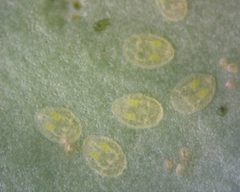
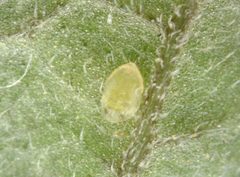
Holometabolous development with four stages: , nymph (four instars), pupa (fourth instar/ ), and adult. Eggs are laid on undersurfaces of leaves. First-instar nymphs () are mobile and disperse to locate feeding sites. Subsequent nymphal instars become , remaining fixed in place for feeding. The fourth instar functions as the pupal stage, with red eyespots visible shortly before adult . Shed pupal skins remain attached to leaves. Development time and survival vary with plant and temperature.
Behavior
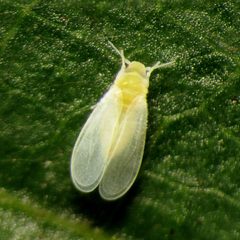
First-instar nymphs () exhibit positive , moving toward light sources to aid in plant location and leaf selection for settlement. are attracted to green light. When disturbed, adults flutter from leaf surfaces. Feeding occurs primarily on undersurfaces of leaves. Distribution within plants shifts based on plant age and prior exposure to chilling stress, with adults and typically on youngest (highest) leaves on non-stressed plants but moving to lower leaves on chilled plants.
Ecological Role
Agricultural pest causing direct damage through phloem feeding and indirect damage through honeydew that supports growth. of at least 111 plant viruses including criniviruses (Sweet potato chlorotic stunt virus, Cucumber yellow stunting disorder virus). Serves as for multiple including Eretmocerus spp. and Encarsia spp. (E. nigricephala, E. pergandiella, E. strenua, E. quaintancei). Subject to by parasitoids and predatory beetles.
Human Relevance
Major economic pest of agricultural and ornamental crops. Causes substantial losses in greenhouse production of poinsettias, chrysanthemums, and vegetables. Responsible for significant damage to field crops including cotton, vegetables, and cucurbits. Development of resistance (including neonicotinoids and bifenthrin) complicates management. Subject to programs combining selective insecticides, agents, and cultural practices. pest of regulatory concern for international trade. Target of robotic suction machine development in Japan for greenhouse tomato production.
Similar Taxa
- Bemisia tabaci (sensu stricto or other cryptic species in complex)Morphologically indistinguishable; B. argentifolii is part of the B. tabaci containing at least 24 cryptic . Distinguished by genetic, behavioral, and -related characteristics including ability to induce silverleafing in squash.
- Trialeurodes vaporariorum (greenhouse whitefly)Co-occurs on greenhouse crops including poinsettias; distinguished by puparial characteristics and lack of silverleafing induction in cucurbits.
- Aleurodicus rugioperculatus (rugose spiraling whitefly)Another whitefly pest in Florida; distinguished by puparial with characteristic waxy secretions.
Sources and further reading
- BugGuide
- GBIF taxonomy match
- iNaturalist taxon
- NCBI Taxonomy
- Catalogue of Life
- Publications | Entomology Research Museum
- The gift of poinsettia. The silverleaf whitefly, Bemisia argentifolii — Bug of the Week
- ‘Twas the week before Christmas and what did I spy: The silverleaf whitefly, Bemisia tabaci — Bug of the Week
- Steve Naranjo: Having an Impact and Making a Difference
- Don't Bet Your Hedges: IPM Guide Outlines Ficus Whitefly Management
- This Robot Sucks: Vacuum Machine Targets Whitefly Pests on Greenhouse Tomatoes
- Phototactic Behavior of Bemisia argentifolii (Homoptera: Aleyrodidae) Crawlers
- Occurrence of Bemisia Argentifolii on Chrysanthemums in Northern Tanzania
- Culturable Bacteria Associated with the Whitefly, Bemisia argentifolii (Homoptera: Aleyrodidae)
- Effects of Chilling of Bemisia argentifolii (Homoptera: Aleyrodidae) Infesting Cabbage
- Intraplant Distribution of Immature Lifestages of Bemisia argentifolii (Homoptera: Aleyrodidae) on Tomato
- Development and Reproduction of Bemisia argentifolii (Homoptera: Aleyrodidae) on Five Host Plants
- Suitability of Bemisia argentifolii (Homoptera: Aleyrodidae) Instars for the Parasitoid Eretmocerus mundus (Hymenoptera: Aphelinidae)
- Reproductive Vigor in Bemisia argentifolii (Homoptera: Aleyrodidae) Associated With Bifenthrin Resistance
- Host Preference and Performance of Bemisia argentifolii (Homoptera: Aleyrodidae) on Weeds in Central Italy
- Life History of Bemisia argentifolii (Homoptera: Aleyrodidae) on Hibiscus rosa-sinensis (Malvaceae)
- Host plant pubescence: Effect on silverleaf whitefly, Bemisia argentifolii, fourth instar and pharate adult dimensions and ecdysteroid titer fluctuations
- Survey of the Parasitoids of Bemisia argentifolii (Homoptera: Aleyrodidae) in Coastal South Carolina Using Yellow Sticky Traps
- Evaluation of Foliar-Applied Insecticides on Abundance of Parasitoids of Bemisia argentifolii (Homoptera: Aleyrodidae) in Vegetables2