
Trialeurodes vaporariorum
(Westwood, 1856)
Greenhouse Whitefly, Glasshouse Whitefly
is a globally distributed pest of protected horticulture, frequently found in greenhouses and polytunnels. are 1–2 mm with yellowish bodies and four wax-coated wings held parallel to the leaf surface. The has a broad range exceeding 300 plant species across multiple crop . It causes economic damage through direct phloem feeding, honeydew , and associated growth. show seasonal peaks in late autumn, with densities reaching 5–7 adults plus nymphs per leaf in greenhouse broccoli systems.
Pronunciation
How to pronounce Trialeurodes vaporariorum: /triː.eɪlˌjʊəroʊˌdiːz væpəˌreɪriˈɔːrəm/
These audio files are automatically generated. While they are not always 100% accurate, they are a good starting point.
Identification
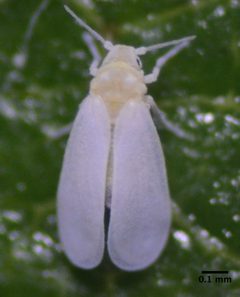
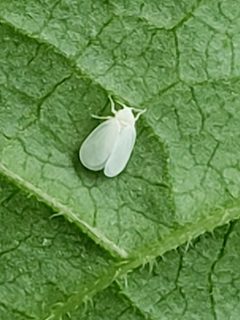
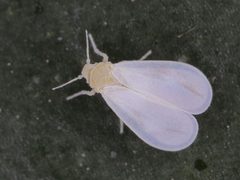
Distinguished from the silverleaf whitefly Bemisia tabaci by wing posture—T. vaporariorum holds wings flat and parallel to the leaf surface, while B. tabaci holds wings roof-like at a distinct angle. lack the zig-zag transverse wing bands present in Trialeurodes abutiloneus. In greenhouse poinsettia systems, T. vaporariorum is one of two most commonly encountered whitefly .
Images
Appearance
measure 1–2 mm in length with yellowish bodies and four wings coated with white wax, held nearly parallel to the leaf surface when at rest. Nymphs and pupae are yellowish to whitish and translucent. Red eyespots are visible on pupae shortly before adult . Shed pupal skins remain attached to leaf undersides.
Habitat
Protected horticultural environments including greenhouses, glasshouses, and polytunnels. Frequently associated with ornamental and vegetable crop production systems. In temperate regions, persist year-round in heated structures but occur seasonally in open field conditions where climate permits.
Distribution
Widely distributed throughout temperate regions worldwide. Documented in greenhouse production systems across Europe, North America, Turkey, and other temperate zones. Specific distribution records include the Azores (Graciosa, São Miguel, Santa Maria, Terceira) and Serbia.
Seasonality
In greenhouse broccoli systems in Malatya, Turkey, first appear in late October to early November, with peaking in mid-season at densities of 5.8–7.2 adults plus nymphs per leaf. Activity continues through the winter growing season under protected conditions.
Diet
Phloem-feeding sap-sucker. and nymphs insert stylets into leaf vascular tissue to extract sugar-rich phloem sap. Excretes honeydew as a waste product, which serves as substrate for fungi.
Host Associations
- Poinsettia - primary ornamental Common holiday plant association; heavy cause leaf yellowing, distortion, and premature drop
- Broccoli - vegetable crop Studied in Turkish greenhouse production systems
- Lycopersiconaceae - crop
- Leguminosae - crop
- Cruciferae - crop
- Cucurbitaceae - crop
Life Cycle
Development includes , four larval instars (L1–L4), pupa, and stages. Eggs are laid on leaf undersurfaces. Mobile first-instar nymphs () disperse before settling to feed. Subsequent instars become , remaining fixed to the leaf surface through feeding and molting. Pupal stage precedes adult . Development rate is temperature-dependent: 1.3–3.0× faster at 22.5°C and 27°C compared to 18°C. Lower developmental thresholds range from 7°C (L3) to 11.5°C (L2) for different stages.
Behavior
exhibit strong visual orientation to yellow hues, particularly RGB values 215:255:6 and 255:255:0, with preference for circular and semi-circular shapes. Yellow-circular combinations provide optimal attraction. Green preference is enhanced under green background conditions, indicating context-dependent plasticity. UV radiation elicits migratory , while green-yellow wavelengths trigger settling. Possesses trichromatic vision with photoreceptor sensitivity peaks estimated at 510–520 nm (green), 480–490 nm (blue), and 340–370 nm (UV), with a blue-green opponent mechanism. Adults flutter from leaf surfaces when disturbed. Males perform sequentially invariant ; some adopt sneak male strategies to disrupt rival courtships. Males persist in courting females that perform maintenance activities during courtship, integrating time investment with probability of insemination.
Ecological Role
Herbivorous pest causing direct damage through feeding and indirect damage via honeydew production and . Serves as for including Encarsia formosa and Eretmocerus delhiensis, which are deployed for . Honeydew production often causes more damage than direct phloem extraction.
Human Relevance
Major economic pest of greenhouse vegetable and ornamental production. Heavy cause crop losses, leaf deformation, premature defoliation, and reduced marketability due to . Commonly introduced to homes on holiday poinsettias. Subject to using selective (including sulfoxaflor), agents, and physical trapping methods. Encarsia formosa is a widely used commercial biological control agent.
Similar Taxa
- Bemisia tabaciSilverleaf whitefly; distinguished by roof-like wing posture versus parallel wing holding in T. vaporariorum; more to including Q strain
- Trialeurodes abutiloneusBandedwinged whitefly; distinguished by transverse zig-zag wing bands absent in T. vaporariorum; more commonly associated with cotton, sweet potato, and malvaceous crops
More Details
Visual System and Trapping
Trichromatic color vision with specific sensitivity to green (550 nm peak attraction) and UV (373 nm peak for ) informs the design of monitoring traps and exclusion strategies. Blue light (469 nm) inhibits settling . Yellow sticky traps are standard monitoring tools in greenhouse programs.
Temperature and Development
Lower temperature thresholds for development vary by life stage, ranging from 7°C for third instar larvae to 11.5°C for second instar larvae. This thermal underlies models for timing interventions in greenhouse systems.
Sources and further reading
- BugGuide
- GBIF taxonomy match
- iNaturalist taxon
- NCBI Taxonomy
- Catalogue of Life
- The gift of poinsettia. The silverleaf whitefly, Bemisia argentifolii — Bug of the Week
- Sulfoxaflor Found to Be Less Harmful to Beneficial Predators of Soybean Aphids
- Bug of the Week
- ‘Twas the week before Christmas and what did I spy: The silverleaf whitefly, Bemisia tabaci — Bug of the Week
- Life at 8X—Bandedwinged Whitefly | Beetles In The Bush
- Population Dynamics of the Greenhouse Whitefly [Trialeurodes vaporariorum (Westwood) Aleyrodidae, Hemiptera] in Broccoli Greenhouse in Malatya, Turkey Sera Beyazsineği [Trialeurodes vaporariorum (Westwood) Aleyrodidae, Hemiptera] nin Malatya İli Brokoli Seralarındaki Populasyon Dalgalanmaları
- Studies on the tendency of Trialeurodes vaporariorum to shape and color
- Temperature Requirements of the White Fly Trialeurodes vaporariorum (Homoptera: Aleyrodidae) and its Parasitoid Encarsia formosa (Hymenoptera: Aphelinidae)
- Fitness and host preference of Encarsia formosa reared from Trialeurodes vaporariorum and Bemisia tabaci
- Blue-green opponency and trichromatic vision in the greenhouse whitefly ( Trialeurodes vaporariorum )
- Safety evaluation of natural products and insecticides to Encarsia formosa Gahan, an endoparasitoid of Trialeurodes vaporariorum Westwood
- Functional Response of Eretmocerus delhiensis on Trialeurodes vaporariorum by Parasitism and Host Feeding
- Male Courtship Persistence in the Greenhouse Whitefly, Trialeurodes Vaporariorum Westwood (Homoptera : Aleyrodidae)