
Trialeurodes abutiloneus
(Haldeman, 1850)
bandedwinged whitefly, banded-wing whitefly
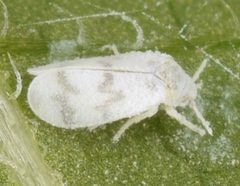
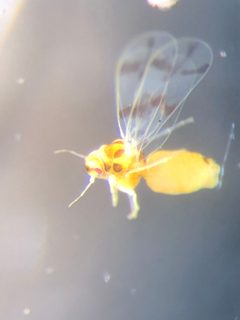
Trialeurodes abutiloneus is a small whitefly in the Aleyrodidae, first described by Haldeman in 1850. measure approximately 1 mm in length and are distinguished by transverse zig-zag bands on the forewings. The species is a phloem-feeding plant pest and a known for Abutilon yellows virus and Sweet potato chlorotic stunt virus. It is primarily associated with malvaceous crops including cotton and hibiscus, as well as sweet potato and soybean.
Pronunciation
How to pronounce Trialeurodes abutiloneus: /traɪəˌljʊəˈroʊdiːz əˌbjuːtɪˈloʊniəs/
These audio files are automatically generated. While they are not always 100% accurate, they are a good starting point.
Identification
are readily identified by the characteristic zig-zag banding pattern on the forewings, visible even at low magnification. This distinguishes T. abutiloneus from the greenhouse whitefly (Trialeurodes vaporariorum), which lacks such banding, and from Bemisia tabaci, which has different wing venation and lacks distinct transverse bands. are oval and deposited on leaf undersurfaces. Nymphs are flattened, oval, and after the stage, with yellowish or whitish translucent appearance.
Images
Habitat
Occurs on the undersides of leaves of plants. Found in agricultural fields, research greenhouses, and areas where host crops are cultivated. In natural settings, associated with wild malvaceous plants.
Distribution
Native to the Americas with historic distribution from Mexico to southern New York and Michigan in the United States. Present in Canada since at least 1973, with confirmed records from southwestern Ontario (Point Pelee National Park, 2012; research greenhouses, 2016). Also recorded from Tennessee, Illinois, and other soybean-growing regions of the United States.
Diet
Phloem-feeding; extracts sap from plant leaves using . Feeding occurs primarily on leaf undersurfaces.
Host Associations
- Gossypium hirsutum - cotton
- Hibiscus - ornamental and wild
- Ipomoea batatas - sweet potato
- Glycine max - soybean; occasional , often spillover from cotton
- Abutilon - wild and cultivated
Life Cycle
Hemimetabolous development with four life stages: , nymph (including mobile stage and feeding instars), pupa (pupal case), and . Eggs are deposited on leaf undersurfaces. Crawlers emerge and locate feeding sites before becoming sessile. Nymphs and pupae are flattened, yellowish to whitish, and translucent. Multiple per year are likely in favorable climates.
Behavior
are weak fliers that flutter from leaf surfaces when disturbed. Colonizes leaf undersurfaces in dense . can build rapidly under favorable conditions, with numerous deposited on leaf surfaces.
Ecological Role
Herbivore that feeds on plant phloem. Acts as a for plant pathogenic viruses including Abutilon yellows virus and Sweet potato chlorotic stunt virus. Serves as prey for in agricultural systems, though specific natural enemy records are poorly documented.
Human Relevance
Agricultural pest of cotton, sweet potato, and occasionally soybean. of economically significant plant viruses. Not considered a major pest in Canada, but of concern in U.S. cotton and sweet potato production. Management in greenhouses and nurseries is important to prevent establishment on ornamental plants.
Similar Taxa
- Trialeurodes vaporariorumGreenhouse whitefly lacks zig-zag wing bands; wings appear uniformly white or with simpler venation patterns
- Bemisia tabaciSweet potato whitefly has different wing shape and venation, lacks distinct transverse banding; more broadly and economically significant
- Trialeurodes urticaeCabbage whitefly has different associations and wing pattern
More Details
Vector Capability
Confirmed for Abutilon yellows virus ( Geminiviridae) and Sweet potato chlorotic stunt virus (family Closteroviridae), both of which cause significant yield losses in susceptible crops.
Taxonomic History
First described by Haldeman in 1850. Despite being present in Canada since 1973, the was not officially recorded there until 2018, when barcode COI sequences were provided to confirm identity.
Detection Methods
High-magnification photography (8X or greater) reveals diagnostic wing patterns and morphological details not visible to the unaided , where appear as mere flecks of dandruff.
Sources and further reading
- BugGuide
- Wikipedia
- GBIF taxonomy match
- iNaturalist taxon
- NCBI Taxonomy
- Catalogue of Life
- Hemiptera | Beetles In The Bush | Page 6
- The gift of poinsettia. The silverleaf whitefly, Bemisia argentifolii — Bug of the Week
- Sulfoxaflor Found to Be Less Harmful to Beneficial Predators of Soybean Aphids
- Trialeurodes abutiloneus (Haldeman) (Hemiptera: Aleyrodidae), a species long present but never officially recorded in Canada