
Trialeurodes
Cockerell, 1902
greenhouse whitefly, whitefly
Species Guides
4- Trialeurodes abutiloneus(bandedwinged whitefly)
- Trialeurodes merlini
- Trialeurodes pergandei
- Trialeurodes vaporariorum(Greenhouse Whitefly)
Trialeurodes is a large of whiteflies in the Aleyrodidae, containing economically significant agricultural pests. The genus includes such as the (T. vaporariorum) and the bandedwinged whitefly (T. abutiloneus), which infest hundreds of plant species including vegetables, cotton, and ornamental plants. Members are tiny phloem-feeding insects, typically measuring 1–3 mm, with distinctive waxy wings and . Several species are subjects of intensive research using .
Pronunciation
How to pronounce Trialeurodes: /ˌtraɪælˈjʊəroʊdiːz/
These audio files are automatically generated. While they are not always 100% accurate, they are a good starting point.
Identification
distinguished from other whitefly by wing venation and body shape; T. abutiloneus identified by characteristic zig-zag transverse bands on forewings. T. vaporariorum lacks wing markings and has more uniformly rounded wing shape compared to Bemisia . Nymphal cases () can be used for species-level identification by microscopic examination of morphological features including vasiform orifice shape and chaetotaxy. From Bemisia tabaci, T. vaporariorum differs in holding wings flatter against substrate and having less waxy appearance.
Images
Appearance
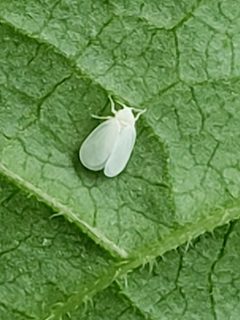
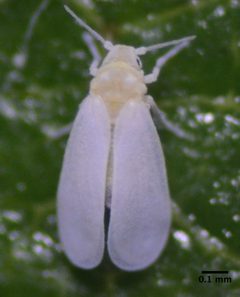
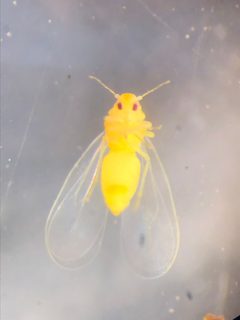
are minute insects, approximately 1–3 mm in length, with powdery white wings held roof-like over the body. Wings often bear distinctive markings: T. abutiloneus displays transverse zig-zag bands on forewings, while T. vaporariorum has uniformly pale wings. Body is soft and pale yellowish. are prominent. Nymphs and pupae are , oval, translucent yellowish or whitish, often with visible red eyespots in late pupal stages. All life stages possess for phloem feeding.
Habitat
Primarily greenhouse and agricultural environments; also open fields in tropical and subtropical regions. Colonizes broad range of plants including vegetables (broccoli, tomato), fiber crops (cotton), and ornamental plants. T. vaporariorum particularly associated with protected systems.
Distribution
distribution with records from Europe (Denmark, Norway, Sweden), North America, South America, and Asia. T. abutiloneus occurs in North America including Tennessee and cotton-growing regions. T. vaporariorum is globally distributed pest of greenhouse crops.
Seasonality
In temperate greenhouse systems, build from October–November through growing season, with first appearing in late October at densities of 0.2–0.3 adults per leaf, peaking at 5.8–7.2 adults plus nymphs per leaf. Multiple overlapping per year in favorable conditions.
Diet
Phloem-feeding on plant sap; extracts nutrients from vascular tissues of plants. Honeydew is characteristic byproduct.
Host Associations
- Gossypium hirsutum - cotton, T. abutilonea
- Glycine max - soybean, occasional
- Brassica oleracea var. italica - broccoli
- Solanum lycopersicum - tomato
- Euphorbia pulcherrima - poinsettia
- Ipomoea batatas - sweet potato, T. abutiloneus
- Abutilon - malvaceous
- Hibiscus - malvaceous
- Encarsia formosa - agent
- Eretmocerus delhiensis - agent
Life Cycle
Hemimetabolous development with four life stages: , nymph (four instars), pupa (pupal case formed by fourth instar ), and . Eggs laid on undersides of leaves. First instar nymphs () mobile, locate feeding site, then become for remaining nymphal stages. Development rate temperature-dependent: 1.3–3.0× faster at 22.5°C and 27°C than at 18°C. Lower threshold temperatures vary by stage: 8.5°C, L1 larvae 11°C, L2 larvae 11.5°C, L3 larvae 7°C, L4 larvae 8.5°C, pupae 10°C. Multiple per year.
Behavior
exhibit wavelength-specific visual orientation : green-yellow light (peak ~550 nm) elicits settling behavior, while UV radiation (peak ~373 nm) initiates migratory behavior. Trichromatic vision with blue-green opponent mechanism demonstrated in T. vaporariorum. Males perform stereotyped courtship with sequential invariable movements; some males adopt 'sneak' strategy approaching courting pairs without preliminary courtship. Males persist in courtship when females perform maintenance activities, with success probability increasing with courtship duration and intensity. Adults disturbed from leaf surface flutter briefly before resettling.
Ecological Role
Herbivorous pest causing direct damage through phloem feeding and indirect damage via honeydew secretion promoting growth. Serves as for Encarsia formosa and Eretmocerus delhiensis, which are important agents in systems. can alter plant physiology and increase susceptibility to other pests.
Human Relevance
Major agricultural pest causing yield reduction and quality loss in greenhouse vegetables, cotton, and ornamentals. T. vaporariorum particularly significant in protected worldwide. Subject of extensive programs using . Chemical control complicated by development of resistance; selective such as sulfoxaflor show efficacy against T. vaporariorum with reduced impact on beneficial . Visual trapping systems exploit color preferences for monitoring and mass trapping.
Similar Taxa
- Bemisia tabaciSimilar whitefly pest; T. vaporariorum holds wings flatter and has less waxy appearance, while B. tabaci holds wings more roof-like and appears more powdery. B. tabaci has more complex status.
- Bemisia argentifoliiSilverleaf whitefly; T. vaporariorum lacks silverleaf induction on squash and has different wing posture and wax production.
- AleyrodesRelated whitefly ; distinguished by puparial and wing characteristics.
More Details
Visual System
T. vaporariorum possesses trichromatic vision with photoreceptor peaks estimated at 510–520 nm (green), 480–490 nm (blue), and 340–370 nm (UV), with demonstrated blue-green opponent mechanism. Yellow-circular visual cues provide optimal attraction.
Courtship Biology
Male courtship persistence represents adaptive strategy: males that persist with females performing maintenance activities achieve higher rates by inducing high-threshold females to mate, while optimizing time investment to avoid diminishing returns.
Pest Management
Encarsia formosa programs well-established; natural products including and cattle by-product show low to , while spiromesifen and imidacloprid are moderately harmful.
Sources and further reading
- BugGuide
- Wikipedia
- GBIF taxonomy match
- iNaturalist taxon
- NCBI Taxonomy
- Catalogue of Life
- Hemiptera | Beetles In The Bush | Page 6
- The gift of poinsettia. The silverleaf whitefly, Bemisia argentifolii — Bug of the Week
- Sulfoxaflor Found to Be Less Harmful to Beneficial Predators of Soybean Aphids
- Biology and Control of the Banded-Wing Whitefly, Trialeurodes Abutilonea (Haldeman), on Cotton in Louisiana.
- Population Dynamics of the Greenhouse Whitefly [Trialeurodes vaporariorum (Westwood) Aleyrodidae, Hemiptera] in Broccoli Greenhouse in Malatya, Turkey Sera Beyazsineği [Trialeurodes vaporariorum (Westwood) Aleyrodidae, Hemiptera] nin Malatya İli Brokoli Seralarındaki Populasyon Dalgalanmaları
- Temperature Requirements of the White Fly Trialeurodes vaporariorum (Homoptera: Aleyrodidae) and its Parasitoid Encarsia formosa (Hymenoptera: Aphelinidae)
- Studies on the tendency of Trialeurodes vaporariorum to shape and color
- Fitness and host preference of Encarsia formosa reared from Trialeurodes vaporariorum and Bemisia tabaci
- Blue-green opponency and trichromatic vision in the greenhouse whitefly ( Trialeurodes vaporariorum )
- Hosls and Distribution of Five Species of Trialeurodes (Homoptera: Aleyrodidae)
- Safety evaluation of natural products and insecticides to Encarsia formosa Gahan, an endoparasitoid of Trialeurodes vaporariorum Westwood
- Functional Response of Eretmocerus delhiensis on Trialeurodes vaporariorum by Parasitism and Host Feeding
- Male Courtship Persistence in the Greenhouse Whitefly, Trialeurodes Vaporariorum Westwood (Homoptera : Aleyrodidae)