
Encarsia formosa
Gahan, 1924
Greenhouse Whitefly Parasitoid Wasp
Encarsia formosa is a minute chalcidoid in the Aphelinidae, renowned as one of the first agents used commercially for greenhouse pest management beginning in the 1920s. Females are approximately 0.6 mm in length and exhibit a distinctive black body with yellow and opalescent wings. The reproduces asexually via thelytoky induced by bacterial ; males are produced but are incapable of inseminating females. This attacks at least 15 whitefly species, with primary including Trialeurodes vaporariorum (greenhouse whitefly) and Bemisia tabaci (silverleaf whitefly).
Pronunciation
How to pronounce Encarsia formosa: /ɛnˈkɑr.si.ə fɔrˈmoʊ.sə/
These audio files are automatically generated. While they are not always 100% accurate, they are a good starting point.
Identification
Distinguished from other Encarsia by the combination of black body with yellow and opalescent wings. The reproductive mode induced by is a key biological identifier. Parasitized whitefly pupae turn black (for greenhouse whitefly) or amber brown (for sweet potato whitefly) within approximately 10 days, providing a diagnostic field indicator of E. formosa activity.
Images
Appearance
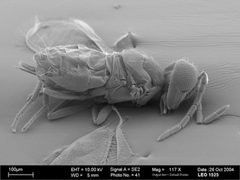
females measure approximately 0.6 mm in length. Body predominantly black with contrasting yellow . Wings display an opalescent (iridescent) quality. Males are produced but are rare and morphologically distinct, lacking functional reproductive capacity.
Habitat
Primarily associated with protected agricultural environments including greenhouses and indoor ornamental plant production systems. Occurs wherever whitefly establish on cultivated plants, particularly tomato, cucumber, and ornamental crops.
Distribution
Widely distributed through commercial programs globally. Established documented in Europe, North America (including California and Florida greenhouse systems), New Zealand, and Russia. Naturally occurring distribution unclear due to extensive commercial movement; records from Serbia, Alberta (Canada), and the Azores (Portugal) among confirmed locations.
Seasonality
Activity governed by temperature rather than . Optimal developmental temperatures range 20–25°C. ceases below approximately 12°C and above 40°C. maturation arrested or severely reduced at temperatures below 15°C, with complete cessation at 5°C. Commercial releases typically timed to coincide with whitefly establishment in greenhouse crops.
Diet
-feeding . females feed on host whitefly nymphs through , consuming host . Larval development occurs within parasitized whitefly nymphs or pupae.
Host Associations
- Trialeurodes vaporariorum - primary Greenhouse whitefly; original target for commercial
- Bemisia tabaci - Silverleaf whitefly; significant agricultural pest
- Aleyrodes proletella - Cabbage whitefly
- Bemisia argentifolii - Formerly considered distinct from B. tabaci
Life Cycle
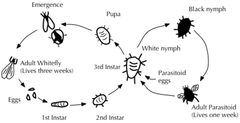
Females deposit 50–100 individually inside whitefly nymphs or pupae. Larval development proceeds through four instars over approximately two weeks at optimal temperatures. occurs within the body. follows approximately 10 days after pupation. Total development time from egg to adult varies with temperature, with thermal thresholds near 2°C for . -induced thelytoky ensures nearly all offspring are female.
Behavior
Exhibits the 'clap and fling' mechanism characteristic of sub-millimeter insects, where wings are clapped together and then flung apart to generate lift. Demonstrates ovicide—destruction of already present in . Engages in lethal interference, where females may kill in previously parasitized hosts. Host-feeding is facultative and influenced by food deprivation and host availability. Shows strong phototactic attraction to green light (peak ~521–524 nm), with substantially reduced response to yellow LED-enhanced traps compared to standard yellow sticky traps.
Ecological Role
regulating whitefly in agricultural and greenhouse . Functions as a agent, reducing reliance on chemical . tightly coupled with whitefly and temperature conditions. Intraspecific and with other whitefly parasitoids (e.g., Encarsia pergandiella) occurs through intrinsic competition and lethal interference.
Human Relevance
One of the earliest and most widely used commercial agents, with continuous use since the 1920s. Usage declined with advent of synthetic in the 1940s but resurged from the 1970s with adoption. Primary control agent for in New Zealand and European protected cropping systems. Applied in programs on tomato, cucumber, and ornamental crops where chemical control is problematic. Compatibility with selective and natural products (, vermiwash) supports integration with reduced-pesticide strategies.
Similar Taxa
- Encarsia pergandiellaCongeneric whitefly with overlapping range; distinguished by differences in size and competitive outcomes in intrinsic competition
- Encarsia luteolaMorphologically similar congeneric ; molecular markers (28S rDNA) required for definitive discrimination
More Details
Wolbachia Symbiosis
The in E. formosa is induced by with the bacterial endosymbiont . treatment can eliminate Wolbachia, resulting in male production. This represents one of the clearest demonstrations of microbial manipulation of reproduction in insects.
Temperature-Mediated Reproduction
Low night temperatures in greenhouse tomato production (<15°C) substantially reduce maturation, potentially compromising efficacy. Temperature management is critical for optimizing performance.
Commercial Production
Mass-reared on whitefly-infested plants or artificial diets for commercial sale. Quality control focuses on female-biased sex ratios and capability.
Sources and further reading
- BugGuide
- Wikipedia
- GBIF taxonomy match
- iNaturalist taxon
- NCBI Taxonomy
- Catalogue of Life
- Publications | Entomology Research Museum
- From Honey Bees to Flower Thrips to Asian Longhorned Beetles | Bug Squad
- Cicindela formosa pigmentosignata (the “reddish-green sand tiger beetle”) | Beetles In The Bush
- Cicindela lengi vs. Cicindela formosa | Beetles In The Bush
- How an Entomologist Explores the Bacterial Saboteurs of Insect Reproduction
- A Passion for Parasitoids: How One Entomologist Found a Calling in Wasp Systematics
- Ovicide in the whitefly parasitoid, Encarsia formosa
- [IN1337] Encarsia Wasp, a Silverleaf Whitefly Parasitoid (suggested) Encarsia formosa Gahan (Insecta: Hymenoptera: Aphelinidae)
- Egg Size, Intrinsic Competition, and Lethal Interference in the Parasitoids Encarsia pergandiella and Encarsia formosa
- Foraging Behavior of the Parasitoid Encarsia formosa on Gerbera jamesonii Leaves
- Phototactic behaviour of the parasitoidEncarsia formosa(Hymenoptera: Aphelinidae)
- Spectral Preferences of Encarsia formosa: Unravelling Attraction to LED Monitoring Traps
- How to behave? : evolution of host-handling behaviour in the whitefly parasitoid Encarsia formosa
- Temperature Requirements of the White Fly Trialeurodes vaporariorum (Homoptera: Aleyrodidae) and its Parasitoid Encarsia formosa (Hymenoptera: Aphelinidae)
- Understanding biological control of greenhouse whitefly with the parasitoid Encarsia formosa : from individual behaviour to population dynamics
- Life history traits and population growth of Encarsia Formosa Gahan (Hymenoptera: Aphelinidae) local population from Serbia
- Fitness and host preference of Encarsia formosa reared from Trialeurodes vaporariorum and Bemisia tabaci
- The parasite‐host relationship between Encarsia formosa (Hymenoptera, Aphelinidae) and Trialeurodes vaporariorum (Homoptera, Aleyrodidae)
- The parasite‐host relationship between Encarsia formosa (Hymenoptera, Aphelinidae) and Trialeurodes vaporariorum (Homoptera, Aleyrodidae)
- Safety evaluation of natural products and insecticides to Encarsia formosa Gahan, an endoparasitoid of Trialeurodes vaporariorum Westwood
- Combined release of the predator Orius similis and the parasitoid Encarsia formosa enhances biological control of Bemisia tabaci
- Behavioral and physiological responses of the aphelinid parasitoid, Encarsia formosa, to interspecific competitors.