
Encarsia
Förster, 1878
Species Guides
4- Encarsia citrina
- Encarsia formosa(Greenhouse Whitefly Parasitoid Wasp)
- Encarsia lanceolata
- Encarsia nigricephala
Encarsia is a large of minute parasitic in the Aphelinidae, comprising approximately 400–473 described with worldwide distribution. The genus exhibits complex morphological variation that complicates species-level identification. Many species are economically important agents used in greenhouse and agricultural settings against whiteflies and scale insects.
Pronunciation
How to pronounce Encarsia: /ɛnˈkɑr.si.ə/
These audio files are automatically generated. While they are not always 100% accurate, they are a good starting point.
Identification
Accurate identification within Encarsia requires specialized taxonomic expertise due to extensive morphological variation. Molecular markers (e.g., 28S rDNA) have been developed to distinguish closely related species such as E. formosa and E. luteola. Reference to authoritative keys and voucher specimens is essential for reliable determination.
Images
Appearance
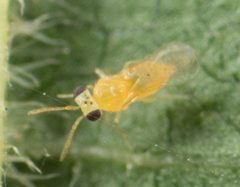
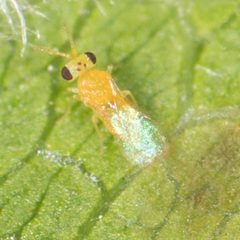
are tiny , approximately 1–2 mm in length. The exhibits substantial inter- and intra-specific morphological variation, making visual identification challenging. Specific diagnostic features vary by and typically require microscopic examination.
Habitat
occur in diverse environments including agricultural fields, greenhouses, orchards, and natural vegetation. Specific vary by association; many species are closely tied to host plant systems supporting their whitefly or insect hosts.
Distribution
Worldwide distribution with documented across all major biogeographic regions. Over 100 species recorded from China alone. Specific distribution records include: Alaska, Arizona, Beijing, California, Colorado, and numerous localities in Europe, Asia, Africa, and the Americas.
Host Associations
- Aleyrodidae (whiteflies) - primary Major group; includes economically important pests such as Trialeurodes vaporariorum (greenhouse whitefly), Bemisia tabaci (sweet potato whitefly), and Aleurocanthus spp.
- Diaspididae (armored scale insects) - primary Second major group; includes pests such as Pseudaulacaspis pentagona (white peach ) and Quadraspidiotus perniciosus (San Jose scale)
- Aphididae (aphids) - Few known to parasitize aphids
- Plataspidae (shield-back bugs) - parasitized by some
- Lepidoptera - parasitized by a few
Life Cycle
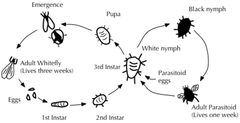
Females develop as primary endoparasitoids within nymphs or . Males commonly develop as hyperparasitoids, emerging from either females or other . This heteronomous development represents a distinctive reproductive strategy in the . Developmental timing varies by species and temperature; E. formosa typically requires 16–21 days from oviposition to at greenhouse temperatures.
Behavior
females search for and oviposit into stages (whitefly nymphs or scale insects). Some show strong phototactic responses; E. formosa exhibits highest attraction to green light wavelengths (peak ≈521–524 nm). Foraging activity varies diurnally, with responsiveness increasing approximately fivefold from morning to afternoon in some species.
Ecological Role
Important natural enemies of agricultural and horticultural pests, particularly whiteflies and armored scale insects. Serve as agents in programs. are closely linked to and plant structure.
Human Relevance
Widely used in commercial programs. E. formosa has been employed in over 20 countries for greenhouse whitefly management, with large- commercial production. Other used specifically for control of Bemisia tabaci (E. bimaculata, E. lutea, E. pergandiella, E. sophia), citrus blackfly (E. clypealis, E. perplexa), and various scale insects (E. berlesei, E. harrisoni, E. perniciosi).
Similar Taxa
- Eretmocerus (Aphelinidae)Also of whiteflies; distinguished by different antennal structure and male development mode
- Coccophagus (Aphelinidae)Related aphelinid of scale insects and whiteflies; differs in wing venation and male genitalia
More Details
Symbiont associations
Some Encarsia harbor the bacterial endosymbiont Cardinium hertigii, which infects male reproductive tissues (sperm or seminal vesicle) and influences reproductive . The effects of this are temperature-dependent.
Taxonomic complexity
The is taxonomically challenging due to extensive morphological variation both within and between . Molecular phylogenetic approaches (mitochondrial , nuclear rDNA) are increasingly employed to resolve species boundaries and relationships.
Mitochondrial genome
Sequenced have mitochondrial of 14,049–14,849 with A+T content of 84.1–84.8%. Phylogenomic analyses support placement of Aphelinidae as sister group to Torymidae within Chalcidoidea.
Sources and further reading
- BugGuide
- Wikipedia
- GBIF taxonomy match
- iNaturalist taxon
- NCBI Taxonomy
- Catalogue of Life
- From Honey Bees to Flower Thrips to Asian Longhorned Beetles | Bug Squad
- Primary Type List | Entomology Research Museum
- Publications | Entomology Research Museum
- Encarsia wasp pupal testis - Entomology Today
- Encarsia suzannae - Entomology Today
- Encarsia-harrisoni - Entomology Today
- Descriptions of Two New Species of Encarsia (Hymenoptera: Aphelinidae) and Mitochondrial Genome Analysis of Three Species of the Genus (†).
- Spectral Preferences of Encarsia formosa: Unravelling Attraction to LED Monitoring Traps.