
Aphelinidae
Thomson, 1876
Subfamily Guides
3is a of minute parasitic containing approximately 1,100-1,160 described across 34-35 . These tiny insects are among the most important agents used in agriculture, particularly for managing scale insects, whiteflies, and other Hemiptera. The family was formerly , leading to the recent elevation of Azotidae, Calesidae, and Eriaporidae to family rank. Specimens deteriorate rapidly after death unless preserved in ethanol, making museum identification challenging.
Pronunciation
How to pronounce Aphelinidae: //æfəˈlaɪnɪdiː//
These audio files are automatically generated. While they are not always 100% accurate, they are a good starting point.
Identification
Separation from other Chalcidoidea requires examination of subtle wing venation characters, particularly the arrangement and reduction of the marginal, stigmal, and postmarginal . Formerly difficult to distinguish from related families Azotidae, Calesidae, and Eriaporidae, which were recently elevated from . Slide-mounting essential for reliable identification; specimens in Hoyer's medium deteriorate over time. Canada balsam mounts preferred for permanent collections. Male and female specimens often require separate diagnostic characters due to in and wing development.
Images
Appearance
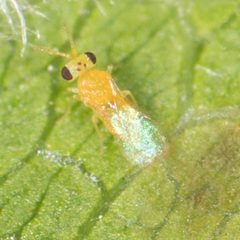
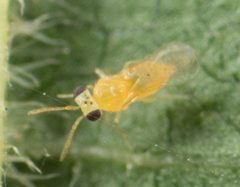
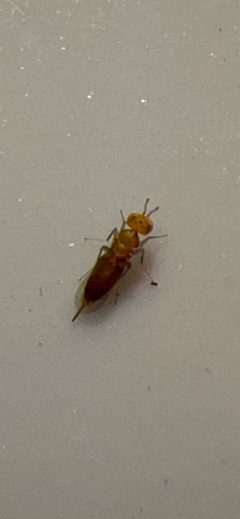
Extremely small , typically 1-2 mm in body length. Body compact with reduced wing venation compared to other Chalcidoidea. with 5-9 segments, often with distinct club. Wings usually with reduced venation; forewing often with distinct venation patterns including marginal, stigmal, and postmarginal that serve as critical diagnostic features. Body coloration variable: many yellow, brown, or black, often with metallic reflections. common, with males frequently smaller and with different antennal structure than females.
Habitat
Found in virtually all terrestrial worldwide, from tropical to temperate regions. Common in agricultural systems, orchards, and natural vegetation. Associated with insects on plants; many tied to specific host plant-host insect combinations. Some species restricted to particular biomes (e.g., desert, tropical forest, Mediterranean climate).
Distribution
distribution with recorded from all continents except Antarctica. Highest diversity in tropical and subtropical regions. Well-documented faunas in North America, Europe, Mexico (184 species), Asia, and Australia. Specific distributions vary by : Aphytis spp. widespread in warm regions; Encarsia spp. nearly worldwide; Coccophagus spp. predominantly in warmer climates.
Seasonality
Activity patterns vary by climate and availability. In temperate regions, multiple per year with peak activity synchronized with host insect cycles. In tropical and subtropical regions, continuous breeding possible year-round. Some overwinter as stages within hosts. Generation times typically short (2-4 weeks) under favorable conditions.
Host Associations
- Hemiptera: Diaspididae - primary armored scale insects; major group for Aphytis spp.
- Hemiptera: Aleyrodidae - primary whiteflies; major group for Encarsia spp.
- Hemiptera: Pseudococcidae - primary mealybugs; for some Coccophagus and other
- Hemiptera: Coccidae - primary soft scales; for some
- Hemiptera: Aphididae - primary aphids; for Aphelinus spp.
- Hemiptera: Psyllidae/Liviidae - primary psyllids; some recorded
- Hemiptera: Cicadellidae - primary leafhoppers; some recorded
- Hymenoptera: Aphelinidae - hyperparasitoidautoparasitism and heteronomous hyperparasitism in some Encarsia spp.
- Lepidoptera - primary of some ; less common
Life Cycle
Development is holometabolous with complete . typically deposited inside or attached to . Larval stages (usually 3-4 instars) develop as endoparasitoids or ectoparasitoids within or on host insects. occurs within host remains or in silken cocoon. time varies: 2-4 weeks under optimal conditions, longer in cooler temperatures. Some exhibit (males from unfertilized eggs), others deuterotoky. Sex ratios often female-biased.
Behavior
Females exhibit -searching involving antennal contact and ovipositor probing. Many demonstrate host discrimination, avoiding previously parasitized hosts. Some Encarsia species are facultative autoparasitoids, with females developing as primary and males as hyperparasitoids of or heterospecific females. Males and females may have different host preferences and . activity generally limited due to small size; often passive via wind or host insect movement.
Ecological Role
Major regulators of sap-feeding insect , particularly scale insects and whiteflies in natural and agricultural . Critical components of programs worldwide. Some maintain populations below in citrus, greenhouse crops, and field agriculture. Hyperparasitoid species may complicate by attacking beneficial .
Human Relevance
Among the most economically important of agents. Aphytis melinus, A. lingnanensis, and related control California red scale and other armored scales in citrus globally. Encarsia formosa is widely used in greenhouses for whitefly control. Encarsia opulenta and E. perplexa manage citrus blackfly in the Americas. programs have introduced numerous species to new regions. Augmentative and inundative releases common in protected agriculture. Some species used in programs.
Similar Taxa
- AzotidaeFormerly Azotinae of ; elevated to rank in recent revisions; subtle differences in wing venation and antennal structure
- CalesidaeFormerly Calesinae of ; elevated to rank; distinct in antennal segmentation and wing venation patterns
- EriaporidaeFormerly Eriaporinae of ; elevated to rank; morphologically divergent with distinct associations
- EncyrtidaeSimilar minute in Chalcidoidea; distinguished by different wing venation patterns and often by with more segments
- TrichogrammatidaeSimilar tiny ; distinguished by wing venation with reduced venation and different antennal structure
Misconceptions
Formerly considered to include Azotidae, Calesidae, and Eriaporidae as ; these are now recognized as separate , making older literature potentially misleading regarding family boundaries. Some literature may not reflect this taxonomic change.
More Details
Taxonomic History
The was formerly , containing Azotinae, Calesinae, and Eriaporinae. Recent phylogenetic studies led to elevation of these to family rank, restricting sensu stricto. This revision affects interpretation of older literature and collection records.
Preservation Challenges
Specimens deteriorate rapidly post-mortem due to desiccation and body collapse. Hoyer's medium mounts degrade over decades; Canada balsam preferred for permanent collections. The UCR Aphytis project remounted over 7,000 specimens from Hoyer's to Canada balsam to preserve this irreplaceable collection.
Biological Control Significance
of Aphytis, Encarsia, and Coccophagus rank among the most successful agents. Aphytis melinus alone has saved California citrus industry millions of dollars annually since its introduction in the 1950s.
Sources and further reading
- BugGuide
- Wikipedia
- GBIF taxonomy match
- iNaturalist taxon
- NCBI Taxonomy
- Catalogue of Life
- Primary Type List | Entomology Research Museum
- Aphytis Project Final Report | Entomology Research Museum
- Remounting Procedure for Aphytis | Entomology Research Museum
- CDFA to Host Fruit Fly Workshop, Free to Participants | Bug Squad
- Publications | Entomology Research Museum
- Looking for Lygus | Bug Squad
- Biodiversidad de Aphelinidae (Hymenoptera: Chalcidoidea) en México
- Primary Host Discrimination and Elimination of Supernumeraries in the Facultative Autoparasitoid Encarsia tricolor (Hymenoptera: Aphelinidae)
- Citrus Blackfly Parasitoid, Encarsia opulenta (Silvestri) (Insecta: Hymenoptera: Aphelinidae)
- Citrus Whitefly Parasitoid, Encarsia lahorensis (Howard) (Insecta: Hymenoptera: Aphelinidae)
- Temperature Requirements of the White Fly Trialeurodes vaporariorum (Homoptera: Aleyrodidae) and its Parasitoid Encarsia formosa (Hymenoptera: Aphelinidae)
- Life history traits and population growth of Encarsia Formosa Gahan (Hymenoptera: Aphelinidae) local population from Serbia
- Life table of the aphid parasitoid Aphelinus asychis (Walker)(Hymenoptera, Aphelinidae) parasitizing different age groups of Aphis gossypii Glover (Homoptera, Aphididae) Biologische Eigenschaften von Aphelinus asychis (Walker) (Hymenoptera, Aphelinidae) bei Parasitierung unterschiedlicher Altersstufen von Aphis gossypii Glover (Homoptera, Aphididae)
- Aphid parasitoids [Hym.: Aphidiidae, Aphelinidae] from the Yemen Arab Republic
- Diversity ofEncarsiaspp. (Hymenoptera: Aphelinidae) and their hosts on different plant species
- Descriptions of Two New Species of Encarsia (Hymenoptera: Aphelinidae) and Mitochondrial Genome Analysis of Three Species of the Genus (†).