
Parasitidae
predatory mites, bee mites, beetle mites
Subfamily Guides
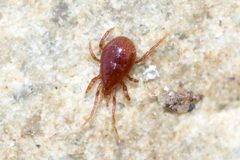
2Parasitidae is a of predatory mites in the order Mesostigmata, representing the sole family in the superfamily Parasitoidea. These mites are relatively large for their group, often appearing yellowish to dark brown in color. The family has worldwide distribution and contains approximately 400 across 29 organized into two : Pergamasinae (soil-dwelling, non-phoretic) and Parasitinae (nest-dwelling, phoretic deutonymphs). Members prey on diverse microarthropods and , with individual species typically exhibiting narrower prey ranges than the family as a whole.
Pronunciation
How to pronounce Parasitidae: //ˌpæɹ.əˈsɪt.ɪˌdiː//
These audio files are automatically generated. While they are not always 100% accurate, they are a good starting point.
Identification
Relatively large body size compared to most mites; coloration ranges from yellowish to dark brown. Two distinguished by and mode: Pergamasinae found in soil without phoretic dispersal; Parasitinae found in animal nests or decaying matter with phoretic deutonymphs.
Images
Habitat
Pergamasinae: soil and rotting organic matter. Subfamily Parasitinae: nests of small mammals or insects, decaying organic matter including seaweed to forest litter, animal and manure.
Distribution
Worldwide distribution. Pergamasinae: Holarctic region with center of diversity in Europe. Specific records from Slovakia, Austria, Hungary, Poland. Parasitinae: ; associated with various including bumblebees, other bees, and dung beetles.
Diet
as a whole preys on wide variety of microarthropods and ; individual typically have narrower prey ranges. Specific documented prey includes fly and nematodes.
Host Associations
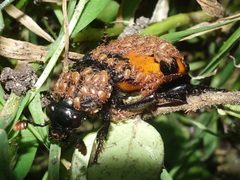
- dung beetles (Aphodiinae) - phoretic for used by Parasitinae deutonymphs for transport to new
- bumblebees - phoretic Parasitellus and related genera
- other bees - phoretic various in Parasitinae
- burying beetles - phoretic Poecilochirus
Life Cycle
Development from to deutonymph occurs rapidly in ephemeral (as quick as three days in some ). Deutonymph serves as environmentally tolerant, non-feeding stage capable of surviving starvation and desiccation for approximately one month. Phoretic deutonymphs disperse on insect . Molting to adulthood triggered by abundant food resources and encounters with conspecifics; lose environmental and dispersal ability, with longevity of approximately one week. Developmental times range from 12 to over 60 days depending on species and conditions; laboratory times of 8.5–10.2 days reported.
Behavior
Phoretic via deutonymph stage on insect carriers. Developmental arrest at deutonymph stage under isolated conditions. Sex-specific molting triggers: female deutonymphs upon encountering males regardless of male stage, while male deutonymphs only molt when paired with female deutonymphs (not females), representing adaptive male mate choice in ephemeral environments.
Ecological Role
Predatory mites controlling of microarthropods and in soil, , and decaying organic matter .
Similar Taxa
- Oribatidaalso called 'beetle mites' but for different reasons; Oribatida is an order of mites with different and , not a within Mesostigmata
Sources and further reading
- BugGuide
- Wikipedia
- GBIF taxonomy match
- iNaturalist taxon
- NCBI Taxonomy
- Catalogue of Life
- How long Parasitidae (Acari: Parasitiformes: Mesostigmata) live?
- First records of three Pergamasinae species (Acari, Mesostigmata, Parasitidae) from Slovakia
- To molt or not to molt: The dilemma of acquiring sexual maturity while losing durability and dispersal ability in Phorytocarpais fimetorum mites (Acari; Gamasida; Parasitidae)
- Two new Pergamasus species (Acari: Mesostigmata: Parasitidae) from Slovakia
- To molt or not to molt: The dilemma of acquiring sexual maturity while losing durability and dispersal ability in deutonymphs of Parasitus fimetorum (Gamasida; Parasitidae)
- Three new species of Psilogamasus Athias-Henriot, 1969 (Acari, Parasitiformes, Parasitidae) from Southwest China.
- Immune-Related Genes in the Honey Bee Mite Varroa destructor (Acarina, Parasitidae).