
- Published on
Tiger Beetles
- Authors

- Name
- Mike Porter
- @bugswithmike
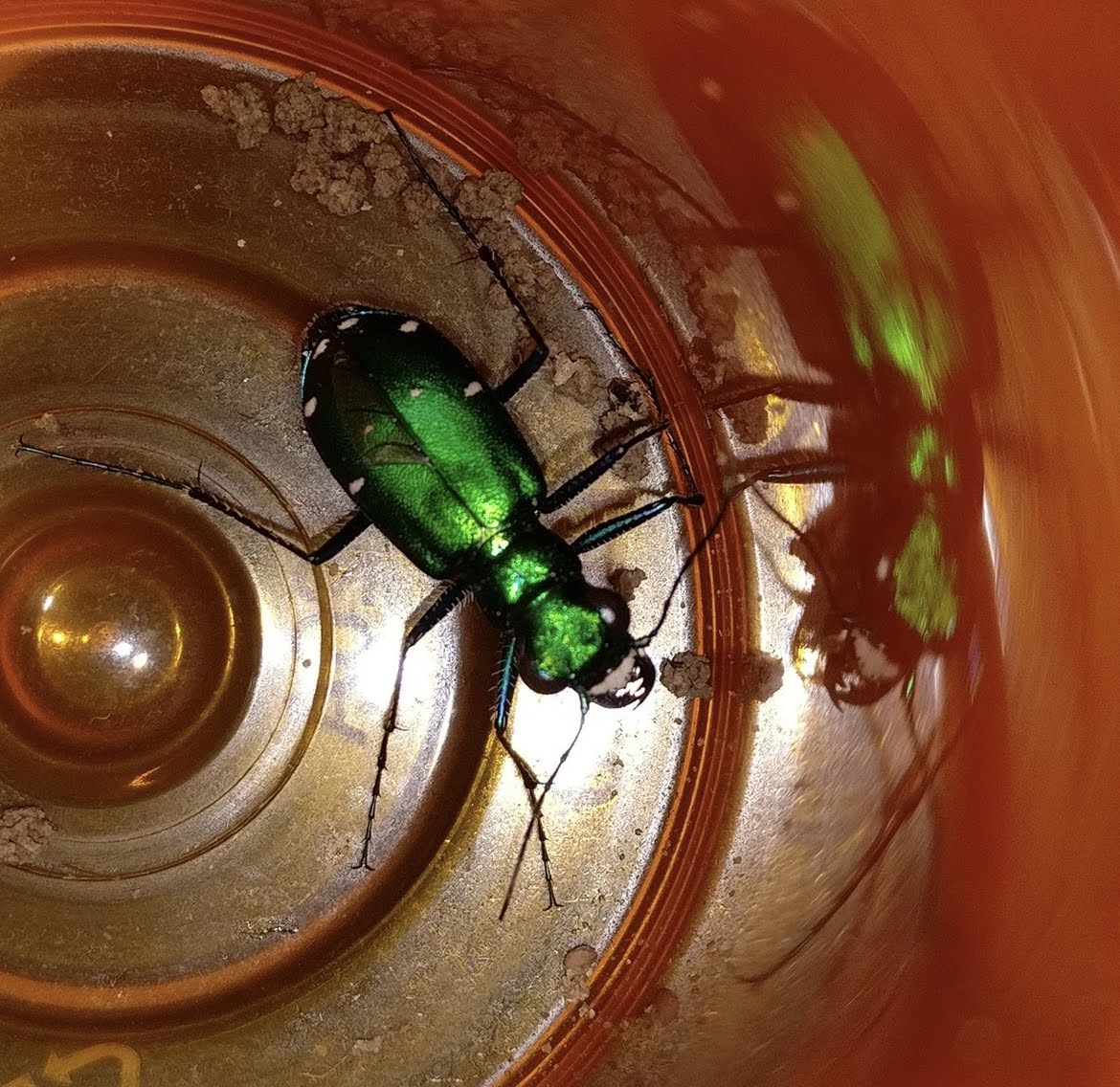
My wife once had the privilege of watching me dash across a sandy beach like a madman. We were on the bank of a river, and there were tiger Now tiger beetles are fast, so I was running across the sand swinging my net like crazy. It was not very efficient, but I did catch a few.
Several years later we were going on a walk in a wooded area and I noticed some tiger beetles. My wife asked if I was going to catch any, and I said no because I did not have a net with me, just a few empty pill bottles. She asked what I would get her if she caught one, and I said I would buy a bottle of perfume she had recently discovered and wanted. It was a safe bet because tiger beetles are fast. However, within a matter of minutes, she had caught one. I was still in a state of disbelief when she caught a second one. She got the perfume and I learned that tiger beetles are not quite as hard to catch as I had made them out to be.
What are tiger beetles?
Tiger beetles look as if they were designed by someone who could not choose between elegance and menace. Many shimmer in iridescent green, blue, bronze, or They stand high on long legs, carry outsized sickle-like and have huge bulging that telegraph exactly what they are: visual hunters.
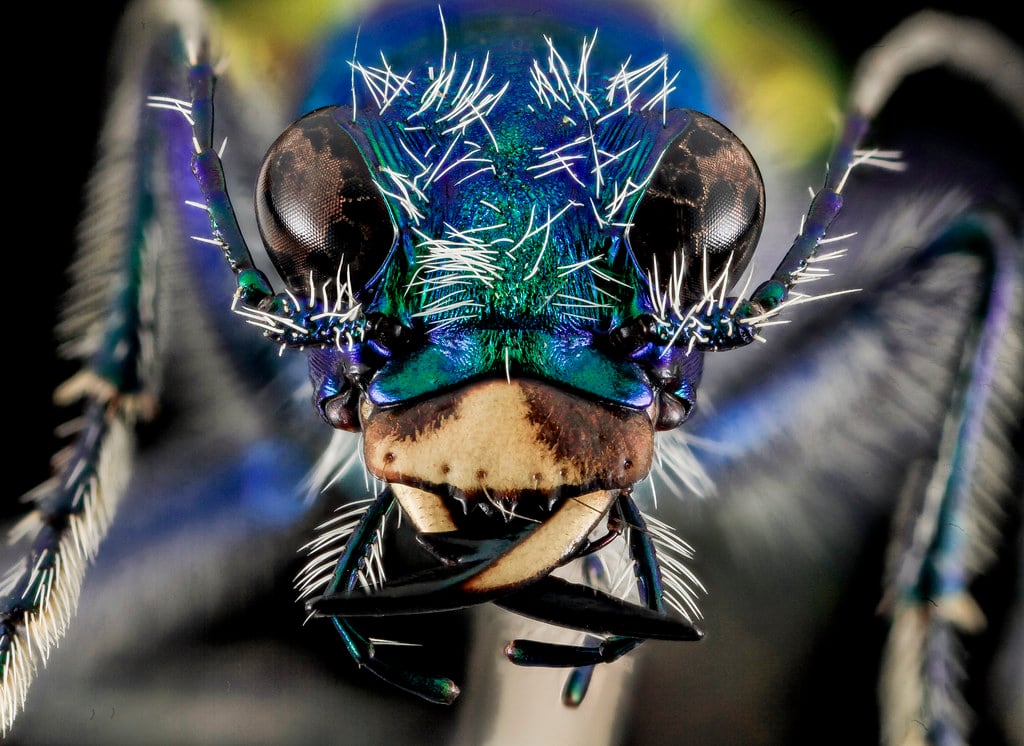
Image by Sam Droege
Used under a Public Domain license.
There are more than 2,600 tiger beetle species worldwide. They occur across much of the globe, though the greatest diversity is in warmer regions. Many people encounter them on sunny paths, riverbanks, beaches, dunes, mudflats, or sparsely vegetated ground—places where speed and eyesight matter.
Built to hunt in bright, open places
Tiger beetles are in open terrain. Most species prefer with bare or lightly vegetated ground, often with sandy, silty, saline, or clay-rich soils. That preference is not just aesthetic. Open ground gives room to sprint and fly after prey, and it gives females suitable places to lay where larvae can dig stable burrows.
The adults are active chasing down flies, caterpillars, small spiders, and other Their large eyes are central to this lifestyle. Tiger beetles are among the insect world's great visual hunters, and some studies have described their response times and pursuit as remarkably sophisticated for such small animals.
And then there is the speed. One Australian species, Rivacindela hudsoni , has been reported running about 2.5 meters per second—roughly 125 body lengths per second. On a human that is absurd. That would be the equivalent of a human traversing two and half football fields in a second. It is one of those facts that sounds made up until you watch a tiger beetle vanish across hot ground and realize the numbers are probably not exaggerating by much.
The strange problem with being too fast
Tiger beetles are famous for a peculiar hunting pattern: sprint, stop, sprint, stop. For years this looked like indecision, but it turns out it is closer to a sensory limitation. When some tiger beetles run at full tilt, they move so fast that their visual system cannot keep prey sharply resolved during the chase. In effect, speed briefly outruns vision.
Research on tiger beetles showed that motion blur degrades what they can see while running. The beetle rushes forward, loses precise visual lock on the target, halts for a fraction of a second to relocate it, then charges again. Another study found that while their eyes are excellent, the beetles rely heavily on their forward-held to detect obstacles during these runs. In other words, they sometimes hunt like animals that are both superbly sighted and temporarily blinded by their own acceleration.
Larvae: ambush predators hiding in plain sight
The adult beetles usually get the attention, but the larvae may be even more interesting. A tiger beetle larva spends much of its life in a vertical soil burrow, often in the same kind of open habitat favored by adults. From the surface, the burrow can be almost invisible except for a neat circular opening and, in some species, a little scatter of excavated soil nearby.
.jpg)
Image by Katja Schulz
Used under a CC BY 2.0 license.
At the top of the burrow, the larva waits with its flattened plugging the entrance. If a small wanders too close, the larva lunges upward, grabs it with powerful jaws, and drags it underground. This works because the larva has a humped back and hooks on the that brace it inside the tunnel, making it difficult for struggling prey to yank it free. Here is a video of one in action.
Larval development usually proceeds through three instars, and the burrow is both home and hunting blind. In many species, larvae and adults overwinter in the soil. That means the habitat has to work year-round and across the whole life cycle, not just for flashy adults in summer.
Why naturalists and conservation biologists care so much about them
Tiger beetles punch above their weight in conservation. They are often habitat specialists, conspicuous enough to survey, and tightly linked to environmental conditions such as soil type, moisture, salinity, flooding regime, shoreline dynamics, or the amount of bare ground. Because of that, they can serve as indicator species: if tiger beetles disappear, the habitat is often changing in ways that matter to many less visible organisms too.
That sensitivity is also why so many species are in trouble. Open habitats are easy for humans to dismiss as empty or degraded, but tiger beetles reveal how biologically rich those places can be. A sandy beach, saline flat, sparsely vegetated river bar, or clay bank may look austere from a distance. To a tiger beetle, it is a finely tuned landscape with exactly the right temperature, texture, exposure, and prey traffic.
When those places are altered, the beetles often go with them. Off-road vehicle traffic can crush larval burrows on beaches and dunes. River damming and channelization can eliminate the shifting sand and cobble bars some species need. Shoreline armoring, plants, heavy foot traffic, development, and changes in hydrology can all convert open hunting grounds into habitat that is unsuitable for tiger beetles.
A few species tell the larger story
Conservation examples make the pattern vivid. The Salt Creek tiger beetle of eastern Nebraska survives in a tiny remnant of saline wetland habitat, more than 90 percent of which has been destroyed or severely degraded. The cobblestone tiger beetle, a riparian specialist of northeastern and eastern North America, depends on dynamic river systems that create and renew sandy cobble bars through flooding and ice scour. When those processes are interrupted, the habitat ages out of suitability.
These are not isolated anecdotes. Across North America and elsewhere, tiger beetle declines often track the same broad pressures affecting many invertebrates: habitat loss, habitat fragmentation, altered disturbance regimes, invasive vegetation, and climate-related shifts in temperature and water. Because each species can be picky about microhabitat, even subtle changes in soil moisture or vegetation cover can matter.
Beautiful does not mean harmless
Tiger beetles are beneficial predators in the everyday sense that they consume lots of other arthropods, including species people might consider pests. But they are not delicate ornaments. If you pick one up carelessly, it may bite, and people who have handled them tend to remember that fact.
That toughness is part of their appeal. They are jewel-bright, yes, but also unapologetically violent on an insect scale. The same animal that flashes emerald in sunlight is perfectly willing to seize prey, wrestle it to the ground, and eat it where it falls.
How to find one without being obnoxious about it
The best way to look for tiger beetles is to slow down and watch open ground on warm, sunny days. River edges, lake shores, ocean beaches, trails through sandy woods, mudflats, salt flats, and sparsely vegetated paths are all promising. Usually you see movement first: a quick metallic flicker, a short run, a pause, then another burst.
If you want photographs, move patiently and avoid casting a sudden shadow. If you want larvae, look for clean circular burrow openings in suitable soil—but do not dig them up or trample the area. For many species, especially rare ones, the right ethic is admiration at low impact. These beetles often live in places that already receive more pressure than they can afford.
Conclusion
Tiger beetles are easy to love because they are flashy and fast, but they are worth deeper attention because they make visible. They show that apparently bare ground can be a sophisticated living system. They show that speed can create its own sensory problems. And they show, with uncomfortable clarity, how quickly specialized habitats can unravel.
In that sense, tiger beetles are more than insect curiosities. They are tiny predators with movie-star looks, but they are also field guides to the health of beaches, dunes, riverbars, saline flats, and other open landscapes we too often overlook. If you start noticing them, you may also start noticing the habitats beneath your feet a little differently.
Sources
- Tiger beetle | Insect, Description, Speed, Predatory, & Facts
- Tiger Beetle - Field Guide to Common Texas Insects
- When tiger beetles chase prey at high speeds they go blind temporarily, Cornell entomologists learn
- Static antennae act as locomotory guides that compensate for visual motion blur in a diurnal, keen-eyed predator
- Speedy tiger beetles use antennae to 'see' while running
- Biology, Life Cycle and Behavior of Tiger Beetle | Department of Entomology
- Tiger Beetles | Xerces Society
- Tiger beetle | Wikipedia