
- Published on
Aphids: Tiny Pests, Weird Lives, and a Bigger Ecological Story
- Authors

- Name
- Mike Porter
- @bugswithmike
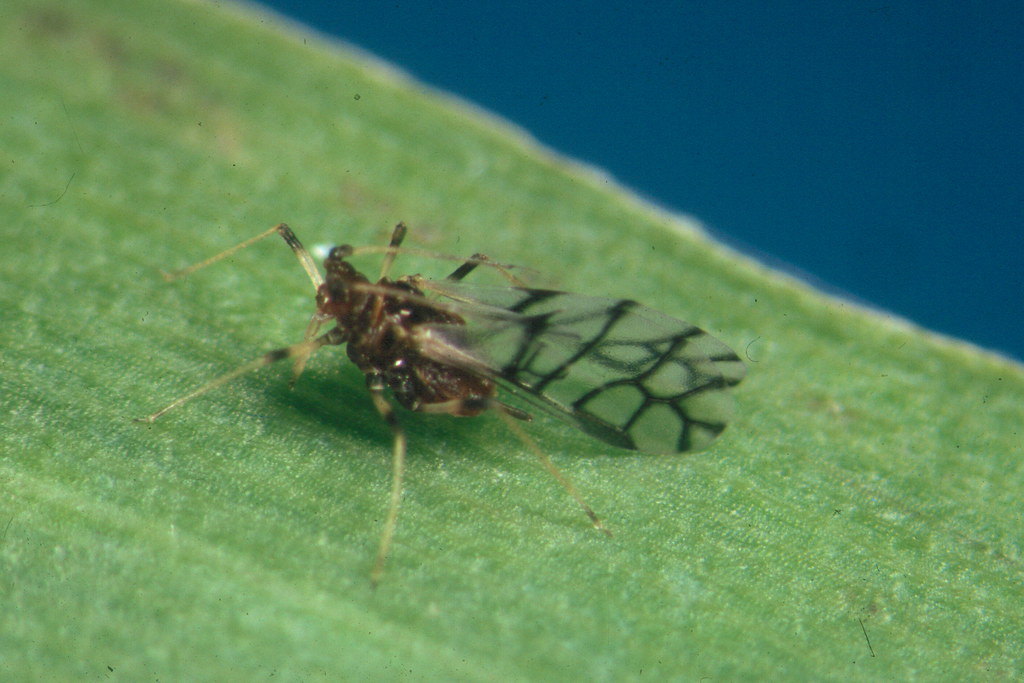
People usually talk about like they are already explained. Tiny green Bad for the roses. Spray them, squish them, move on.
That is not wrong. It is just a very small version of the story.
Aphids really are serious plant pests. They feed on phloem, the sugar-rich fluid moving through a plant's plumbing, and in big enough numbers they can leave leaves curled, sticky, and generally miserable.1 But once you look past the “little green pest” label, aphids turn out to be much stranger and much more important than they get credit for. They are sap-feeding with bacterial partners living inside them, one of the oddest reproductive systems in everyday insect life, and an ecological role that reaches well beyond the plant they are sitting on.23
What aphids are
-PLoS.jpg)
Image by Shipher Wu (photograph) and Gee-way Lin (aphid provision), National Taiwan University
Used under a CC BY 2.5 license.
Aphids are small hemipteran insects built to feed with piercing mouthparts.2 In plain English, they are plant-sap drinkers. More specifically, many of them tap into phloem, the sugary fluid plants use to move energy around.1
That sounds convenient, and in one sense it is. Phloem is full of But it is also nutritionally lopsided, especially when it comes to essential amino acids. Aphids deal with that problem with help. Inside their bodies live bacteria called Buchnera aphidicola , which supply nutrients missing from that diet.3
So an aphid is not really operating alone. It is more like a tiny sap-feeding partnership.
That diet also explains honeydew, the sticky sugary waste aphids excrete after taking in all that phloem.1 Honeydew is one of the most obvious signs of an aphid but it is also the start of a bigger ecological story.
Why aphid populations can explode so fast
Aphids are famous for seeming to appear out of nowhere, and their life cycle is a big part of the reason.
Many spend favorable parts of the year reproducing parthenogenetically, meaning females produce offspring without mating.2 During that phase, many aphids also give live birth rather than laying 2 That combination lets colonies build very quickly when temperatures, plants, and season all line up.
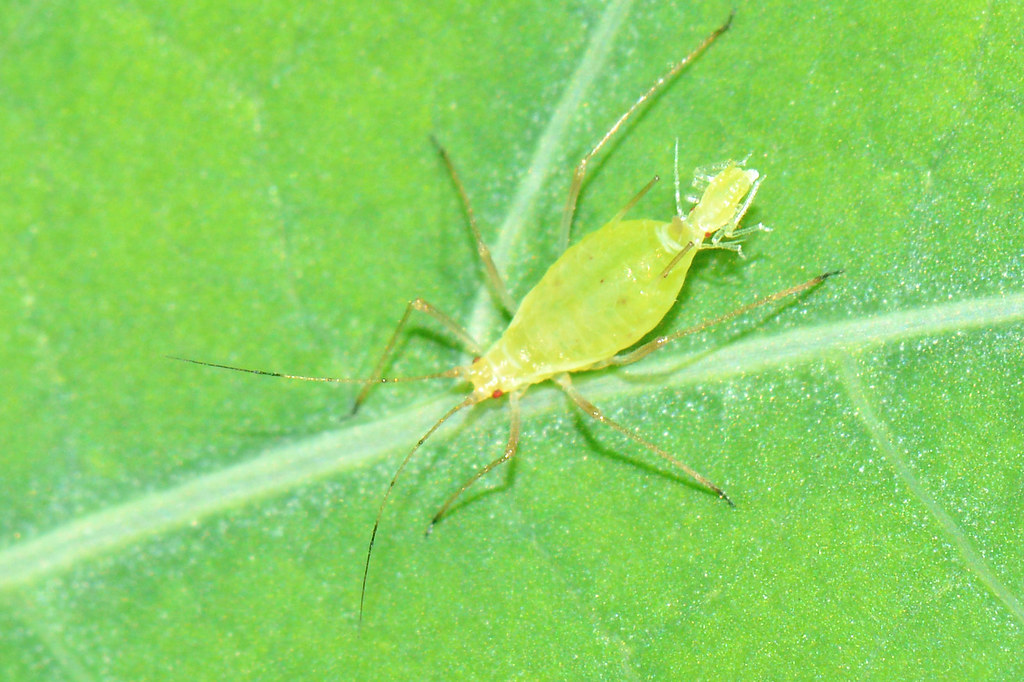
Image by jeans_Photos
Used under a CC BY 2.0 license.
This is also where aphids get properly weird.
In some species, a female can contain developing daughters that already contain embryos of the next The usual phrase for that is “telescoping generations.”2 It sounds exaggerated until you realize aphids have been making a living this way for a very long time.
But aphids do not reproduce that way all the time. In many species, shortening day length and cooling temperatures trigger a shift back to sexual 2 That sexual phase typically produces eggs that can survive unfavorable seasons, especially winter.2 So the short version is this: many aphids themselves live when conditions are good, then switch back to sex when it is time to make durable eggs.2
Aphids are flexible in other ways too. Depending on species and conditions, they can produce wingless or winged forms, with crowding, host quality, and season all helping determine which version gets made.2 So the colony on one stem is not necessarily staying there.
Why farmers and gardeners care so much about them
If aphids only removed plant sugars, they would still be annoying. But sap loss is not the whole problem.1
Aphids are among the most important insect of plant viruses.1 A 2010 review states that they transmitted 275 of the 600 insect-borne plant viruses recognized in that framework.1 The exact count matters less than the overall point: virus transmission often matters more than the direct feeding damage itself.1
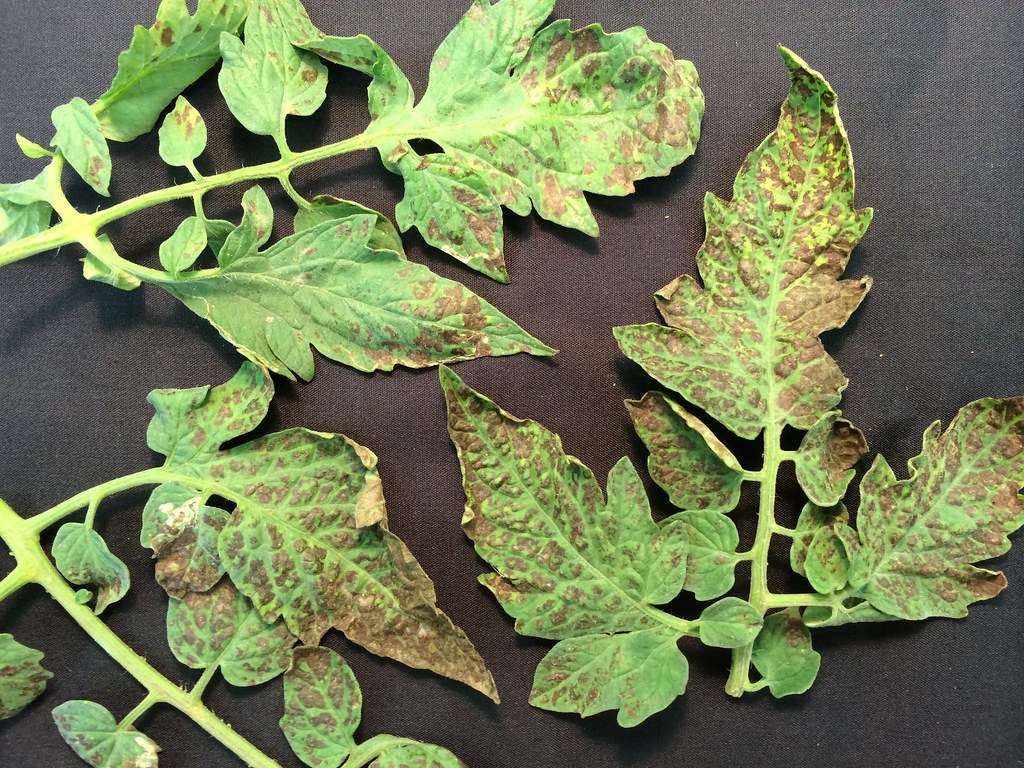
Image by Plant pests and diseases
Used under a CC0 1.0 license.
That is why aphids punch above their size in agriculture. A few aphids on a stem can look minor. A few aphids moving viruses through a crop is another story entirely.
They also leave behind honeydew, which can coat plants and support sooty molds.1 So even when they are not transmitting they can still make a plant look and function worse.
Aphids and ants: one of the classic insect mutualisms
Most people who know a second aphid fact know the one.
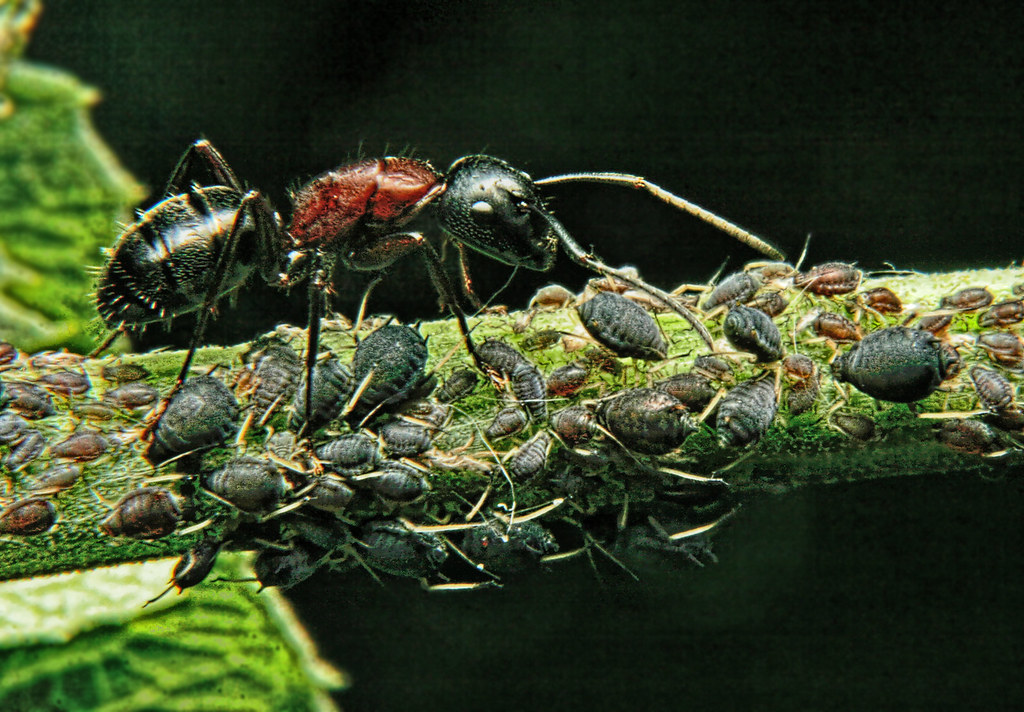
Ants collect aphid honeydew, and in return they often protect aphids from and 4 That much is real. But the usual version of the story is still too simple.
Sometimes ants protect aphids, aphids increase, and the plant loses. But broader reviews show the outcome can be more complicated, because the same ants may also suppress other herbivores on the plant.4 In some systems, the net plant-level result can even be positive if the ants drive off insects that are more damaging than the aphids they are tending.4
That does not mean aphids are good for plants in general. It just means a plant with aphids on it can become the center of a much more complicated little society than it first appears.
Honeydew is waste from the aphid’s point of view. For ants, it is a food subsidy. And once that subsidy appears, around the plant can change fast.
Aphids matter because lots of things eat them
Aphids are not just feeding on plants. They are also feeding a lot of other organisms.
They are important prey and hosts for predators, parasitoids, and 5 Lady are the familiar example, but they are not the only ones. larvae, hoverfly larvae, parasitoid fungi, and many other organisms make use of aphids in one way or another.5
One food-web study recorded 29 aphid species along with 24 parasitoid species, five fungi, and 13 specialist predator species in the system it examined.5 You do not need to memorize the numbers to get the message. Aphids are not ecologically isolated. They are part of a larger traffic pattern of energy and
So even though aphids can absolutely be pests from a human point of view, they also help support other insects and animals higher up the food chain. That is one reason “just kill every aphid” is a management instinct, not an ecological summary.
Some aphids get much weirder than the ones on your tomatoes
The ordinary aphid story is already strange. Then the gall-formers show up and make it stranger.
Some aphids induce plant galls, which function as custom-made housing and feeding sites.6 And some of those gall-forming aphids are social in ways most people would never guess.
A minority of aphids are gall-inducers, but that minority includes species with specialized soldier nymphs used for defense and colony maintenance.6 In some open galls, those soldiers help push out honeydew, shed skins, and dead aphids.6 In some closed galls, the setup gets even better: the aphids manipulate plant tissue so the gall wall itself absorbs liquid waste away from the colony.6
That is a lot of complexity to hide inside an insect most people only notice when it is clogging up a rosebud.
Even their little back tubes are easy to misunderstand
Aphids have paired abdominal tubes called cornicles, and a lot of people understandably assume those are where honeydew comes from.
They are not.7
Honeydew comes from the rear end. Cornicles are associated with defensive secretions and alarm signaling.7 Under attack, aphids can release alarm especially (E)-β-farnesene, and nearby aphids may respond by moving away or dropping off the plant.7
So an aphid colony that looks quiet may actually be reacting chemically in real time.
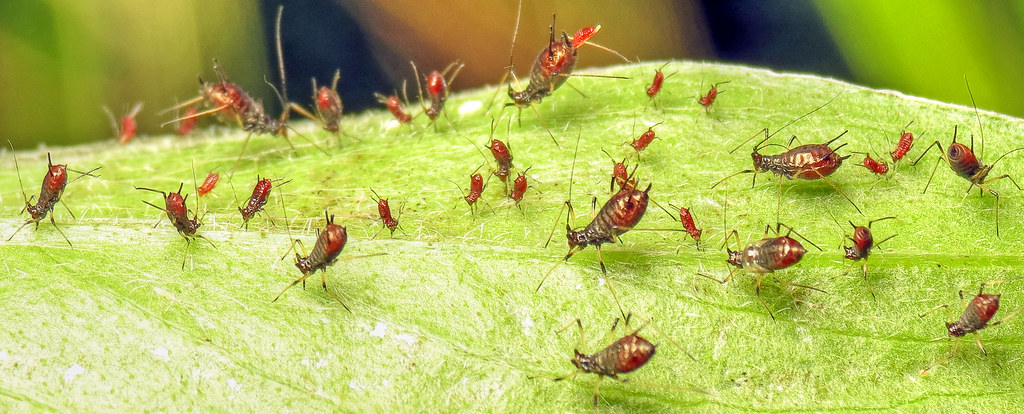
Image by Martin Cooper Ipswich
Used under a CC BY 2.0 license.
Aphids are still pests. They are just not only pests.
None of this means aphids deserve a reputation makeover. If they are spreading viruses through crops or building up on your plants, they are a real problem.1
But “tiny plant pest” is still too small a description for what they are doing.
Aphids are phloem specialists running on an ancient bacterial partnership.3 Many spend part of the year reproducing parthenogenetically and giving live birth, then shift back to sexual reproduction when the season turns.2 They produce honeydew that can recruit ants and change the social life around a plant.4 They matter as prey and hosts for a whole lineup of predators, parasitoids, fungi, and other natural enemies.5 And in some lineages, they turn plants into galled apartments with soldiers and built-in waste management.6
So yes, aphids can be bad news. But they are not biologically boring, and they are not ecologically trivial. They are one of the better examples of how a tiny common insect can be both a nuisance and a surprisingly important part of how an works.
Footnotes
Dedryver, C.-A., Le Ralec, A., & Fabre, F. (2010). The conflicting relationships between aphids and men: A review of aphid damage and control strategies. Comptes Rendus Biologies , 333(6-7), 539-553. https://comptes-rendus.academie-sciences.fr/biologies/articles/10.1016/j.crvi.2010.03.009/ ↩ ↩2 ↩3 ↩4 ↩5 ↩6 ↩7 ↩8 ↩9
Simon, J.-C., Delmotte, F., Rispe, C., & Crease, T. (2010). Evolutionary and functional insights into reproductive strategies of aphids. Comptes Rendus Biologies . https://comptes-rendus.academie-sciences.fr/biologies/articles/en/10.1016/j.crvi.2010.03.003/ ↩ ↩2 ↩3 ↩4 ↩5 ↩6 ↩7 ↩8 ↩9 ↩10
Douglas, A. E. (2023). Microbe Profile: Buchnera aphidicola : ancient aphid accomplice and endosymbiont exemplar. Microbiology , 169(5). https://pmc.ncbi.nlm.nih.gov/articles/PMC10228527/ ↩ ↩2 ↩3
Styrsky, J. D., & Eubanks, M. D. (2007). Ecological consequences of interactions between ants and honeydew-producing insects. Proceedings of the Royal Society B , 274(1607), 151-164. https://pmc.ncbi.nlm.nih.gov/articles/PMC1685857/ ↩ ↩2 ↩3 ↩4
Van Veen, F. J. F., Müller, C. B., Pell, J. K., & Godfray, H. C. J. (2008). Food web structure of three guilds of natural enemies: predators, parasitoids and pathogens of aphids. Journal of Animal , 77(2), 191-200. https://pubmed.ncbi.nlm.nih.gov/17986208/ ↩ ↩2 ↩3 ↩4
Kutsukake, M., Uematsu, K., Fukatsu, T., & Shibao, H. (2019). Plant Manipulation by Gall-Forming Social Aphids for Waste Management. Frontiers in Plant Science , 10, 933. https://pmc.ncbi.nlm.nih.gov/articles/PMC6664026/ ↩ ↩2 ↩3 ↩4 ↩5
Hatano, E., Kunert, G., Michaud, J. P., & Weisser, W. W. (2008). Real-Time Analysis of Alarm Pheromone Emission by the Pea Aphid ( Acyrthosiphon pisum ) Under Predation. Journal of Chemical Ecology , 34, 718-725. https://pmc.ncbi.nlm.nih.gov/articles/PMC2758399/ ↩ ↩2 ↩3