
- Published on
What ladybugs really are
- Authors

- Name
- Mike Porter
- @bugswithmike
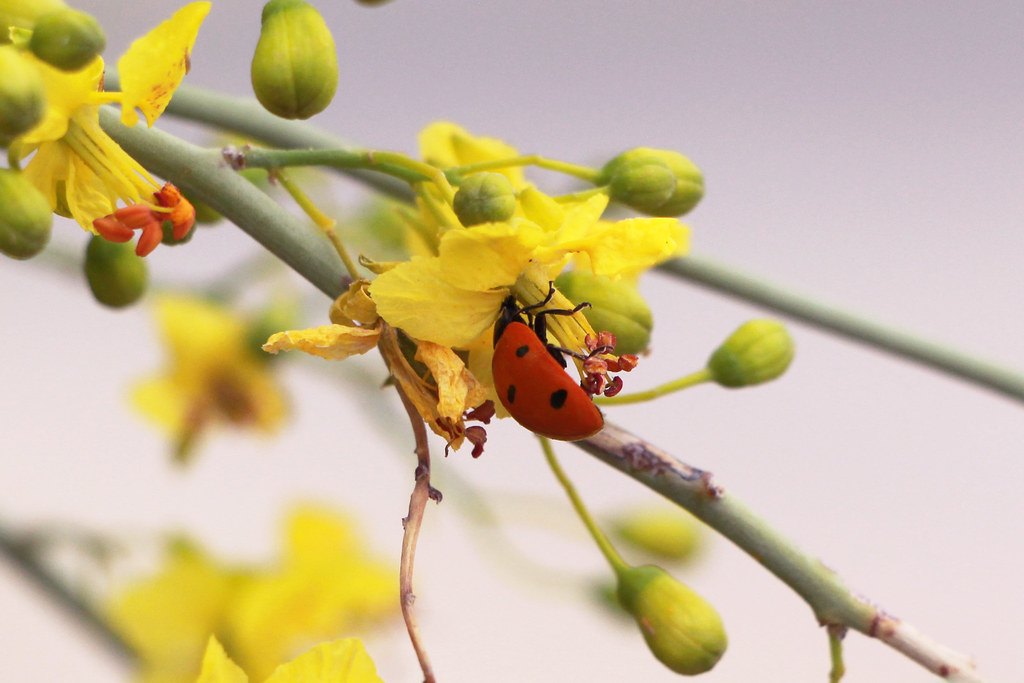
Most people have a very specific mental image of a
It is small, round, red, cheerful, and somehow exempt from the usual suspicion we reserve for insects. If a lands on your sleeve, most people recoil. If a ladybug lands on your sleeve, a lot of people smile.
That reputation is not completely undeserved. Many ladybugs really are useful animals to have around. They eat and other soft-bodied plant pests, which is why gardeners, farmers, and biological-control researchers have appreciated them for so long.12
But the cute public image also hides what ladybugs actually are.
Ladybugs are beetles in the more precisely, they are lady beetles if you want the technical common name. Many of them are active They patrol stems and the undersides of leaves looking for aphids, mites, and other tiny prey.23 If you zoom in on the life of a ladybug, it stops looking like a good-luck charm and starts looking more like a serious little hunter.
They do not even look like themselves for most of their childhood
Part of the confusion comes from the fact that most people only recognize the stage.
Ladybugs go through complete larva, pupa, adult.24 The eggs are usually laid near food. The larvae that hatch out do not look like miniature adults. They are elongated, fast-moving, and often dark gray or black with orange or yellow markings. To people who have never seen one before, they can look more like tiny alligators or spiny little pests than anything related to a ladybug.24
.jpg)
Image by Anders Sandberg from Oxford, UK
Used under a CC BY 2.0 license.
That is unfortunate, because the larval stage is often where some of the heaviest feeding happens. A person trying to “clean up bugs” in a garden can easily remove the exact animal that is currently doing the most aphid control.
Then comes the pupa: attached to a surface, oddly still, halfway between larva and beetle. From that pupa emerges the familiar adult form—domed, shiny, often red, orange, or yellow with dark spots, though the exact pattern varies a lot between and even within some species.
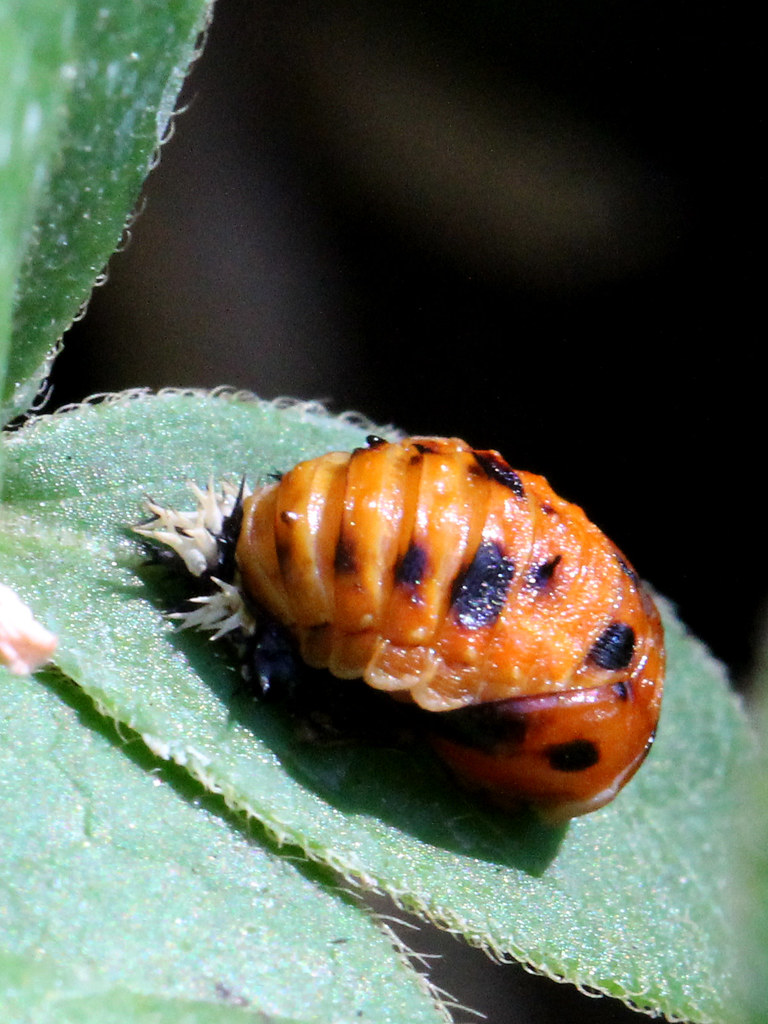
Image by siamesepuppy
Used under a CC BY 2.0 license.
The cute colors are a warning label
That bright color pattern is part of the reason ladybugs are so recognizable, and it is not just decoration.
Lady beetles are famous for chemical defense. When threatened, many species perform what entomologists call reflex bleeding : they ooze droplets of yellowish from their leg joints. That fluid contains defensive compounds, including alkaloids, and it smells and tastes bad to predators.56 Their strong colors are widely understood as aposematic warning coloration—in other words, a visual signal that says they are not pleasant things to eat.57
That defensive chemistry helps explain how such a small, obvious beetle can spend so much time exposed on leaves in broad daylight. A lot of insects survive by not being seen. Ladybugs often survive by being seen and recognized as a bad snack.
Not all ladybugs are aphid specialists
A lot of lady beetles are predatory, but not all of them live the same kind of life. Some feed on mildew. Some specialize on scale insects. Some are plant-feeders rather than predators.23 So while the phrase “ladybugs eat aphids” is broadly true for many of the species people notice most often, it is not a universal rule for the whole family.
That matters because people tend to talk about ladybugs as if they are a single personality type: good, helpful, harmless, native, and interchangeable. Biologically, they are a whole family of beetles with very different ecologies.
Why gardeners love them
The good reputation did come from somewhere.
Predatory lady beetles really do matter in agriculture and gardens. They are among the most familiar natural enemies of aphids, and extension guidance routinely lists them as beneficial insects because both larvae and adults can reduce pest numbers.23 The USDA has also highlighted their role in helping protect crops from aphid 1
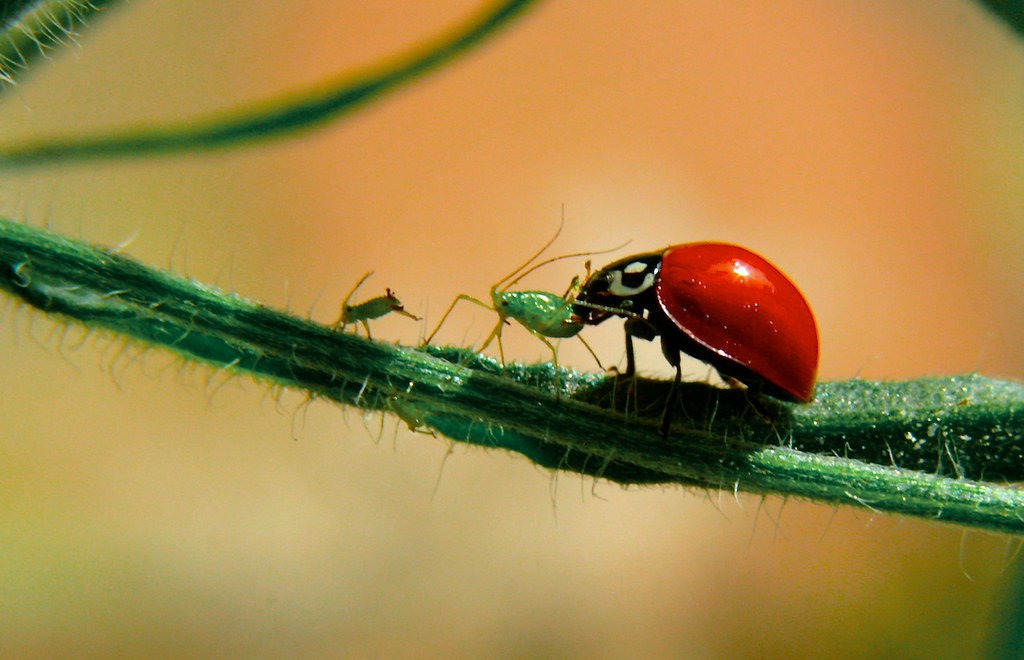
Image by Anderson Mancini
Used under a CC BY 2.0 license.
That said, ladybugs are not magic. Pest control in the real world depends on which species are present, whether there is enough prey to keep them around, what the surrounding looks like, and whether have wiped out the rest of the predator
This is also why buying bags of ladybugs can be disappointing. Released adults often disperse quickly instead of staying where you wanted them.2 In most cases, encouraging the local predators already adapted to your yard is more reliable than buying a temporary beetle delivery.
The ladybug in your house may be the reason people are less sentimental now
If your experience of “ladybugs” includes finding dozens of them on sunny windows in the fall, or discovering a cluster of them in your attic, your relationship with this insect may be a little less storybook.
That is often because the beetles showing up indoors are not the classic native species people are imagining. In many regions, the culprit is the multicolored Asian lady beetle , Harmonia axyridis .48
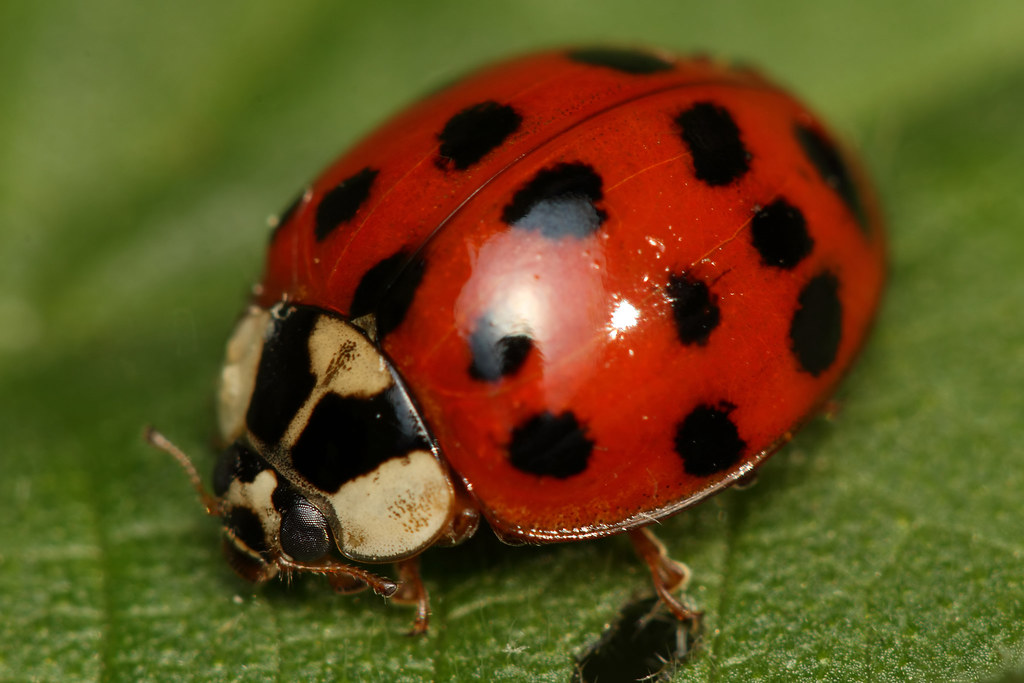
Image by Danny Chapman
Used under a CC BY 2.0 license.
This species was intentionally used as a biological-control agent because it is an effective predator of aphids and other pests.7 In that narrow sense, it succeeded. But outside its native range, it also became in many places and is now associated with a much more mixed legacy.79
Multicolored Asian lady beetles can gather in large numbers on buildings as they search for sheltered sites. They may crawl indoors through cracks and gaps, cluster on walls or windows, release foul-smelling defensive fluids, stain surfaces, and sometimes bite people.48 They are not dangerous house pests in the way or roaches are, but they are very capable of making themselves unwelcome.
This is where public perception gets messy. One person is thinking of a single red beetle on a rose bush. Another is thinking of a warm October afternoon when a hundred beetles appeared in the living room. Both are saying “ladybug,” but they are not really talking about the same experience.
The invasive-species story is real, but not perfectly simple
The multicolored Asian lady beetle is also one reason ladybug now comes with an asterisk.
Research on Harmonia axyridis has documented non-target impacts, including competition with and on other aphid-eating insects, including native lady beetles.79 It is a large, adaptable, chemically well-defended species.
At the same time, the broader story of native lady beetle decline is not perfectly simple. Reviews of the literature point to a tangle of interacting causes: habitat, prey availability, landscape change, urbanization, and competition among species, with the effects of invasive lady beetles varying by place and habitat.9
That nuance is worth keeping. It is tempting to reduce the whole story to “scientists introduced a good and it turned bad.” Reality is more ecological than moral. Harmonia axyridis is still a very effective predator. But it is also a documented nuisance and, in many places, a genuine conservation concern. Those things can all be true at once.
Conclusion
Ladybugs deserve a little more respect, and a little less simplification.
They are lovely, but not because they are tiny symbols of innocence. They are lovely because they are successful beetles: animals with larvae that look like miniature armored hunters, life cycles tied to prey outbreaks, warning colors, chemical weapons, and in some cases enough ecological swagger to become invasive on other continents.
And reality is more interesting than the nursery-rhyme version. The next time you see a ladybug on a plant, it is worth remembering that you are not looking at a lucky red dot with legs. You are looking at a small, highly visible predator that survives by being distasteful, recognizable, and very good at making a living in a world full of things that would happily eat it.
Cute? Yes.
But also much more interesting than cute.
Footnotes
Clemson Cooperative Extension: Lady beetles in the landscape ↩ ↩2 ↩3
Cornell CALS / NYS IPM: Multicolored Asian Lady Beetle ↩ ↩2 ↩3 ↩4
Diet and chemical defence in ladybird beetles (Coleoptera: Coccinellidae) ↩ ↩2
The multicolored Asian lady beetle, Harmonia axyridis: A review of its biology, uses in biological control, and non-target impacts ↩ ↩2 ↩3 ↩4
Interactions Among Native and Non-Native Predatory Coccinellidae ↩ ↩2 ↩3